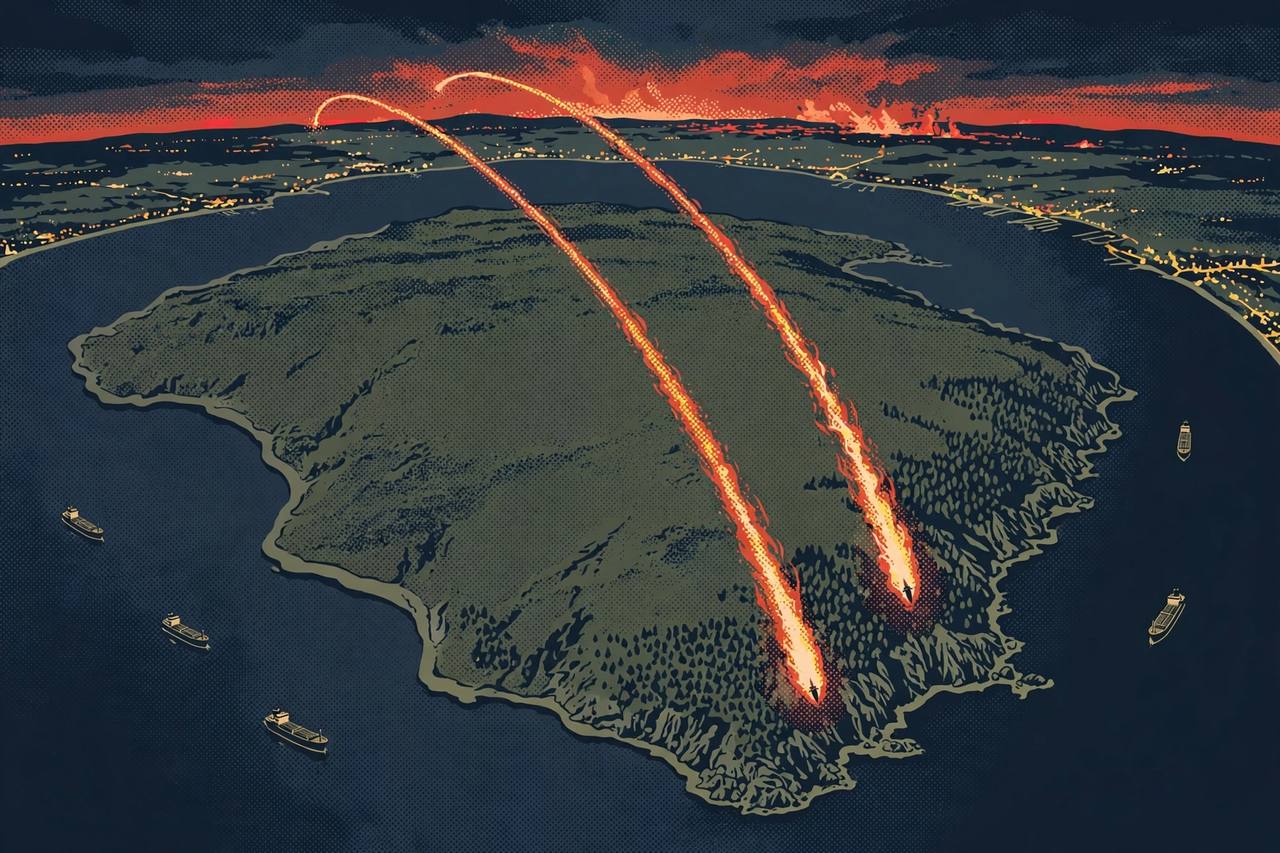
Two missiles struck Iran's Qeshm Island in the Strait of Hormuz on Saturday, Iran's semi-official Tasnim news agency said, in initial reports that carried no official information on damage - the latest hit on an island that has become one of the most contested points of the US-Iran war.
Source: Reuters, reporting Tasnim, Nov 7, 2026
Tasnim said further details would be released once the relevant authorities confirmed the incident. Iran's state news agency IRNA had earlier reported that local witnesses said two projectiles had struck the Suza area of Qeshm Island in southern Iran after the sound of an aircraft was heard over the island, Reuters reported from Cairo. Who fired the missiles, what they hit and whether anyone was hurt had not been officially established in the reports.
Source: Reuters, reporting Tasnim and IRNA, Nov 7, 2026
The reported strike follows a claim a day earlier that Iran's Revolutionary Guards had destroyed a US MQ-1 drone over Qeshm - the claim Awaaz Punjab reported on Friday. Iranian state media on Saturday also claimed an MQ-9 drone had been shot down over Qeshm. The United States had not confirmed either drone claim, and no US statement on Saturday's missile reports had been carried in the Reuters report. Read: Iran's MQ-1 drone claim over Qeshm
Qatar denies reports the talks have failed
On the same Saturday, Qatar's International Media Office denied circulating reports that the United States and Iran had failed to reach an agreement to end their war, describing the allegations as false and misleading, Reuters reported. It said the Qatari prime minister had affirmed that both sides continue to work toward an agreement, and that Qatar's mediation efforts are ongoing, in close coordination with Washington and Tehran, to support the negotiations.
Source: Reuters, reporting Qatar International Media Office, Nov 7, 2026
The denial lands in the middle of a contradictory week on the talks. Iran has sent Washington a fresh nuclear proposal through Qatari mediators while saying negotiations and any reopening of the Strait of Hormuz depend on its seven demands being met - the proposal Awaaz Punjab reported earlier this week. President Donald Trump said on Thursday that the United States was talking to Iran and doing 'very well', and claimed Hormuz was 'opening' - a claim Tehran denied, saying no such talks were under way on those terms.
Source: Reuters, Nov 5-6, 2026
Trump's Hormuz claim and Tehran's denial were reported earlier by this desk. Read: Trump says US is 'doing very well' talking to Iran
Why Qeshm keeps being hit
Qeshm is Iran's largest island and sits inside the Strait of Hormuz, the narrow waterway between Iran and Oman that carries about a fifth of the world's oil. The island hosts Iranian Revolutionary Guards naval and missile positions, which is why it keeps appearing in the war's exchanges. On November 2, US officials said the United States had carried out limited, defensive strikes on a missile launcher on Qeshm after, they said, the IRGC fired surface-to-air missiles at a US aircraft near the strait - strikes President Trump later described as a minor attack. Iran at the time said it had shot down US drones south of the island.
Source: Reuters and US officials, Nov 2-3, 2026
The wider war began on February 28 with US and Israeli attacks on Iran, followed by Iranian strikes on Israel and on Gulf states hosting US forces. Since then the fighting has repeatedly closed or slowed Hormuz shipping, and every new strike on the strait is watched first in the Gulf itself - where lakhs of Punjabi and Indian workers live and work in Saudi Arabia, the UAE, Qatar, Kuwait, Bahrain and Oman, and whose flights, jobs and remittances are the first things hit when the strait shuts or Gulf airspace closes.
Source: Reuters, war background, 2026
What is solid
- Iran's Tasnim news agency reported initial indications that two missiles struck Qeshm Island on Saturday, with no official damage information yet, and IRNA reported witnesses saying two projectiles hit the Suza area after an aircraft was heard - both carried by Reuters
- Qatar's International Media Office on Saturday denied reports that the US and Iran had failed to reach an agreement, calling them false and misleading, and said Qatari mediation is ongoing in coordination with Washington and Tehran
What is only claimed
- Who fired Saturday's missiles, what was hit and whether there were casualties: not established in the reports; no US confirmation or statement was carried by Reuters
- Iranian state-media claims that an MQ-1 on Friday and an MQ-9 on Saturday were shot down over Qeshm: the United States has not confirmed either claim
- The state of the talks themselves: Trump says the US is talking and Hormuz is opening; Tehran says there will be no negotiations or Hormuz reopening until its seven conditions are met; Qatar says both sides still work toward an agreement
Oil, and what happens next
Oil markets went into the weekend caught between the same two forces. Brent crude reclaimed $100 a barrel on Friday - $100.3 in one Friday report, up 2 percent - and US West Texas Intermediate rose to about $91.8, after fresh tanker attacks in and near Hormuz revived supply fears; yet both benchmarks were still on course for weekly falls of about 12 percent, because traders were also pricing in a possible diplomatic end to the war. Shipping through Hormuz was still running below 60 percent of normal capacity, according to market assessments cited in Friday reporting.
Source: HDFC Sky / Oilprice.com, reporting Friday oil markets, Nov 6, 2026
What happens next turns on three confirmations that had not arrived when Reuters filed: an official Iranian account of what was hit at Suza and what damage was done; any US statement on the missile reports and on Iran's drone claims; and whether the Qatari channel - which Doha insists is still alive - produces an answer to the proposals now with both sides, before the post-midterms window in Washington in which President Trump has said he will decide whether to resume major military operations against Iran.
Source: Reuters, Nov 6-7, 2026
Qeshm is not a remote rock: it guards the mouth of the Gulf. A strike there tests three things at once - Iran's air defences around Hormuz, the Qatari mediation that is the only live channel between Washington and Tehran, and the oil price every truck driver and household from Punjab to Brampton pays at the pump. That is why a two-missile report with no confirmed damage still moves the whole region's weekend.