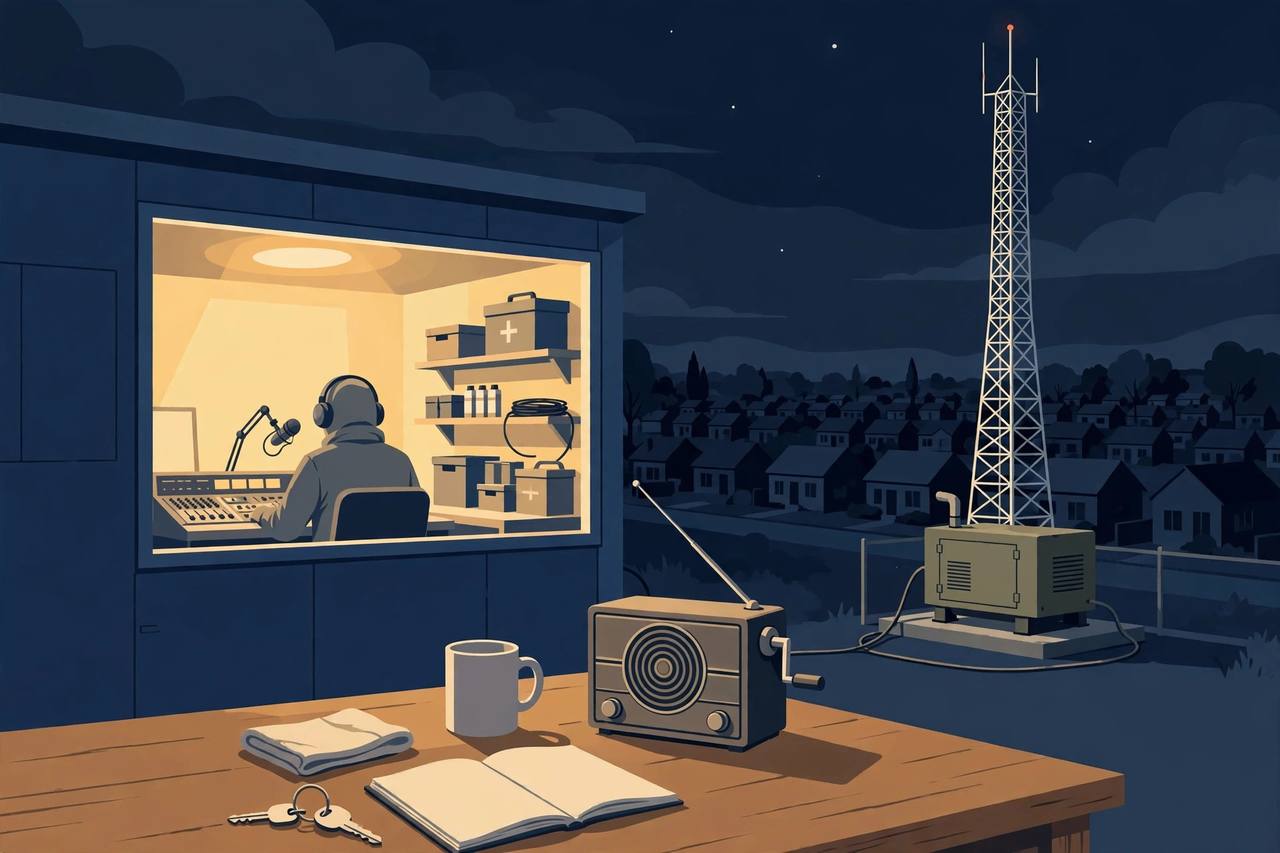
LONDON — If Britain's electricity grid failed completely, the BBC would keep broadcasting from a small protected emergency studio, its transmitters running on diesel and carrying pre-written government scripts. The BBC's media and arts correspondent David Sillito described the arrangement in reporting published on Saturday: about 100 BBC staff are designated to run the studio in the event of a “Black Sky” — the civil-contingency term for a catastrophic, prolonged failure of the national electricity grid.
Source: BBC via Signal Post News
The caveat comes first, in the government's own words. The Cabinet Office told the BBC: “The UK has one of the most resilient electricity systems in the world, and there has never been a complete outage in the grid's 75-year history.” Officials say there is no specific threat to the grid. What has changed is that planning for the worst case is now being described in public, in operational detail, by the national broadcaster itself.
Inside the emergency studio
The studio's communication lines do not depend on the internet, and it holds fuel, water and food to keep running without resupply for at least three days, the BBC reported. A select number of journalists would broadcast via satellite vehicles from emergency centres around the UK “as long as the diesel lasts”, staying in touch by satellite phone, with pre-agreed protocols and meet-up points if those failed. The FM transmitters that would carry the broadcasts are isolated from the internet and hold diesel tanks of between 5,000 and 40,000 litres, enough to keep broadcasting for three days without the grid.
Much of what the studio would say has already been written. On December 16, 2025, the government and the four UK Chief Medical Officers published pre-written emergency radio broadcast scripts online, including guidance on daily drinking-water requirements and how to dispose of human waste when toilets will not flush, the BBC reported. Sillito was transparent that he reconstructed the studio arrangement from internal briefings — “only a small number of staff know the full details” — so the roughly 100 staff and three days of supplies are reported orders of magnitude, not lines from a published government document.
Saturday's reveal is the infrastructure end of a preparedness push that has been building for weeks in Britain, from warnings about infrastructure resilience to the household-level Be Ready campaign. Read: Streeting's infrastructure resilience warning
Three days is not an arbitrary number. At a recent UK resilience summit, the working focus was on withstanding a Black Sky event for a minimum of 72 hours, and a BBC source explained the revision: it was originally thought planning should cover five to seven days, but the latest advice from Neso, the National Energy System Operator, is that power would probably be restored in two to three days. The formal definition of a black sky event, as telecommunications expert Andrew White of Harberry Limited put it to LADbible, runs to weeks or months of infrastructure failure triggered by extreme natural hazards or deliberate attacks — and White questioned whether the studios and transmitters could withstand such a prolonged disruption.
Britain has never had a national blackout, but it has rehearsed one by accident. On December 5, 2015, during Storm Desmond, the River Lune flooded a substation in Lancaster and 61,500 people lost power; water supplies, rail services, petrol stations, shops and cash machines failed with it. Two systems kept working: copper-wire landlines, which carry their own power, and FM radio, whose local station became the city's information lifeline. That copper network is now being switched off — BT and Openreach's shutdown completes on January 31, 2027 — while the government is reported to be spending £70 million (yaani roughly 7 crore pounds) on high-altitude platform systems, aircraft that would provide at least a week of emergency mobile and internet connectivity if ground networks failed.
Lord Harris, chair of the National Preparedness Commission, told the BBC: “People need to know power cuts are about more than just the lights going out. It's likely to stop the water supply because unless you happen to be located neatly downstream of a reservoir, that requires electricity.” He added: “In the drive towards efficiency over the last five decades, we've lost backup systems.” The same doctrine now reaches households: the Cabinet Office's Be Ready campaign, launched on October 22, 2026 as a three-year effort, asks households to hold three days of supplies — bottled water, tinned food, a torch, cash and a wind-up or battery-powered FM radio, the receiving end of the emergency studio's transmissions.
Watch three markers: the government's review of FM radio's future, since switching off the transmitters would retire the plan with them; whether the £70 million high-altitude connectivity programme moves from project to working capability; and how the National Risk Register treats total grid failure. The government maintains there is no specific threat — the story is that the plan for the unthinkable now has a public shape: 72 hours, one studio, and FM radio as the last mass medium that works when everything else is dark.