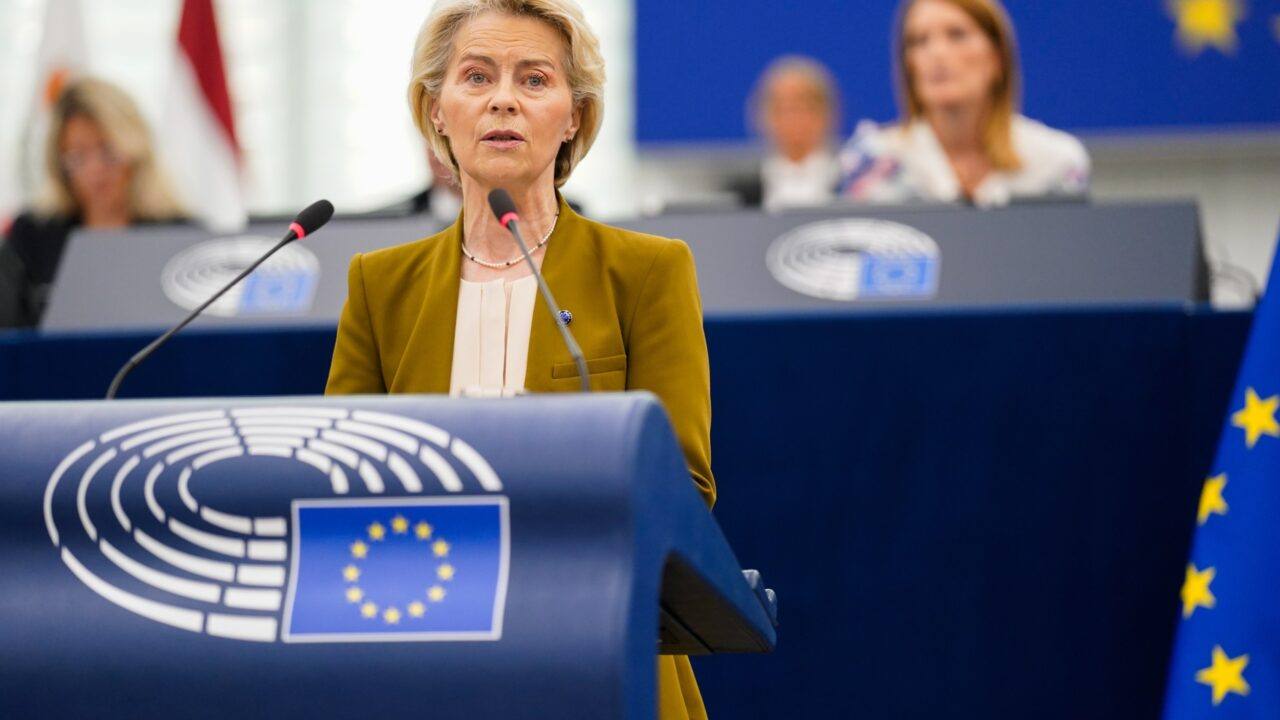
European Commission President Ursula von der Leyen told the European Parliament in Strasbourg on Wednesday that a strong European team will take part in the next round of negotiations to end the war in Ukraine — and she laid out two tests for Moscow to prove it is serious about peace.
Source: European Commission
"We will judge progress by Russia's actions, not simply by its words," she told MEPs. "A strong European team will take part in the next round of negotiations. This is important because Ukraine's security directly affects our security."
Two tests for Moscow
First, Russia must agree to a winter truce on energy infrastructure — a halt to attacks on the power and heating systems Ukrainians depend on through the cold months. Russia has intensified its strikes on Ukraine's energy and heating infrastructure as winter approaches; on November 25 a large-scale Russian strike forced a Ukrainian thermal power plant run by DTEK, the country's largest private energy company, to suspend electricity generation.
Second, a ceasefire to guarantee safe passage for food exports through the Black Sea. Both steps, she said, "would show that Russia is serious about negotiations."
€45 billion more for Kyiv in 2027
The money would come through a new Instrument for Coordinated Support for Ukraine, covering about two-thirds of Kyiv's estimated €70 billion financing gap next year — yaani 4,500 crore euro of support against a 7,000 crore euro gap. Ukraine would only have to repay once Russia has paid for the damage of its war, von der Leyen said.
She said the European Union has already provided more than €235 billion in assistance since Russia's full-scale invasion began — yaani 23,500 crore euro — and the bloc will not ease pressure on Moscow until a lasting and just peace that safeguards Ukraine's sovereignty is achieved.
The Commission presented its 22nd package of sanctions against Russia on Monday, targeting about 60 more banks for removal from SWIFT, crypto evasion networks and shadow-fleet ships. Read the sanctions story
What Russia says
The Kremlin said on November 24 that it sees "no added value" in Europe joining the Ukraine talks, and its spokesman Dmitry Peskov said no date has been set for the next round. Von der Leyen said the EU's approach is "maximum support for Ukraine, combined with maximum pressure on Russia" and full European engagement in negotiations for a lasting peace.
What happens next
EU leaders meet for a special European Council summit on November 26–27, where Ukraine's financing is on the agenda; von der Leyen said she is very confident all 27 member states will agree. Ukraine and the United States expect a four-way working meeting — Ukraine, Europe, the United States and Russia — before Christmas. The EU also expects to open the remaining two clusters of Ukraine's EU accession talks before the end of 2026.
Europe is insisting on a seat at the negotiating table — and setting concrete tests, not just words, for Moscow. A winter energy truce would protect millions of Ukrainians from freezing in the dark, and safe Black Sea passage would keep Ukrainian grain moving to world markets.
What is solid
- A strong European team will take part in the next round of Ukraine talks, von der Leyen told the European Parliament on November 25.
- The Commission has proposed €45 billion in additional support for Ukraine in 2027 — €20 billion for the budget and €25 billion for the military.
- The 22nd EU sanctions package was presented on November 23.
What is only claimed
- Whether Russia will agree to a winter energy truce and a Black Sea ceasefire.
- Whether all 27 EU capitals will approve the €45 billion package at the November 26–27 summit.