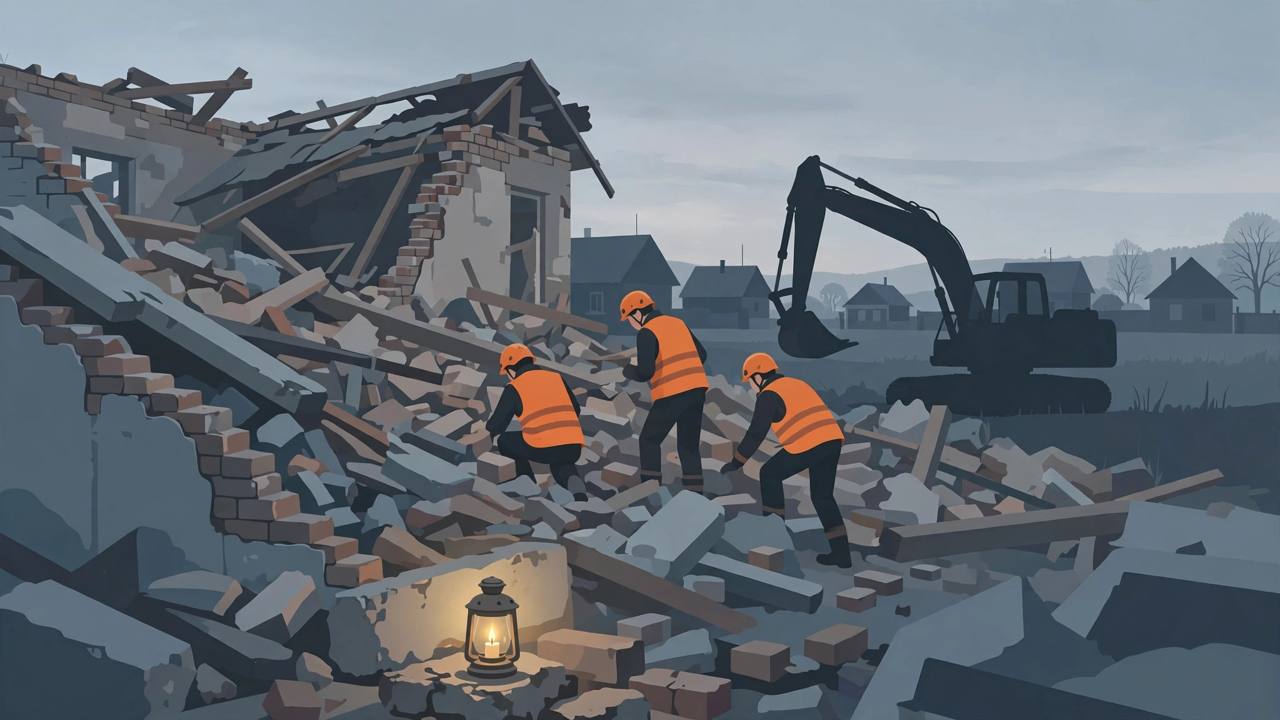
The death toll from Russia's bombing of an aid distribution point in Ukraine's southeastern Zaporizhzhia region on Monday has risen to 53, the acting regional governor said on Friday, making it one of the deadliest strikes on civilians this year. In a post on Telegram, acting governor Mykhailo Semikin said search and rescue work at the site in the village of Komyshuvakha had entered its fifth day; Ukraine's Emergency Service had earlier on Friday reported 50 dead, and its Zaporizhzhia spokesperson Yuliia Barysheva told an interagency press conference that rescuers had brought 53 bodies to the surface with around another 50 people still considered missing.
Source: Reuters, Nov 6, via Devdiscourse
The attack struck on Monday, November 2. President Volodymyr Zelenskyy has said Russian forces first dropped aerial bombs on an underground school building being used as a distribution point as people arrived to collect aid, then struck the shelter where residents had taken cover with more bombs. Classes at the school had long been suspended because Komyshuvakha lies some 17 km (11 miles) from the nearest Russian positions, but the building served as a shelter and handed out humanitarian aid every Monday, Zelenskyy said. The World Central Kitchen charity, which delivers food and water to the community, said the facility that was hit was a humanitarian and administrative centre for local residents.
Source: Reuters, Nov 4-6; Ukrinform via UNITED24 Media
Ukraine's national police said the strikes included a 3-ton FAB glide bomb, a weapon that defence intelligence websites say carries around 1.4 tons of explosives. The United Nations Human Rights Monitoring Mission in Ukraine said local authorities reported nine aerial bombs striking Komyshuvakha in two waves, and said on Tuesday that the bombing likely violated international law.
Source: Reuters / UN Human Rights Monitoring Mission, Nov 4-6
Among the dead are four police officers and two rescue workers, Ukrainian emergency services and media reported, and five people were wounded. Ukrainian police released body-camera footage from one of the officers killed in the attack, which Reuters verified: it shows residents in civilian clothing gathered outside the entrance to an underground shelter as a warning comes over the radio that Russian glide bombs are heading toward the village, moments before a large explosion turns the camera black. Zelenskyy called the attack "further proof that Russia does not want any kind of de-escalation, any real justice."
Russia's Defence Ministry gave a different account. It said the attack targeted Ukrainian military units around Komyshuvakha and two other settlements in the region, and that up to 25 Ukrainian servicemen were killed. Moscow's claim could not be independently verified, and it does not address the civilian aid distribution that Ukrainian officials, the UN mission and aid workers describe at the site.
The toll has climbed all week as rescuers worked through the rubble under the constant threat of repeat strikes: officials reported 37 dead, then 40 on Wednesday, 42 on Thursday in police figures, 43 in Zelenskyy's Thursday update, 50 on Friday morning and now 53. At an earlier stage Reuters reported 59 people listed as missing, a figure officials have since revised as bodies were recovered and families traced survivors; the numbers remain preliminary and may rise again while the search continues.
The Komyshuvakha search is unfolding as Russian strikes also plunge Kyiv into its worst power outages of the war, with President Zelenskyy and Mayor Klitschko trading blame over the capital's defences. Read: Kyiv's worst outages and the Zelenskiy–Klitschko blame row
Hours after the original attack on Monday, US special envoy Steve Witkoff announced that delegations from Ukraine and Russia will meet in Abu Dhabi on November 10-11 to discuss post-war security arrangements, de-escalation and humanitarian measures. Whether a strike of this scale hardens positions before those talks is now the open question: Kyiv presents Komyshuvakha as evidence for stronger air defence and accountability, while Moscow continues to describe its targets as military. For the families in Komyshuvakha, the immediate reality is simpler — a fifth day of digging, and a list of the missing that is still about 50 names long.