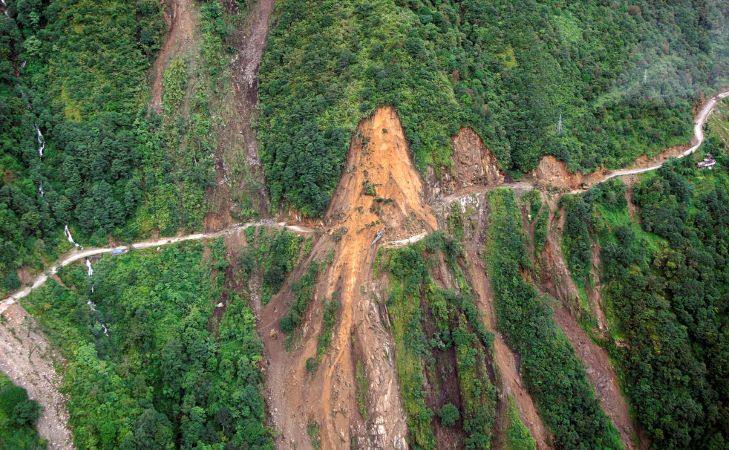
Faridabad, Nov 23 — India has completed landslide susceptibility mapping across about 4.3 lakh square kilometres of landslide-prone terrain and compiled an inventory of nearly 91,000 historical landslides, Union Minister of State for Science and Technology and Earth Sciences Dr Jitendra Singh said on Monday, addressing the inaugural session of the 7th World Landslide Forum (WLF7) in Faridabad.
The forum, being held from November 22 to 27, is being hosted in India for the first time — by Amrita Vishwa Vidyapeetham in collaboration with the International Consortium on Landslides and the International Programme on Landslides — with experts, scientists and policymakers from more than 75 countries taking part.
From relief to prevention
Singh said India's approach is progressively shifting from post-disaster relief to prevention, preparedness and risk reduction, using AI-based prediction, geospatial technologies, satellite monitoring and last-mile early warning to strengthen landslide resilience.
The National Landslide Forecasting Centre, established in Kolkata in 2024, has now extended its forecasting activities to 20 districts. A regional forecasting system set up in 2020 supports experimental and operational forecasting across vulnerable regions.
The government has approved a ₹1,000-crore National Landslide Mitigation Project covering 15 states, alongside ₹1,115.67 crore sanctioned for disaster mitigation and capacity building, Singh said.
The mapping, carried out by the Geological Survey of India under the National Landslide Susceptibility Mapping programme, covers hilly and mountainous areas across 19 states and Union Territories, including the Himalayas, the Western Ghats and the Northeast. Meso-scale mapping of 200 critical sectors is targeted for completion by 2028; work in 160 sectors was completed by the end of the 2024-25 field season.
Singh recalled past disasters in Wayanad in Kerala, Chamoli in Uttarakhand, and events in Sikkim, Himachal Pradesh and Jammu and Kashmir, saying India's diverse geological landscape makes landslide risk reduction a critical national priority.
Sources: Press Information Bureau; Business News Week.
Source: Press Information Bureau