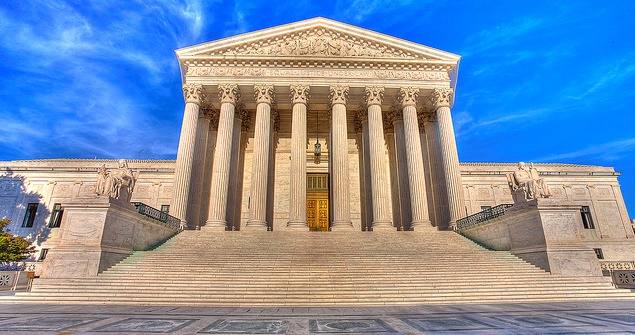
The US Supreme Court has allowed Alabama to use a congressional map favouring Republicans in this year's elections, blocking a lower-court ruling that the redistricting plan intentionally discriminates against Black people. The order is the latest development in a redistricting fight that could help decide control of the US House of Representatives in November.
Source: Associated Press
The justices granted the state's emergency appeal to use a map it adopted three years ago that has a majority-Black population in just one of its seven congressional districts. The three liberal justices dissented. In an unsigned opinion, the court's conservative majority wrote that the lower court 'did not heed the presumption of legislative good faith.'
Justice Sonia Sotomayor, dissenting, accused her colleagues of enabling what she called 'a chaotic election, held under a never-before-used congressional map that intentionally discriminates against Black Alabamians.'
What the map changes
Under the map the Supreme Court has now cleared, Black residents form a majority in only one of Alabama's seven congressional districts. The lower court had instead ordered Alabama to use the same court-drawn map it used in the 2024 elections, under which Black residents comprise a majority, or close to it, in two of the state's seven districts. Alabama's population is about 27 percent Black.
The use of the court-ordered map led to the 2024 election of US Representative Shomari Figures, a Black Democrat, who became the first Black person to represent Tuskegee in Congress in modern history. The map put into place by the Supreme Court's order gives Republicans an opportunity to reclaim the south Alabama seat.
Source: BBC News
What the state and its critics say
Alabama Attorney General Steve Marshall told the court that the state did not intentionally discriminate against Black residents and should be allowed to hold elections this year under a map chosen by lawmakers, not judges. 'Tonight's decision is a major victory for Alabama and for the principle of self-governance,' Marshall said. 'The United States Supreme Court confirmed what we always knew: that Alabama's Congressional maps are constitutional and lawful under the Voting Rights Act.'
Civil rights lawyers condemned the order. 'The Supreme Court's decision gives cover to Alabama and others to deliberately and openly discriminate against Black voters without fear of any consequence. The Court's shameless decision to reinstate an intentionally racially discriminatory map defies any thoughtful or consistent application of the law,' said Deuel Ross, director of litigation for the NAACP Legal Defense Fund. He said the fund would 'continue to throw all of our resources into the fight to ensure that Alabama voters have the fair representation that they deserve.'
How the case got here
The Alabama case stretches back several years. In 2023, a three-judge panel ruled that a map drawn by Republican state lawmakers intentionally diluted the voting power of Black citizens, and the Supreme Court upheld that ruling the same year. A court-selected map was then used in 2024.
After the Supreme Court's recent ruling in the Louisiana case, Callais v. Louisiana, which struck down a Black-majority district in Louisiana and weakened the federal Voting Rights Act, Alabama officials moved to implement the 2023 state-drawn map. The Supreme Court's conservative majority agreed to lift the injunction that had blocked the map's use and sent the case back to the three-judge panel for reconsideration in light of the Louisiana ruling.
Upon further review, the judicial panel stood behind its initial finding that there was 'undisputed evidence' of intentional racial discrimination, and it said the special congressional primaries should instead proceed under the previous court-approved districts. The panel had cited evidence including a text message in which a state legislator referred to Montgomery, the state capital, as 'monkey town.' Alabama's Republican leadership then went to the Supreme Court last week, the day after the three-judge court refused to let the state use its preferred map.
What happens next
Voters already cast ballots in Alabama's May 19 primaries, and Governor Kay Ivey has set new special primaries for August 11 in the four congressional districts affected by the map switch. The order comes a day before an important deadline that Ivey had already extended in the state's push to use the map. The underlying case continues, with the lower court to reconsider the map in light of the Louisiana ruling, and civil rights groups say they will keep challenging it.
The decision lands in the middle of a redistricting frenzy across the country, part of a broader push by President Donald Trump to try to hold on to Republicans' slim House majority in the November elections. Republicans in several Southern states have taken steps to reshape voting districts with large minority populations that have elected Democrats since the Louisiana ruling. For voters in Alabama's Black Belt — including Montgomery, which is more than 60 percent African American, and Tuskegee, where nearly one in three people live in poverty — the order means this year's elections will be fought under a map in which Black voters hold a decisive voice in only one of seven seats.