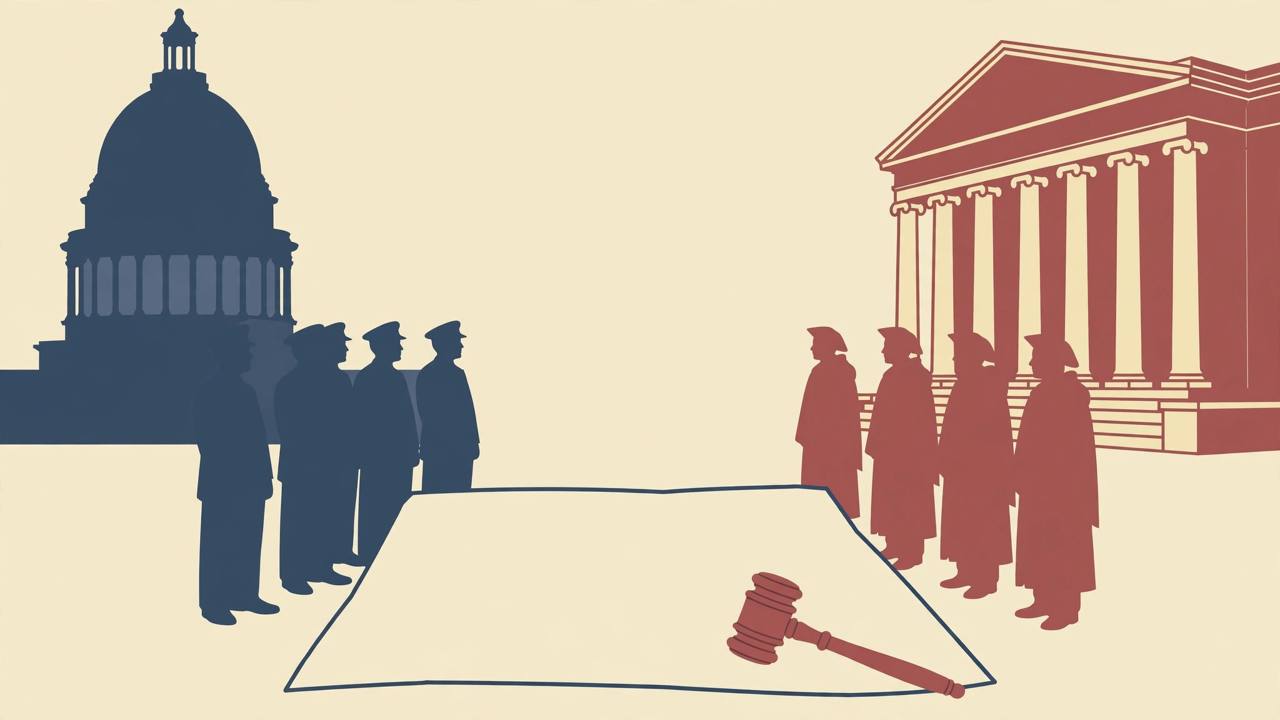
Rep. Alexandria Ocasio-Cortez of New York said this week that Democrats should keep every impeachment option open when they take control of Congress in January — including, she suggested, toward Supreme Court justices she accused of shielding President Donald Trump. "All options are on the table," she told CNN's chief congressional correspondent Manu Raju.
Source: Morning Report
The exchange began when Raju asked whether the incoming Congress would impeach Trump himself. Ocasio-Cortez said the Supreme Court had "legalized a lot of his criminality" and referred to impeachment as she discussed the court. She named no justice she would seek to impeach, announced no plan to bring articles against any of them, and gave no timetable for any impeachment effort — a point her critics and her supporters both had to work around as the clip spread on Wednesday and Thursday.
Source: Breitbart News via FreedomSquare
Her wider answer was about investigations as much as impeachment. "There are so many criminals in this administration, it's hard to figure out who should be, you know, the order of operations. There are going to be many, many, many investigations. I imagine many subpoenas, and we have to follow wherever the evidence takes us," she said. She also argued that removal from office should not be the final step where evidence supports criminal prosecution.
Source: OK Magazine
The vote that set this off
The interview followed a 211-to-204 vote in which House Republicans blocked an effort to impeach Secretary Pete Hegseth, brought by Kentucky Republican Rep. Thomas Massie. Massie's resolution lists eight articles of impeachment, including an allegation that Hegseth violated the War Powers Resolution of 1973. Asked whether impeaching Hegseth should be a priority in January, House Minority Leader Hakeem Jeffries had already told ABC News on Sunday that he was a "hard yes" — while Ocasio-Cortez declined to put Hegseth first in line.
Rep. Pramila Jayapal of Washington, in a separate exchange with Raju, linked the case for impeaching Hegseth to affordability, corruption and constitutional rights. On the oversight side, Rep. Jamie Raskin has alluded to investigations touching Jared Kushner, Todd Blanche and Elon Musk, and expected Oversight chairman Robert Garcia has warned Trump's inner circle to "lawyer up," outlining plans to probe alleged corruption involving the Trump family, corporate influence, immigration enforcement and the Jeffrey Epstein files.
House Minority Leader-elect Jim Jordan, who will hand over the majority in January, predicted the other side's playbook plainly: Democrats would try to impeach Trump a third time and would use committees across the House to investigate Cabinet officials and people outside government. He repeated the prediction in a Fox News interview with Sean Hannity on Thursday. Trump himself has dismissed the renewed impeachment talk, warning Democrats could face political blowback, and the White House and Justice Department have rejected the accusations of misconduct.
A justice answers from the other branch
On Thursday, Justice Samuel Alito gave the judiciary's side of the argument — without naming the election or the incoming Congress. Speaking at the Federalist Society's Antonin Scalia Memorial Dinner to an audience of more than 1,000 conservative lawyers, Alito warned that Congress could use its control over funding to interfere with the Supreme Court, saying lawmakers could in effect "turn off the lights at the Supreme Court" by cutting off its money. Preserving judicial independence, he argued, is essential to keeping the constitutional system adopted in 1789 intact, and he described the judiciary as the least powerful of the three branches and "vulnerable" to both Congress and the executive.
Source: Morning Report
The funding pressure Alito described is not theoretical inside the building. Justices Elena Kagan and Amy Coney Barrett visited Capitol Hill over the summer to press for the judiciary's budget and additional security funding, amid increased threats against judges. Democrats have previously considered using funding as leverage over the court, which holds a conservative majority, and the court's defenders argue that budget retaliation for rulings would itself be a constitutional crisis.
In more than two centuries, only one Supreme Court justice — Samuel Chase, in 1804 — has ever been impeached by the House, and the Senate acquitted him. No justice has ever been removed from the bench. That history is why Ocasio-Cortez's refusal to rule it out drew attention even though she proposed no articles, no names and no timetable.
What happens next
The interview came a week after Democrats won control of both the House and the Senate in the midterm elections. The new Congress takes over in January, and the first tests of the impeachment talk will be concrete rather than rhetorical: which committees open investigations, who receives the first subpoenas, whether any articles are drafted against Hegseth, Trump or anyone else, and how the judiciary's budget request fares in a Congress whose members are openly discussing leverage over the court.
For Punjabi diaspora readers in the United States, the fight matters beyond the personalities: the same committees preparing investigations oversee immigration enforcement, and the same court whose funding is being debated is deciding cases on executive power and immigration that reach directly into diaspora communities. November's talk is positioning; January's committee gavels will show how much of it becomes action.