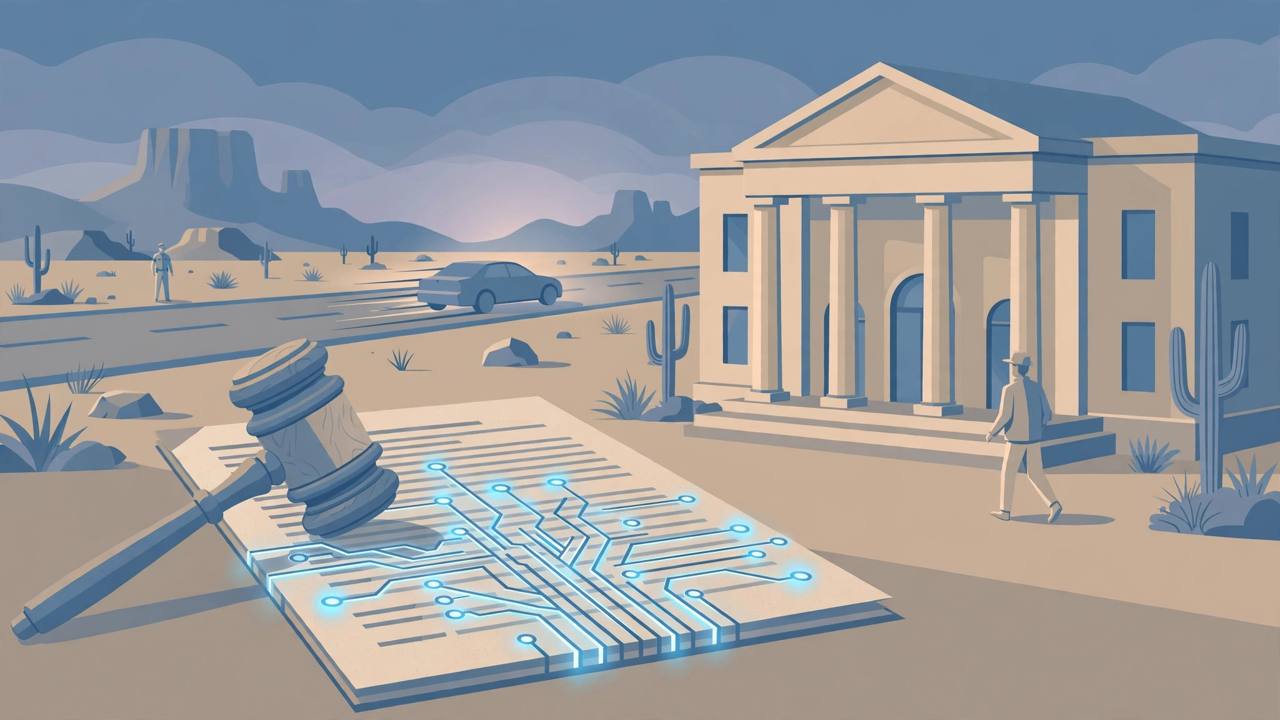
A Maricopa County court commissioner has released a Phoenix-area driver arrested on DUI and related charges after finding that probable cause could not be established from a probable-cause statement that disclosed it was generated with assistance from Truleo AI, according to reporting published on Friday, November 13.
Maricopa County Superior Court Commissioner Daniel Fenzel released the driver, Anthony Quidera, after writing that, without the trooper's own original account, the court could not tell which factual allegations the officer authored and which a generative system produced. Fenzel wrote, in the words quoted by ABC15 and summarised by The Century Report, that "the Court is unable to determine probable cause at this time."
What happened on Interstate 10
The arrest happened on October 29, 2026, on eastbound Interstate 10 near 79th Avenue in Phoenix. An Arizona Department of Public Safety trooper clocked a Dodge Charger travelling above 100 mph in a 65 mph zone, according to the probable-cause statement summarised in the reporting.
The statement described the vehicle weaving, the smell of alcohol, six of six cues on a horizontal gaze nystagmus eye test, and open containers on the floor of the car. Those details are the trooper's allegations as recorded in the statement; Quidera is presumed innocent of the charges, and the allegations have not been proved in court.
The disclosure at the end of the report
The probable-cause statement ended with a disclosure that it "was generated with assistance from Truleo AI" and reflects "the officer's own observations and recollections." Truleo is a company that offers artificial-intelligence tools to help law-enforcement agencies draft and review police reports and body-camera footage.
Commissioner Fenzel raised no objection to AI drafting itself, according to the reporting. The problem, as the commissioner framed it, was that the trooper's original account — the input the disclosure cited — was not supplied alongside the finished narrative, so the court had no way to check the AI-assisted text against what the officer himself had recorded.
Probable cause is the legal threshold an officer must meet for an arrest: reasonably trustworthy facts that would lead a person of reasonable caution to believe an offence was committed. When the document carrying those facts cannot be separated into the officer's words and a system's words, a judge can find that threshold unproved — even when the underlying stop is not in dispute.
The case did not end with the release
Quidera was later charged and was scheduled for arraignment on Thursday, November 12, according to ABC15 reporting summarised by The Century Report. The ruling therefore delayed the case rather than ending it: prosecutors can still pursue the charges, and the defence can still challenge the arrest paperwork as the case proceeds.
A wider argument about AI in policing and the courts
Report-writing systems that turn body-camera audio or an officer's dictation into a first draft are spreading through US police departments because they cut paperwork time. Phoenix police began piloting Axon's Draft One system in October, according to the same reporting. Supporters say the tools free officers for patrol; critics and defence lawyers say a draft no human can fully account for is a weak foundation for an arrest.
Arizona's courts are working on rules of their own. The Arizona Supreme Court has formed a steering committee on artificial intelligence in the courts, and it is due to send a status report by March 1, 2027. A state appeals court has also previously ordered a resentencing in a case involving an AI-generated victim video while leaving the conviction standing, a sign that Arizona judges are drawing case-by-case lines rather than banning the technology outright.
What it means for drivers in Arizona
For anyone stopped on an Arizona highway, the ruling does not change the law of the road: speeding and impaired driving remain offences, and a trooper's own testimony can still support a case. What it changes is the paperwork standard. Agencies using AI drafting tools in Maricopa County now have a clear signal that the officer's original account should be kept and produced beside the finished report, and defence lawyers in DUI cases can be expected to ask for exactly that record.
What happens next
Quidera's case continues after his scheduled November 12 arraignment, with the charges still to be answered in court. Beyond this case, watch for guidance from the Arizona Steering Committee on Artificial Intelligence and the Courts ahead of its March 1, 2027 status report, and for any new disclosure rules Arizona law-enforcement agencies adopt for AI-assisted reports.