The White House and the U.S. Department of Transportation on Friday urged Congress to approve a further $30.1 billion to upgrade the United States' aging airports and air traffic control system, in a letter sent to lawmakers by White House Office of Management and Budget Director Russell Vought and Transportation Secretary Sean Duffy.
Source: Reuters
Of the new request, $10.1 billion would go to air traffic control modernization, including $7.2 billion for a common automation platform and controller workstations and $2 billion for cloud computing. A further $2 billion would replace and improve Federal Aviation Administration (FAA) air traffic control towers, and $18 billion would fund airport-related projects, including $10 billion to modernize or replace aging terminals.
"This investment is critical to complete the modernization of our national airspace – delivering a resilient telecommunications backbone for air traffic controllers, modern hardware and software, state-of-the-art control towers, and world-class airport infrastructure," Duffy and Vought wrote to lawmakers, asking for swift action, Reuters reported.
Why the administration says the system needs the money
The United States runs the world's most complex airspace, and it has suffered a series of events in recent years that disrupted flights and risked safety. In January 2025, a midair collision at Ronald Reagan Washington National Airport killed 67 people. Congress responded in part in July 2025, approving $12.5 billion over five years to upgrade air traffic control and increase the hiring of controllers, following complaints about airport congestion, flight delays and technology problems.
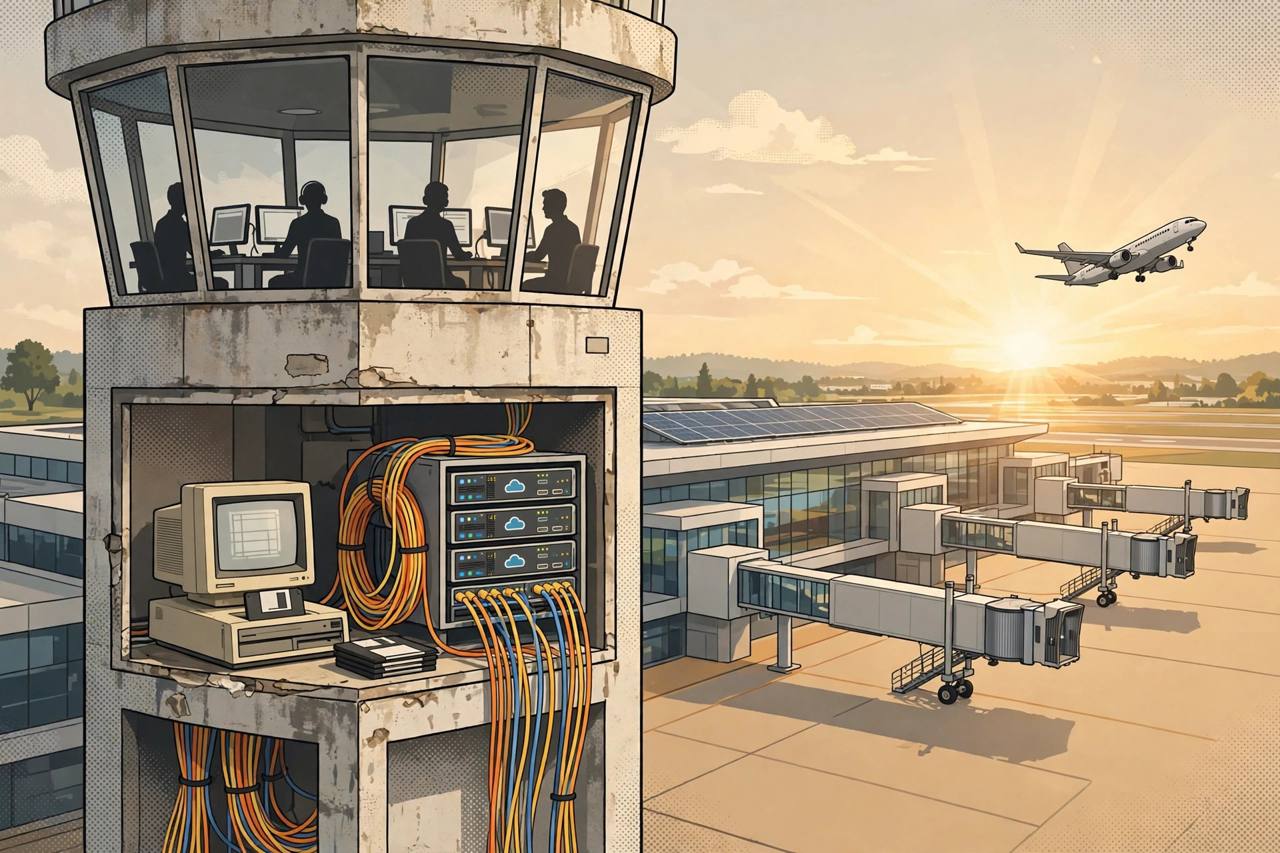
The FAA still relies on decades-old computers, and even on replacement parts bought through auction websites. Last week, the agency said it would replace, by the end of 2028, the floppy disks used for weather and other critical information at more than 400 air traffic control facilities. Vought and Duffy said in their letter that the FAA has already replaced 68% of its legacy copper telecommunications network with high-speed fiber infrastructure.
The fragility of the current system was on display in September, when the dual failures of a circuit at a Philadelphia air traffic facility and the accidental severing of a fiber-optic cable in New Jersey by a construction crew led to thousands of flights across the densely populated Northeast being delayed or canceled.
Airlines back the request; oversight warnings remain
Major airlines including American Airlines, Delta Air Lines, United Airlines and Southwest Airlines have expressed support for the request, Reuters reported. The push also follows an earlier proposal by Senator Eric Schmitt, who introduced the Modern Skies Act in September, and a September warning from the Government Accountability Office that the FAA needed better cost and schedule planning for its modernization program, according to reporting summarizing the request.
The $30.1 billion is a request, not approved funding. Congress must still vote on it, including how much goes to the FAA and how much supports airport projects.
The timing is political as well as technical. The administration has called on the Republican-led Congress to approve the funding in the final weeks of the year. Democrats are set to take control of Congress in January, which means the White House is asking the current Congress to act before the change of control.
For travellers — including the many Punjabi diaspora families in the United States who fly domestically and to and from India, and the truckers and airport workers who keep freight moving — the stakes are practical: an aging control system means delays, cancellations and safety risks at the country's busiest airports, while modern automation, fiber networks and rebuilt towers are meant to cut those failures.
What happens next
Lawmakers must now decide whether to approve the full $30.1 billion, a smaller package, or nothing in the final weeks of the year. If approved, the money would sit on top of the $12.5 billion already committed in July 2025. The FAA's own deadlines continue in parallel, including the plan to retire floppy disks at more than 400 facilities by the end of 2028.