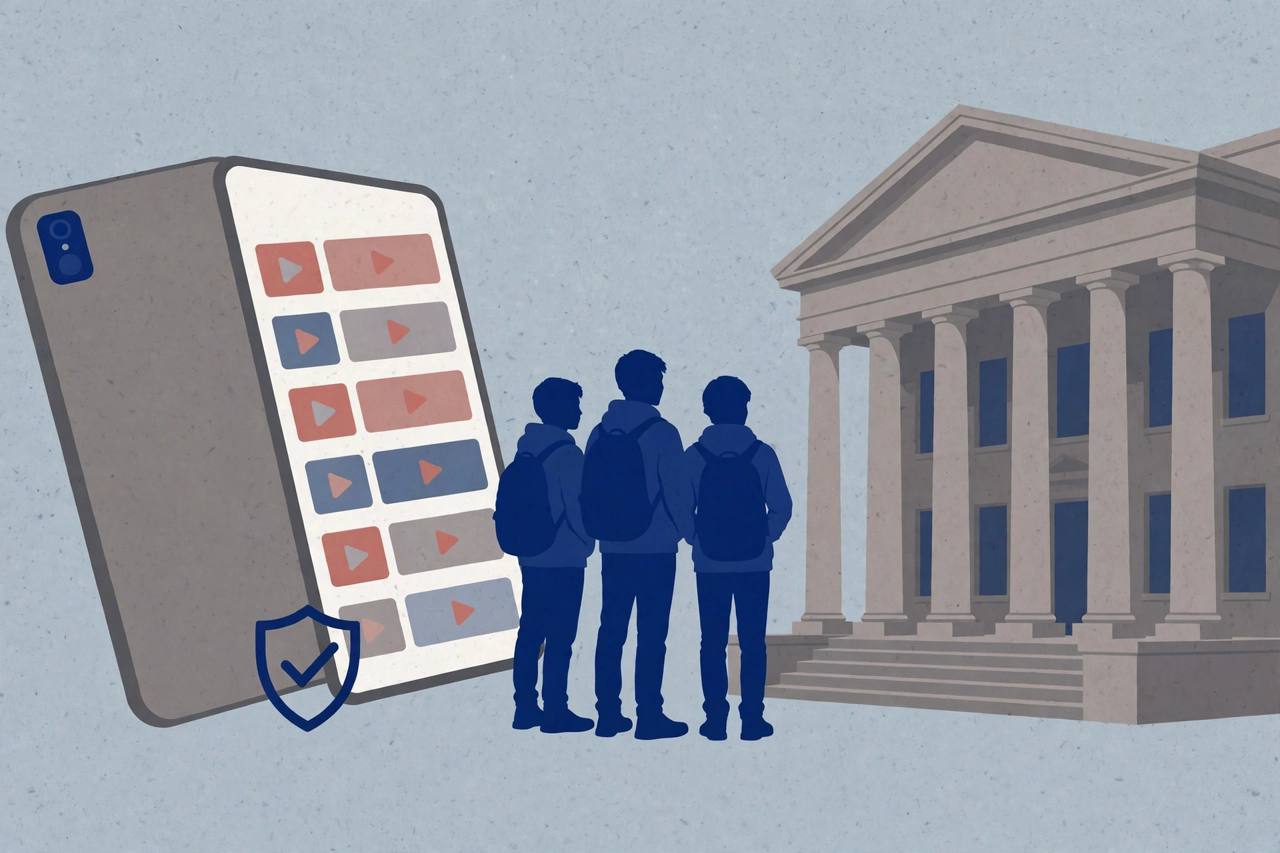
Google, Meta and TikTok have gone to federal court to stop California from enforcing a new child-safety law that would strip personalised feeds and autoplay away from every social media user in the state under the age of 16. The three companies filed separate lawsuits on Wednesday, November 4, 2026, all of them naming California Attorney General Rob Bonta, in his official capacity, as the sole defendant, and all of them asking a judge to block Assembly Bill 1709 before its scheduled start date of January 1, 2027.
Source: Bars Across, reporting the three federal complaints and dockets, Nov. 6, 2026
The cases were spread across the state. They were filed in California's Northern and Central Districts and are docketed in San Francisco (3:26-cv-13201), San Jose (5:26-cv-13204) and Los Angeles (2:26-cv-12965). The plaintiffs are Google LLC and YouTube LLC, Meta Platforms, Inc., and TikTok Inc. together with TikTok USDS Joint Venture LLC. Each lawsuit seeks preliminary and permanent injunctive relief — a court order stopping the law — plus a declaration that the statute is unlawful. These are the companies' allegations, not judicial findings: as of November 6, no court had blocked AB 1709 or decided whether it is constitutional.
What the California law actually requires
Governor Gavin Newsom signed Assembly Bill 1709 on September 10, 2026. The bill was sponsored by Assemblymember Josh Lowenthal and adds sections 22682 to 22686 to California's Business and Professions Code. It does not ban under-16s from social media outright. What it bans is giving a California user under 16 an 'addictive feature' — defined in the statute to include an 'addictive feed' that selects or prioritises content using information linked to the user or their device, and autoplay, with power for the Attorney General to designate further covered features by regulation. Endless scrolling is also covered in summaries of the enacted text.
A platform may keep an under-16 account open if that user is not given any addictive feature. If a platform does provide the restricted features to a younger user, the law requires deletion of the account and its associated personal information. Platforms must take reasonable measures to keep the features away from under-16 users and use age-assurance procedures — tied to California's separate Digital Age Assurance Act — before offering the features. Only the Attorney General or a local public prosecutor can sue to enforce the law; parents and teenagers have no private right of action. Courts setting penalties must consider company size, duration, severity and good-faith compliance.
The companies' argument: feeds are speech
All three companies argue that choosing what a user sees in a feed — selecting, organising and ranking other people's posts and videos — is editorial judgement protected by the First Amendment, and that California has crossed from regulating product design into controlling how online speech is presented. They also invoke Section 230 of the Communications Decency Act, the federal provision that shields platforms from certain liability for third-party content, arguing that the state is regulating the publication, selection and distribution of that content. TikTok's complaint adds objections under the Fourteenth Amendment and the dormant Commerce Clause, arguing the law could reach platform activity beyond California's borders.
The filings put the companies' case in their own words. Google's lawsuit argues for YouTube: 'Absent personalized feeds, under-16 users will be deprived of a compilation of videos tailored to their interests, preferences, and developmental needs — preventing them from effectively accessing the valuable content that YouTube provides,' adding that without personalisation much of that content 'will be buried beneath an endless stream of videos intended for viewers of different ages or with different interests.' TikTok called the law a 'blatantly unconstitutional restriction on free expression that erodes the long-standing and protected practice of curating content based on user preferences, which bookstores, TV networks and streaming services all use.' The companies are represented by senior litigators: Elizabeth B. Prelogar of Cooley LLP for Google and YouTube, Isaac D. Chaput of Covington & Burling LLP for Meta, and Theodore J. Boutrous Jr. of Gibson Dunn & Crutcher LLP for TikTok.
Attorney General Rob Bonta's office has said it is reviewing the lawsuits and is committed to defending California's laws protecting children online. The state frames AB 1709 as a rule about design systems built to maximise engagement among children — not a ban on any viewpoint or content. No court has yet tested either side's framing.
Background: this is the second California feed fight
AB 1709 is not the first California law the same companies are fighting. TikTok is already challenging Senate Bill 976, the Protecting Our Kids from Social Media Addiction Act, which requires verified parental consent before a platform shows an addictive feed to a minor under 18; that appeal is pending before the US Court of Appeals for the Ninth Circuit. AB 1709 is stricter in one key respect: it bars the features for under-16s even with parental consent. The new lawsuits also land while the industry is under wider legal pressure over teen use — TheWrap reported that in August Meta reached an $18 billion settlement in a teen social-media addiction trial brought by nearly every state, and that in September TikTok settled with Alabama for at least $100 million over addictive features. TheWrap also noted that in August a judge denied a preliminary injunction the companies had sought against an earlier California social-media safety law — a reminder that asking a court to block a law before it starts is not the same as winning.
Why this matters for families — including California's Punjabi diaspora
California is home to one of the largest Punjabi communities in the United States, concentrated in the Central Valley — Fresno, Sacramento, Stockton, Modesto, Bakersfield and Yuba City — as well as Los Angeles and the Bay Area. For those families, this case is not abstract. If AB 1709 takes effect on January 1, a teenager under 16 in California would open YouTube, Instagram, Facebook or TikTok to find no personalised For You or home feed and no autoplay — a chronological or non-personalised version of the service instead — unless a court intervenes first. Parents who today rely on parental-consent tools should note the change: under AB 1709, parental permission does not restore the features for under-16s. Platforms, for their part, face a build-or-delete choice for younger California accounts, backed by penalties of up to $50,000 per affected child for a knowing violation.
What happens next
The next step is the fight over preliminary injunctions: the companies must persuade three federal judges — in San Francisco, San Jose and Los Angeles — to freeze the law before January 1, 2027, while the underlying constitutional cases proceed. The Attorney General's office will defend the statute in each case. If no judge blocks it, the restrictions begin on January 1 and platforms must already have their age-assurance and non-personalised under-16 experiences ready. If a judge does block it, the law waits on appeal — quite possibly to the same Ninth Circuit already hearing the SB 976 fight. Either way, California's attempt to redesign how teenagers experience social media is now a federal court question, and the first rulings will set the calendar for every family and platform watching this case.