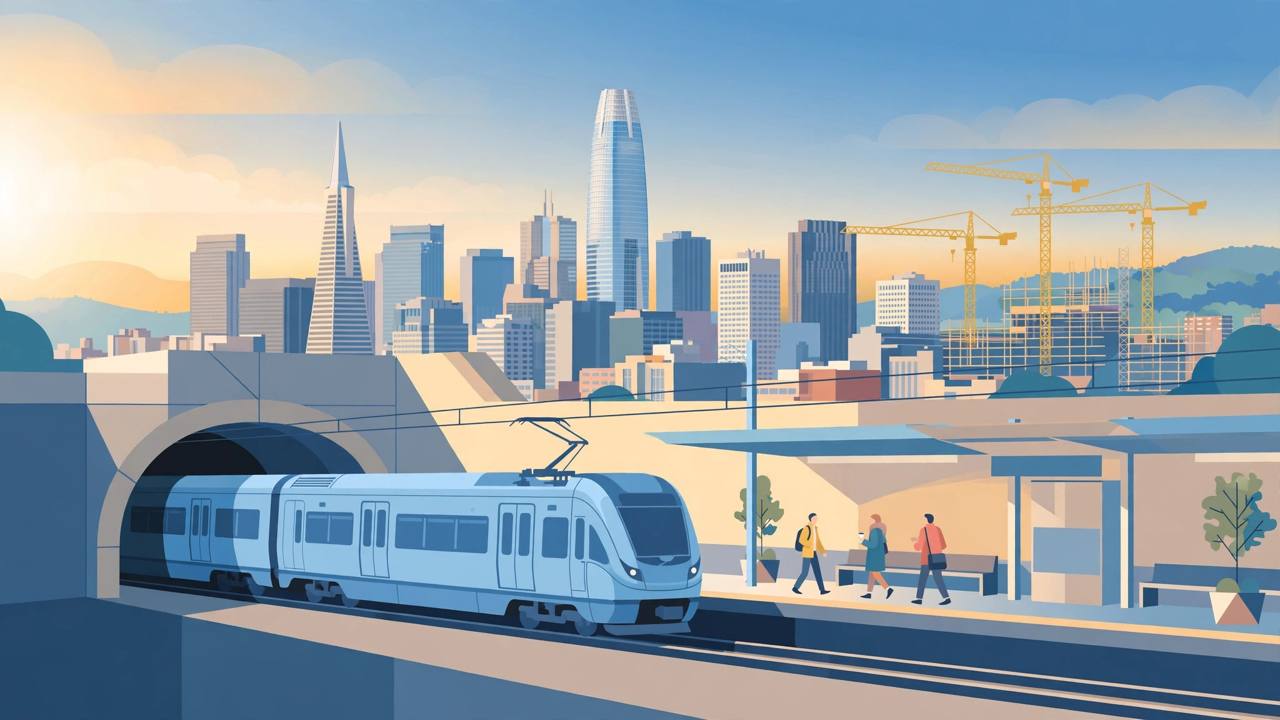
California has put $750 million of state money behind The Portal, the long-planned rail tunnel that will carry Caltrain trains about two miles from their current terminal at Fourth and King streets into the Salesforce Transit Center in the heart of downtown San Francisco. The California State Transportation Agency (CalSTA) awarded the money to the Transbay Joint Powers Authority (TJPA), the public agency that owns the transit center and is building the extension, through the eighth cycle of the Transit and Intercity Rail Capital Program (TIRCP). Governor Gavin Newsom announced the award on November 10 as the largest single grant in a package of nearly $1.3 billion for rail and clean transportation across the state.
Source: Governor of California
For eight years, the lowest level of the Salesforce Transit Center has stood as a finished concrete train box with no trains in it. The Portal is the project designed to fill it: twin rail tracks running under Townsend and Second streets, a new underground station at Fourth and Townsend, and a direct rail link into a building that already serves regional bus operators and sits one block from the Embarcadero BART station. The TJPA says the extension will connect riders to eight transit operators in one place and will also serve as the future San Francisco terminus for California high-speed rail.
How the $750 million will be spent
The money arrives in two pieces, the TJPA said in its November 10 statement. The first $100 million, funded in the current TIRCP cycle, pays for preconstruction work intended, in the authority's words, to make The Portal "one of the most shovel-ready transit projects in the United States." The remaining $650 million is committed over several years for construction, and is meant to help leverage the $3.38 billion already committed to the project through the Federal Transit Administration's Capital Investment Grants program. TJPA Board Chair Jeff Gee and Executive Director Adam Van de Water thanked the Governor, Transportation Secretary Toks Omishakin and CalSTA for the award, calling The Portal San Francisco's highest-priority transit expansion project and a project of state and national significance.
Source: Transbay Joint Powers Authority
Part of a $1.3 billion statewide package
The Portal award was the biggest item in a wider announcement. The Governor's office said the nearly $1.3 billion in awards, made through the TIRCP and the State Rail Assistance program, will also help prevent major Metrolink service cuts in Southern California and bring more than 75 zero-emission buses and smaller transit vehicles to California communities. The programs are paid for by Senate Bill 1, the 2017 gas-tax law, and by the state's Cap-and-Invest climate program. In Berkeley, for example, BART will receive $25 million from the same round of state funding to help build more than 600 housing units on the Ashby BART station parking lot, the Daily Californian reported. "California is turning big transit ideas into everyday trips," Transportation Secretary Toks Omishakin said in the Governor's announcement.
Source: San Francisco Inquirer
What the money does not settle
The award is large, but it is not new money in the project's own books: the TJPA's funding plan already counted on a state contribution of roughly this size. The authority's September status report, based on figures current as of July, puts the project's cost at about $7.57 billion and still lists a "funding gap — to be planned" of $587 million. The federal share is not fully locked in either: the $3.38 billion federal commitment still has to be confirmed through a Full Funding Grant Agreement with the Federal Transit Administration, which the authority is targeting for July 2027. A separate question is the share expected from California high-speed rail, whose revised business plan means the TJPA says it will need to restart conversations with the High-Speed Rail Authority about its commitment.
The Portal is the northern anchor of California's planned high-speed rail line. When both are built, trains from the Central Valley — home to a large Punjabi community in and around Fresno, Stockton and Bakersfield — would run directly into downtown San Francisco instead of stopping at Fourth and King. For now, the project mainly affects Bay Area commuters and the thousands of workers who ride Caltrain between San Jose, the Peninsula and San Francisco.
Background: a transit center waiting for its trains
The Salesforce Transit Center opened in 2018 with its underground train box already built, on the expectation that Caltrain and high-speed rail would follow. Caltrain, for its part, completed a $2.4 billion electrification project in 2024 that replaced its diesel trains with electric ones between San Francisco and San Jose. State law has also been adjusted to help the extension: in September, Governor Newsom signed Assembly Bill 2308, by Assemblyman Matt Haney of San Francisco, which extends by 25 years — past a scheduled 2050 sunset — the tax-increment financing from development on state-transferred land around the transit center.
What happens next
On the current schedule, preconstruction contracts for the main tunnel package, which is being procured through a progressive design-build process, are expected to be approved and awarded into spring 2027, with construction readiness targeted for 2029. Everything still hinges on the federal grant agreement targeted for the summer of 2027. The TJPA's status report puts the target date for the start of passenger service in November 2036 — a decade away, and dependent on closing the remaining $587 million gap and keeping the federal money in place.