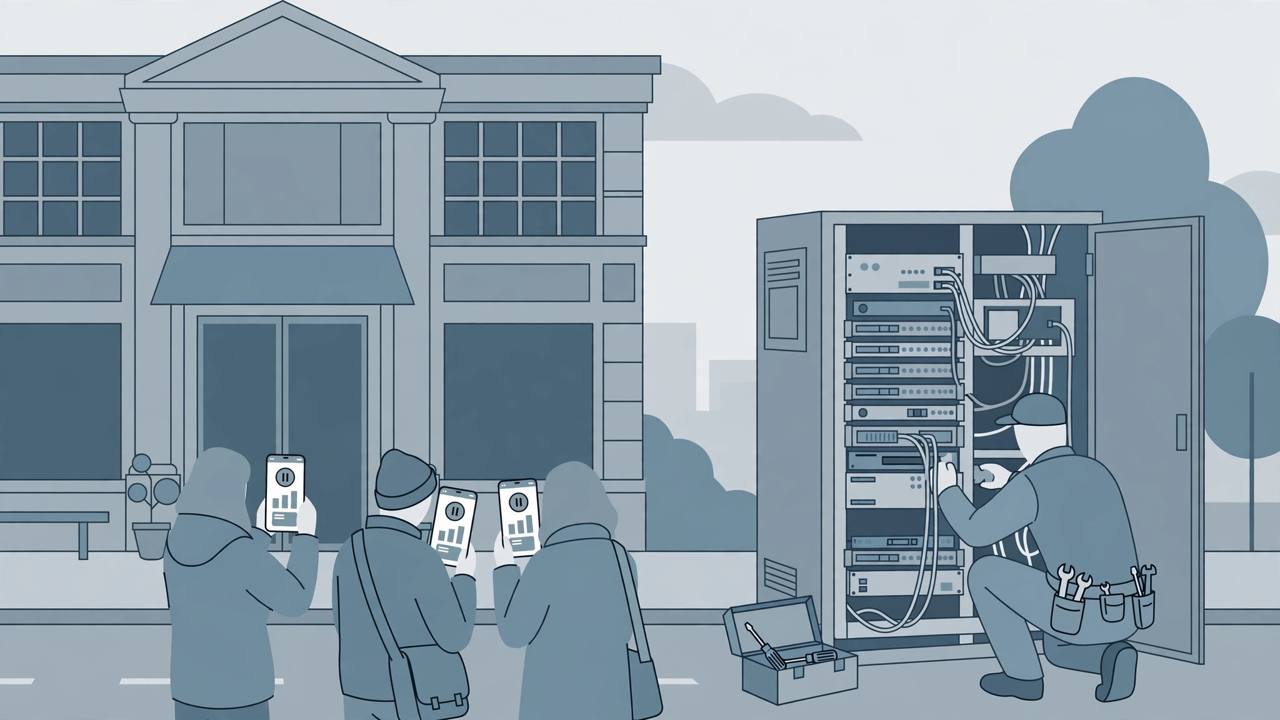
Customers of JPMorgan Chase and several other large US banks had trouble reaching their online accounts, viewing balances and completing transfers on Monday, November 16, after a software problem inside Chase's own systems slowed transactions across the banking network. Chase, the largest bank in the United States, said the disruption came from a software bug in its on-premise hardware systems and stressed that there was no evidence of a cyberattack.
Source: Associated Press, via CU Daily
The complaints rose sharply in the early afternoon Eastern time on Monday, with Chase generating the highest number of reports, according to the outage tracker Downdetector and Associated Press coverage of the incident. Customers described being locked out of mobile apps and websites, seeing error messages, or finding that transfers and routine transactions would not complete.
How big was the disruption?
The exact scale depends on which tracker count is used, and none of the counts is an official tally of affected customers. Downdetector figures cited by the New York Post and reported by the Associated Press put the complaints at more than 3,300 for Chase and about 800 combined for Bank of America and Wells Fargo. Other tracker readings reported on Tuesday put the peak higher, at close to 5,000 reports for Chase, about 2,000 for Bank of America and roughly 1,000 each for Wells Fargo and U.S. Bank. Downdetector counts complaints submitted by users; it does not independently verify how many accounts actually failed.
Chase said customers could still access their accounts and their funds throughout the incident, although some services were taking longer than usual. In a statement reported by several outlets, JPMorgan Chase said it had experienced a temporary issue related to a software bug in its on-premise hardware systems, that there was no evidence the problem was cyber-related, and that the issue was not systemic. By Monday evening, Chase said transactions were processing normally again.
Why customers of other banks saw problems too
Reports involving Bank of America, Wells Fargo, U.S. Bank and Truist did not necessarily mean each of those banks had its own failure. Payments involving a Chase customer on one side of a transaction could be delayed even where the other bank's systems were working. U.S. Bank said its own platforms were not directly affected, although clients sending or receiving Zelle payments involving other institutions might see temporary delays. Zelle itself said its network was operating normally and that any holdups originated at participating banks.
Source: Crowdfund Insider
That distinction matters for readers checking their own accounts: a failed or delayed transfer on Monday afternoon was, on the banks' own accounts, a processing delay at one major institution spilling into shared payment rails — not a loss of funds, and not, on the evidence published so far, a hack or a system-wide banking failure.
A week of outages in other systems
The banking disruption came in a period when other large US systems have also stumbled. The Associated Press coverage noted that the outage came just days after the US air traffic control system was hit by outages, and a week after many services provided by Microsoft were knocked offline. There have been no reports to date that those incidents are related, and Chase attributed its problem specifically to its own internal hardware and software.
On the banks' statements, account balances and deposits remained secure and accessible during the disruption, and Chase said normal processing had resumed by Monday evening. Anyone who still sees a missing or duplicated transfer from Monday should check the transaction inside their own bank's app first and contact that bank directly — do not rely on social-media outage posts for account-specific information.
Why this matters for diaspora and trucking readers
For Punjabi diaspora families, Monday afternoon is exactly when many people send money, pay rent and bills, and move funds between accounts — and for truckers on the road, a stalled banking app can mean a fuel payment, a lumper fee or a repair bill that will not go through at the moment it is needed. A delay measured in hours is an inconvenience for most customers, but it can become a missed payment deadline for a driver or a small business working to a tight schedule.
Branches, ATMs and telephone banking remained alternative routes during the peak of the disruption, according to the reporting. The practical lesson banks and consumer advisers repeat after every such incident is the same: keep a second payment method available for essential spending, and screenshot or note the time of any failed transaction so the bank can trace it.
What happens next
Chase has not published a detailed technical account of the bug beyond its statement that the fault sat in its on-premise hardware systems. The next test of that account will be whether the bank discloses more detail about what failed and what has been changed, and whether complaint volumes stay at normal levels through Tuesday. As of Tuesday morning, tracker volumes had trended back toward baseline and no bank was reporting an active outage.