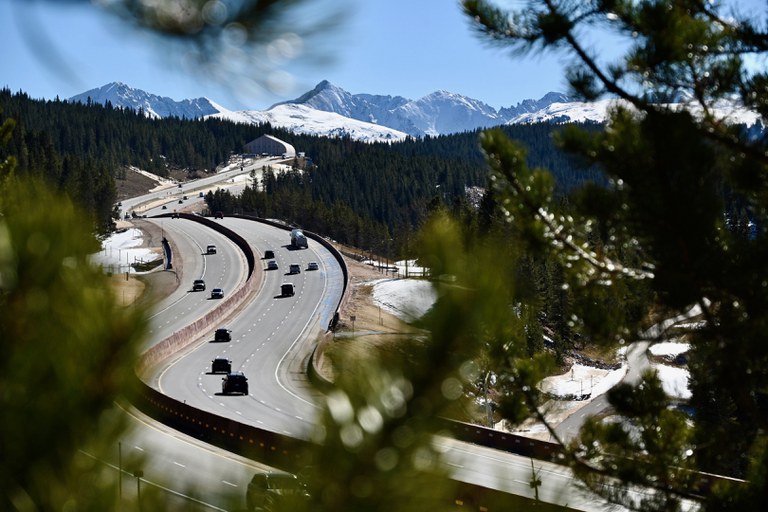
Colorado transportation officials on Monday, November 16, celebrated the completion of the I-70 West Vail Pass Auxiliary Lanes project — a six-year rebuild of one of the most weather-beaten freight and ski corridors in the American West, finished just as the winter season closes in on the high country.
Source: Colorado Department of Transportation
The Colorado Department of Transportation (CDOT) gathered at the Vail Pass Rest Area in Eagle County with prime contractor Kiewit Infrastructure Co., the Federal Highway Administration, local elected leaders and project partners. Even Ullr, the mythical Norse patron of skiing and winter, was listed among the special guests — a nod to the pass's vital role in Colorado's winter economy.
What was built for trucks and traffic
The centrepiece for drivers is a continuous third eastbound climbing lane between Mile Point 187 and the Vail Pass summit at MP 190. It separates slow-moving heavy vehicles from lighter passenger traffic on the final climb, which CDOT says reduces the speed-differential crashes that happen when fast cars close on crawling trucks. For the Punjabi and other long-haul truckers who run I-70 between Denver and the Western Slope, that lane, the expanded truck parking near the summit and a rebuilt emergency truck ramp are the parts of this project they will feel first.
Crews also modernized the dual bridges near MP 185, engineered for a 100-year service life, realigned them to soften the sharp curves and shifted them north to protect Polk Creek. The emergency truck ramp just east of West Vail at MP 182 was reconstructed with a straighter entry path to prevent runaway-truck rollovers, with an integrated hazardous-materials settlement basin to protect nearby Gore Creek. Truck parking along I-70 near the summit was expanded using repurposed excavated soil, giving drivers a safer place to rest and prepare for mountain conditions.
At the Narrows, near MP 186, crews installed the state's first passive avalanche and rockfall mitigation system, designed to keep active slide paths in check and limit the multi-hour closures and detours that avalanche control work has long forced on I-70. A new overhead variable message sign near MP 186.5 feeds an Active Transportation Management System warning drivers of lane closures ahead.
Avalanche, wildlife and water protections
CDOT and the Colorado Avalanche Information Center can use the Narrows system to monitor and manage active avalanche paths more safely. Five new wildlife underpasses — two large and three small-to-medium — with exclusionary fencing between MP 187 and MP 190 reconnect movement corridors for Canada lynx, elk, moose and deer, and are projected to cut wildlife-vehicle collisions by 80 to 90 percent. "These five underpasses paired with exclusionary fencing form the first multi-crossing system along the mountain corridor," said Colorado Parks and Wildlife Director Laura Clellan. Upgraded sediment basins trap winter traction sand and highway runoff before they reach Gore Creek and Polk Creek, protecting trout and insect habitat.
To make room for the road work, the Vail Pass Recreation Path was relocated further south between MP 185 and MP 187, and CDOT partnered with the U.S. Forest Service to expand the trailhead parking lot on Bighorn Road in East Vail — built with excavated rock and soil from the corridor — improving access to the Gore Lake and Deluge Lake trailheads. Crews also installed fiber-optic infrastructure powering variable speed limit signs, weather sensors and automated traffic management, and resurfaced the road with asphalt engineered for Vail Pass's severe freeze-thaw cycles.
What officials said
"Vail Pass presents some of the most challenging terrain on Colorado's highway system," said CDOT Executive Director Shoshana Lew. "All of the components of this project — from widened shoulders for emergency responders to cutting-edge avalanche mitigation improvements that will protect travelers and avoid road closures for avalanche control work — will make this corridor safer and more dependable." FHWA Division Administrator John Cater called the project "a testament to what can be achieved through strong interagency coordination, innovative engineering, and dedicated community partners." Craig Hurst, assistant director in CDOT's Office of Freight Mobility & Safety, said the improvements "enhance safety for commercial drivers and the traveling public, strengthen freight movement and support Colorado's economy," and that CDOT will keep investing in the corridor, including future chain-station improvements.
Background, money and what happens next
West Vail Pass is one of Colorado's most critical and weather-impacted interstate corridors, carrying ski traffic, local travel and transcontinental freight across the Rockies on I-70. Construction began in August 2021. CDOT's completion release puts the delivered project at $340 million, funded by the $60.7 million federal Infrastructure for Rebuilding America (INFRA) grant, state matching funds and FHWA program allocations; CDOT's project page separately lists a $325 million construction cost. Participating partners included FHWA, Kiewit, the U.S. Forest Service, Colorado Parks and Wildlife, the Colorado Avalanche Information Center, Eagle County, the Town of Vail and the I-70 Coalition. Independent trade and ski-industry coverage through the project's final season described the same scope — the MP 187.3–190 climbing lane, the new MP 185 bridge and a December 2026 completion target ahead of the 2026-27 ski season.
Completion does not end winter on Vail Pass. The corridor will still face chain laws, storms and closures when conditions overwhelm even the new systems, and CDOT urges travellers to check conditions before they go through its COtrip resources. What changes from this winter onward is the margin: a climbing lane that keeps trucks and cars apart on the steepest stretch, a ramp rebuilt for the runaway-truck case, more room to park and chain up near the summit, and an avalanche system built to shorten the closures that have stranded freight and skiers alike. The first full ski season, starting now, is the real test.
What is solid
- CDOT celebrated completion of the I-70 West Vail Pass Auxiliary Lanes project on November 16, 2026, at the Vail Pass Rest Area (CDOT release).
- The project covers MP 180 to MP 190, with a third eastbound climbing lane MP 187–190, rebuilt MP 185 bridges, five wildlife underpasses and Colorado's first passive avalanche mitigation system at the Narrows (MP 186).
- CDOT's release puts the delivered project at $340 million, including a $60.7 million federal INFRA grant; its project page lists construction cost as $325 million.
What is only claimed
- How much the new systems reduce closures and crashes in practice — the 80–90% wildlife-collision reduction is a CDOT projection, and the first full winter season will test the avalanche and climbing-lane benefits.