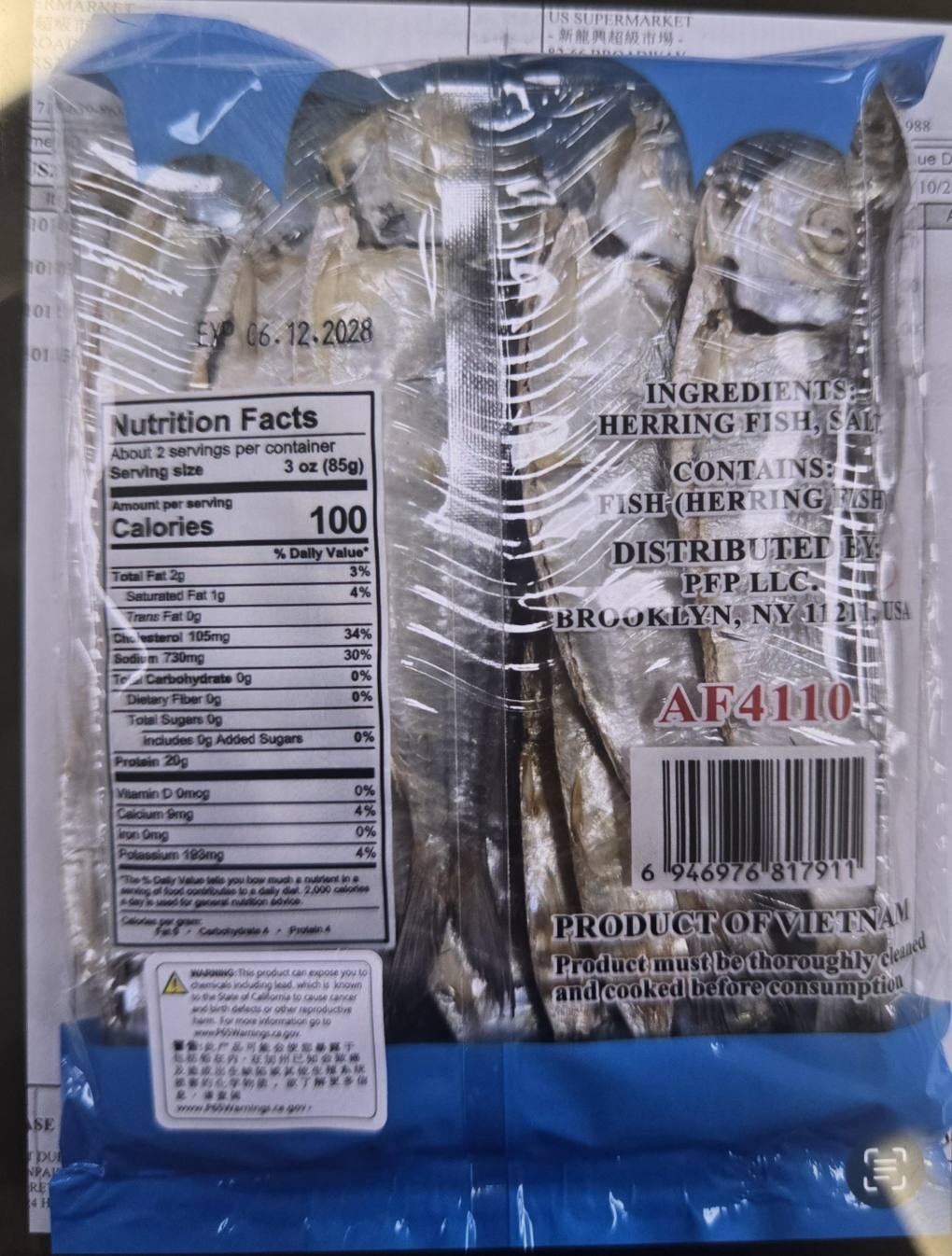
Prime Food Processing LLC of Brooklyn, New York, is voluntarily recalling 225 cases of Dried Herring Fish because the fish was not adequately eviscerated, the U.S. Food and Drug Administration announced on November 23, 2026. The uneviscerated fish could carry Clostridium botulinum, the bacterium that causes botulism, a rare but potentially fatal form of food poisoning.
Source: U.S. Food and Drug Administration
How to tell if your fish is affected
The recalled product is item AF4110, Dried Herring Fish, lot code 25180, with an expiration date of 12.28.27. It comes in clear plastic packaging of 7 ounces (198 grams) with blue trim. The FDA notice lists no brand name. The fish was imported from Vietnam and distributed by PFP LLC of Brooklyn.
The recalled fish was distributed to Asian grocery stores in 28 states: Alabama, Arkansas, California, Colorado, Florida, Georgia, Hawaii, Idaho, Illinois, Indiana, Kansas, Massachusetts, Maryland, Michigan, Minnesota, Missouri, North Carolina, New Jersey, Nevada, New York, Ohio, Oklahoma, Oregon, Tennessee, Texas, Utah, Washington and Wisconsin.
Why the fish is dangerous
The sale of uneviscerated fish is prohibited under New York State Agriculture and Markets regulations because Clostridium botulinum spores are more likely to be concentrated in the viscera — the internal organs — than in any other part of the fish. Uneviscerated fish have been linked to outbreaks of botulism poisoning, the FDA said.
Botulism symptoms include dizziness, blurred or double vision, trouble speaking or swallowing, difficulty breathing, muscle weakness, abdominal distension and constipation. Symptoms can appear hours or days after eating contaminated food, and botulism can be fatal without prompt medical care.
How the problem was found
The problem was identified during routine testing by the New York Department of Agriculture and Markets. The product was selected and sent for regulatory testing, and a subsequent investigation traced the issue to an imported product manufactured in Vietnam, the FDA notice said. At the time of the announcement, no illnesses or adverse reactions associated with the affected fish had been reported.
What to do if you bought it
Anyone who bought Dried Herring Fish item AF4110, lot 25180, should return it to the shop with the uneaten fish and packaging for a full refund — and should not taste or cook it first. Anyone who ate the fish and develops symptoms should seek medical care immediately.
Consumers with questions can contact Prime Food Processing LLC at 718-963-2323, Monday to Friday, 9 a.m. to 5 p.m. Eastern time. The company said the recall concerns only the identified lot and package, not all herring sold in the states involved.
Why this matters beyond one lot
Dried and salted fish is a staple in many Asian kitchens, and the recall reaches deep into communities across the United States — including California, New York, New Jersey, Texas, Illinois, Minnesota and Washington, states with large Asian and South Asian populations. The 28-state distribution list shows how a single imported lot can reach dinner tables from coast to coast within weeks.
Botulism is rare in the United States, but it is one of the most serious foodborne illnesses: the toxin attacks the nervous system, and severe cases need hospital care and a ventilator. Public-health agencies treat any botulism risk in a widely distributed food as urgent, even when no illnesses have yet been reported — because the first cases can be severe.
What happens next
The FDA notice remains the authoritative source for the recall, and the agency has not reported any illnesses linked to the fish. Shoppers should check lot 25180 on any dried herring bought recently, and grocers in the 28 states should pull the lot from shelves. We will update this report if illnesses are reported or the recall is expanded.