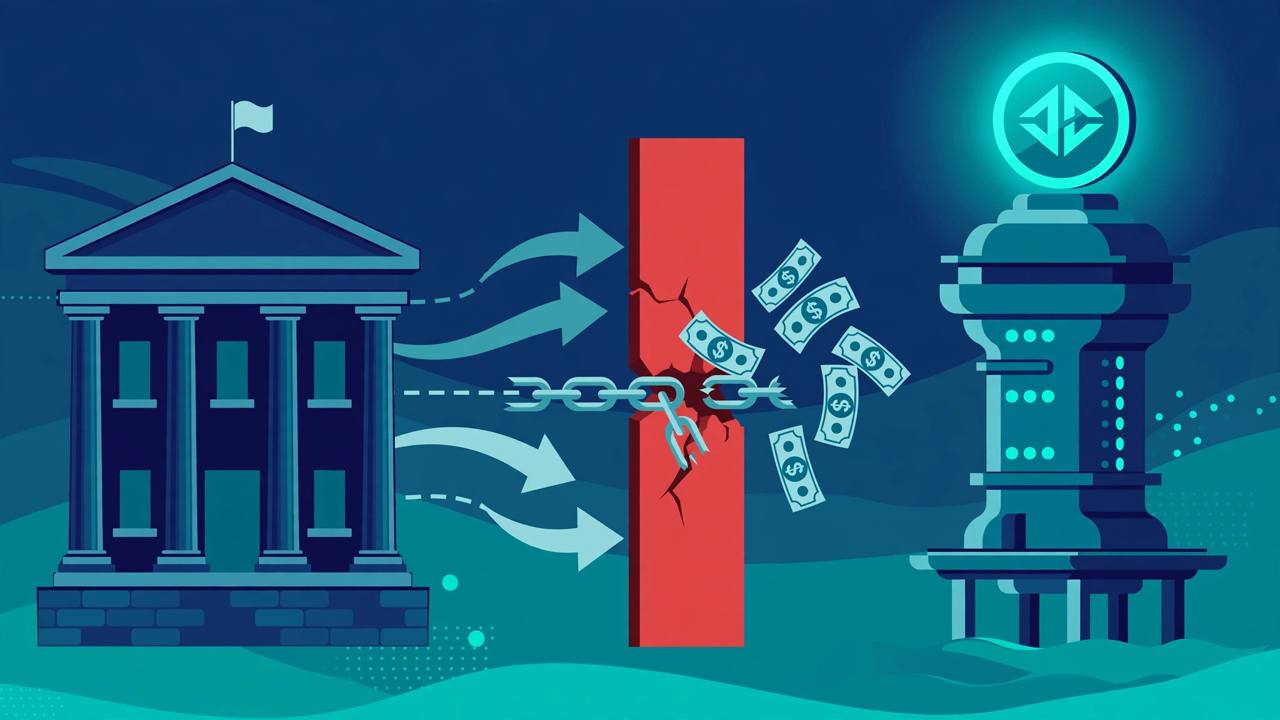
The United States Treasury has ordered American banks and financial firms to cut off MEXC Global, one of the world's 20 largest crypto exchanges, from the U.S. financial system. In a final order issued on Friday, November 6, the Treasury's Financial Crimes Enforcement Network (FinCEN) found MEXC to be a financial institution of "primary money laundering concern in connection with Russian illicit finance" and alleged that the offshore exchange facilitated at least $16 billion in illicit transactions between May 2021 and May 2026, tied to Russian, Iranian and North Korean sanctions evasion and to cybercrime. The action is part of the Treasury's sanctions-evasion campaign it calls Operation Economic Outcast.
Source: Bitcoin Magazine, Nov. 6, 2026 (reporting the U.S. Treasury / FinCEN press release sb0685)
The order, signed by FinCEN Deputy Director Jimmy L. Kirby, was issued under section 9714(a) of the Combating Russian Money Laundering Act. Once it takes effect, covered U.S. financial institutions will be barred from any transmittal of funds from or to MEXC Global, and the ban expressly includes transfers of convertible virtual currency as well as ordinary bank payments. The 30-day clock has not started yet: the order takes effect 30 days after it is published in the Federal Register, and as of Saturday that publication was still pending, so no exact effective date exists yet. The order has no end date. Willful violations can bring civil or criminal penalties, and because institutions cannot always refuse crypto sent to them, the order gives U.S. firms some discretion in handling unwanted incoming transfers, for example where funds passed through an unhosted wallet before arriving.
Source: Bitcoin Insider, Nov. 7, 2026 (detailed breakdown of the FinCEN order)
What FinCEN alleges: Russia, Garantex and the A7 network
FinCEN's findings are allegations by a regulator, made on public and non-public information; they are not a court judgment, and the order does not charge MEXC with a crime. On Russia, FinCEN said MEXC sent or received nearly $1.5 billion with direct or indirect exposure to Russian sanctions evasion, including $232 million in direct transactions with entities sanctioned by the United States, the European Union or the United Kingdom. It said the exchange handled about $129 million with the sanctioned Russian exchange Garantex and $4.1 million with its successor Grinex after their designations, and was still transacting with both as recently as June 2026, more than four years after the U.S. Office of Foreign Assets Control (OFAC) designated Garantex. FinCEN also cited nearly $26 million benefiting the sanctioned A7 sanctions-evasion network and almost $200 million connected to A7A5, a ruble-backed stablecoin.
Source: Bitcoin Insider, Nov. 7, 2026 (detailed breakdown of the FinCEN order)
On Iran and North Korea, FinCEN said MEXC processed nearly $2 billion connected to Iranian actors or suspected terrorist groups, including more than $1 billion in direct transactions with more than 40 Iranian crypto exchanges and about $22 million associated with the Central Bank of Iran and the Islamic Revolutionary Guard Corps and its Qods Force. It said the exchange helped a sanctioned North Korean money launderer, Sim Hyon Sop, receive about $350,000 in 2025, more than two years after his designation. On cybercrime, FinCEN put flows to or from illicit cyber actors at at least $1.99 billion and said MEXC received more than $37.9 million in suspected ransomware payments between January 2022 and July 2024. FinCEN said the pattern broke MEXC's own user agreement, which bars users in Iran, North Korea and other prohibited jurisdictions.
Source: Bitcoin Insider, Nov. 7, 2026 (detailed breakdown of the FinCEN order)
"Financial institutions cannot have it both ways: Either you support the Iranian regime, or you have access to the U.S. financial system." — Bessent, in the Treasury press release announcing the order under Operation Economic Outcast
A large exchange, not a niche venue
MEXC is far larger than the platforms FinCEN has cut off under the same authority before, such as the Russia-linked exchange Bitzlato in 2023 and the ruble exchange PM2BTC in 2024. Founded in 2018 and formerly branded MXC, the Seychelles-incorporated exchange processed more than $1 billion in transactions a day as of June 2026 and held about $5 billion in reserves, according to FinCEN, which said it had roughly 9 percent of global centralised-exchange trading volume at the end of 2025, offers trading in more than 50 fiat currencies and lists more than 3,000 crypto and tokenised assets. The order covers MEXC Global and its named affiliates operating outside the United States, including MEXC Global Ltd and MX Global Ltd in the Seychelles, MEXC Estonia OU in Estonia, GIDA Technology AG in Switzerland and MXC Global Ltd in the United Kingdom, two former Singapore entities, and any successors, branches and offices outside the U.S.; any MEXC offices located inside the United States are excluded.
Source: Bitcoin Insider, Nov. 7, 2026 (detailed breakdown of the FinCEN order)
Regulators elsewhere had already been circling. The United Kingdom's Financial Conduct Authority put MEXC Global Ltd on its warning list in March 2024 as unauthorised, Hong Kong's Securities and Futures Commission warned the same month that the platform was marketing to local investors without a licence, the Seychelles Financial Services Authority took action in May 2026 against MX Global Ltd for unlicensed virtual-asset operations, and regulators in Japan have also previously warned that the exchange operated without a licence, according to the reporting on FinCEN's order. MEXC already lists the United States as a prohibited jurisdiction in its own user terms, so the practical bite of Friday's order falls on the dollar rails, banking partners and U.S.-regulated counterparties that still touch the exchange.
Source: Bitcoin Magazine, Nov. 6, 2026 (reporting the U.S. Treasury / FinCEN press release sb0685)
What this order is — and what it is not
This is a FinCEN funds-transmittal ban, not an OFAC sanctions designation. MEXC is not being added to the sanctions list, no assets are being frozen, holding an account on MEXC is not made illegal, and the order does not rewrite Bank Secrecy Act duties or OFAC rules, which stay in force, including suspicious-activity reporting. FinCEN said it weighed MEXC's legitimate business before acting: it assumed part of the exchange's activity is legitimate, but concluded those services are available from regulated competitors and that the risk from the alleged illicit flows outweighs them. MEXC, for its part, said it is reviewing the order with its legal and compliance teams, that it is operating normally and that user assets remain secure, and that it has begun an independent review of its anti-money-laundering and sanctions controls and intends to engage with FinCEN and other regulators. In that statement it did not address FinCEN's specific transaction figures.
Source: Bitcoin Insider, Nov. 7, 2026 (detailed breakdown of the FinCEN order)
Why it matters to readers in the United States
Millions of people in the United States hold or trade crypto, including many Punjabi diaspora families in California, New York, New Jersey, Texas and Washington who use offshore exchanges because they list tokens that U.S.-regulated platforms do not. For anyone who moves money between MEXC and a U.S. bank, payment firm or U.S.-regulated crypto platform, those routes are set to close once the order takes effect: dollars and coins will no longer be able to travel between MEXC and covered U.S. institutions in either direction. Balances held on MEXC itself are not frozen by this order, but the doors between MEXC and the American banking system are being shut, which can strand users who wait until the last minute to move funds through U.S. channels. Truckers and small business owners in the diaspora who receive payments or hold savings in crypto should expect U.S. counterparties to start blocking MEXC-linked transfers as the effective date approaches, and to keep their own records of any transfers they make before then.
Source: Halving Report, Nov. 6, 2026
What happens next
Everything now hinges on the Federal Register. The 30-day countdown starts only on the day the order is published there, and until that happens the ban is announced but not yet in force. FinCEN says MEXC or other parties can submit relevant information to it in the meantime. U.S. banks, payment firms and crypto businesses will need to have blocking in place by the effective date, and FinCEN says the order is also meant to put foreign institutions on notice; whether other jurisdictions follow the U.S. lead is an open question. Awaaz Punjab will update this story when the Federal Register publication fixes the effective date.
Source: Bitcoin Insider, Nov. 7, 2026 (detailed breakdown of the FinCEN order)
What is solid
- FinCEN issued a final order on Nov. 6, 2026, under section 9714(a), signed by Deputy Director Jimmy L. Kirby, as part of Operation Economic Outcast (Treasury press release sb0685, reported by Bitcoin Magazine, Halving Report and Bitcoin Insider).
- The ban covers any funds transmittal, including crypto, between covered U.S. financial institutions and MEXC Global and its named non-U.S. affiliates, and takes effect 30 days after Federal Register publication, which was still pending as of Nov. 7.
- The order is not an OFAC sanctions designation, freezes no assets and does not make holding a MEXC account illegal.
What is only claimed
- The scale and character of the alleged illicit flows — at least $16 billion in total, including the Russia, Iran, North Korea and cybercrime breakdowns — are FinCEN's allegations, not court findings; MEXC says it is reviewing the order and its controls and has not addressed the specific figures.
- Some outlets put the total of likely illicit activity at $16.7 billion rather than at least $16 billion; Awaaz Punjab uses the Treasury figure of at least $16 billion.