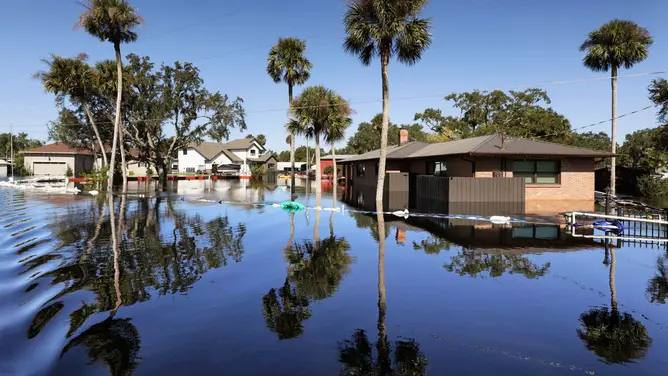
Governor Ron DeSantis said on Monday that Florida will ask Washington for a second major disaster declaration after a fresh round of historic flooding pushed the St. Johns River to a record crest and left hundreds of families waiting for help. Speaking in West Melbourne, in Brevard County, alongside Florida Division of Emergency Management Executive Director Jared Perdue, Brevard County Sheriff Wayne Ivey, Florida State Guard Director Colonel Mark Thieme and Congressman Mike Haridopolos, DeSantis said parts of the state received 15 to 20 inches of rain in the past week.
"Parts of Florida, including here in West Melbourne, received 15-20 inches of rain in the last week. In response to severe flooding, the State of Florida has been focused on saving lives, supporting residents in need, and keeping critical services available," DeSantis said. "State personnel have completed nearly 500 floodwater rescues, and more than 10,000 feet of Tiger Dams have been deployed to protect critical infrastructure. We are submitting an additional Major Disaster Declaration request to secure federal assistance for communities affected by flooding."
A river at record height
The St. Johns River near Cocoa reached nearly 19 feet on Saturday, November 21, surpassing its previous record by more than a foot, according to DeSantis. Above Lake Harney, near Geneva, the river gauge stood at 13.1 feet on Monday morning, against a flood threshold of 8 feet, the National Weather Service said. Communities near Sanford, DeLand and Astor have also seen serious flooding, and forecasters warned that water levels in some places would rise further this week. State Road 50 in Brevard County and State Road 46 in Seminole County remained underwater on Monday.
The rescue effort, by the numbers
State agencies — including the Florida Fish and Wildlife Conservation Commission, the Florida National Guard, the Florida State Guard and the Florida Highway Patrol — have carried out nearly 500 floodwater rescues. The National Guard has mobilised 421 personnel, carried out 417 welfare checks and deployed 54 high-water vehicles across six counties. The response also includes 173 wildlife officers, more than 200 highway patrol troopers and nearly 160 State Guard personnel.
The state has distributed more than 22,000 boxes of water, 7,500 ready-to-eat meals, 1,200 flood cleanup buckets and 1,300 tarps, and has deployed 90 pumps and 22 vacuum trucks in Brevard, Broward, Indian River, Flagler and Palm Beach counties. State Guard crews have helped with "muck and gut" work at more than 250 properties in Brevard and Okeechobee counties, clearing water-damaged material from flooded homes. Two responder base camps, volunteer villages and two logistical staging areas are in place, and multi-agency resource centres have already helped more than 1,600 residents.
Why federal help is still out of reach
The new request matters because the first one has not been granted. Florida asked on November 9 for an expedited major disaster declaration for nine counties for the flooding that began on October 31, and that request was still awaiting presidential action on Monday, according to DeSantis and Congressman Haridopolos. Without a presidential declaration, FEMA Individual Assistance — the programme that lets flood survivors apply for household aid — does not open.
Perdue said the state could have enough damage information to move forward with the second request as soon as Monday or Tuesday, and that it will cover a broader area because more counties and communities were affected by the latest rainfall. He said the state expects the request to warrant federal approval. In the meantime, residents do not have to wait for federal approval for some help: the state's emergency travel trailer programme can provide temporary housing for qualifying residents whose homes are uninhabitable, and the resource centres are offering supplies, cleanup help and counselling.
Perdue urged residents to stay off flooded roads, including the stretches of State Road 50 and State Road 46 that remained underwater on Monday. The state publishes response updates and resources at FloridaDisaster.org/Updates. This is the second round of historic flooding in Florida in less than a month, and many of the neighbourhoods hit hardest were still recovering from the first round earlier in November.
What happens next
The state will finish its damage assessments and submit the second declaration request in the coming days, while the St. Johns River remains at or near record levels in several communities. Officials warned that the flooding could take weeks — even months — to fully subside in the hardest-hit areas. For families whose homes were flooded twice in a month, the open question is whether the second request moves faster than the first, which has now waited two weeks without an answer.
Our November 21 report covered the flooding as the St. Johns River passed its 1953 crest and schools shut across the region. This story carries the story forward with Monday's rescue totals, the record crest near Cocoa and the state's second disaster declaration request. Read our earlier report