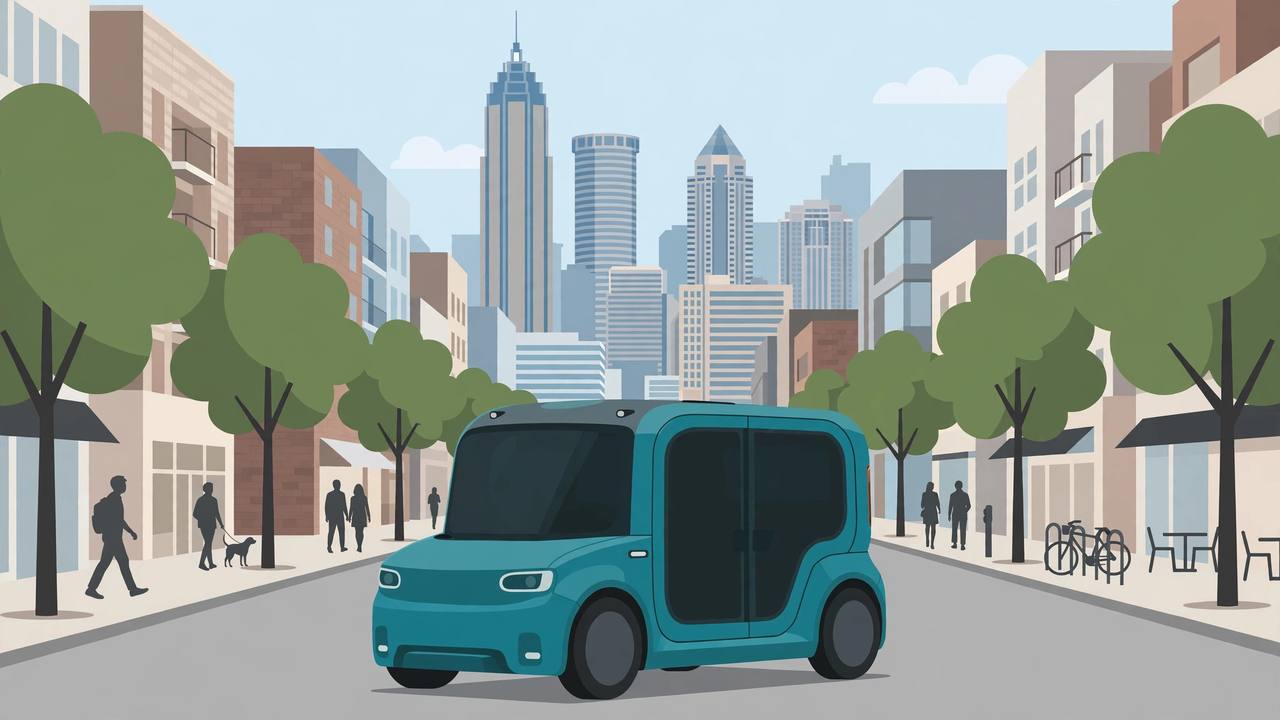
Atlanta drivers are about to start sharing the road with a vehicle that has no steering wheel, no pedals and no driver's seat. Zoox, the autonomous-vehicle company owned by Amazon, announced on Friday, November 13, that its purpose-built robotaxi is now driving on public streets in Atlanta, starting in the city's northwest, around Atlantic Station, Woodward and Home Park.
Source: CleanTechnica (reporting Zoox's announcement)
For now, almost nobody in Atlanta can actually ride in one. Zoox says the first phase of rides is limited to its own employees, their families and friends while testing continues. A public waitlist for Atlanta will open in the coming months, the company says, ahead of the launch of its Zoox Explorers early-rider program in the city next year. Residents who spot the boxy teal vehicles should not mistake this testing phase for a service they can book today.
A vehicle built only to drive itself
Unlike rivals that retrofit ordinary cars, Zoox designed its robotaxi from the ground up for fully autonomous ride-hailing. It has no steering wheel or driver's seat; instead, up to four passengers sit carriage-style, facing one another, in what the company describes as a private space to socialize and relax. The vehicle is bidirectional and symmetrical, with sensors at its corners giving it a 360-degree view, and Zoox says it is currently the only company deploying a fully driverless, purpose-built robotaxi on public roads in the United States — a claim the company itself makes about its design. Zoox owns, operates and assembles its vehicles.
A year and a half of groundwork before the first ride
Zoox did not arrive in Atlanta last week. The company says it started operations in the city in the spring of 2025, using a test fleet to map the streets and learn local driving behaviors, weather patterns — Atlanta's frequent thunderstorms included — and city infrastructure. Since then it has steadily expanded its autonomous driving, its geofence, its fleet size and its local team to prepare for this stage of testing.
The company says its philosophy is “no surprises”: before driving in a new city it engages with local and state officials and regulators, and in Atlanta it has partnered with the @Promise Center to help local youth learn and prepare for their futures. Ron Thaniel, Zoox's senior director of policy and regulatory affairs, said the company is “grateful to the City of Atlanta and the state of Georgia for their collaboration as we introduce a new kind of vehicle and rider experience to the city.” Chief executive Aicha Evans marked the launch by noting the progression from employee rides toward the waitlist and early-rider program.
Why Atlanta — and who else is already on its streets
Zoox calls Atlanta a “dynamic, vibrant city” and the “Silicon Valley of the South,” with one of the largest ride-hailing markets in the United States, a dense urban layout and a growing population — demand the company says is exactly what on-demand autonomous ride-hailing is built for. Atlanta has also become a hub for autonomous-vehicle testing generally.
Zoox is not arriving in an empty market. Waymo already offers public, unsupervised driverless rides in Atlanta, primarily through Uber, and May Mobility runs a public robotaxi service with a safety supervisor through Lyft — which makes Atlanta a three-operator robotaxi city. What Zoox adds is a different kind of vehicle: not a converted SUV with a driver or supervisor, but a purpose-built pod with no controls for a human driver at all.
The teal Zoox pods now driving around Atlantic Station, Woodward and Home Park are in a closed testing phase. There is no public fare, no public booking and no announced date for general rides in Atlanta. The next public step is a waitlist, expected in the coming months, followed by the Explorers early-rider program next year; the Zoox app will notify riders when service reaches their area.
What happens next
Zoox says it will expand its Atlanta driving area throughout the year as testing progresses, then open the waitlist and launch Explorers. Atlanta joins Austin and Miami as a testing market for the robotaxi; the company already runs a public service in Las Vegas and its Explorers early-rider program in San Francisco. For Atlanta's large rideshare and taxi workforce — and for commuters in one of America's biggest ride-hailing markets — the significance of this week is not a new app to open, but a new kind of vehicle now learning their streets, with public access following only after the company is satisfied the testing justifies it.