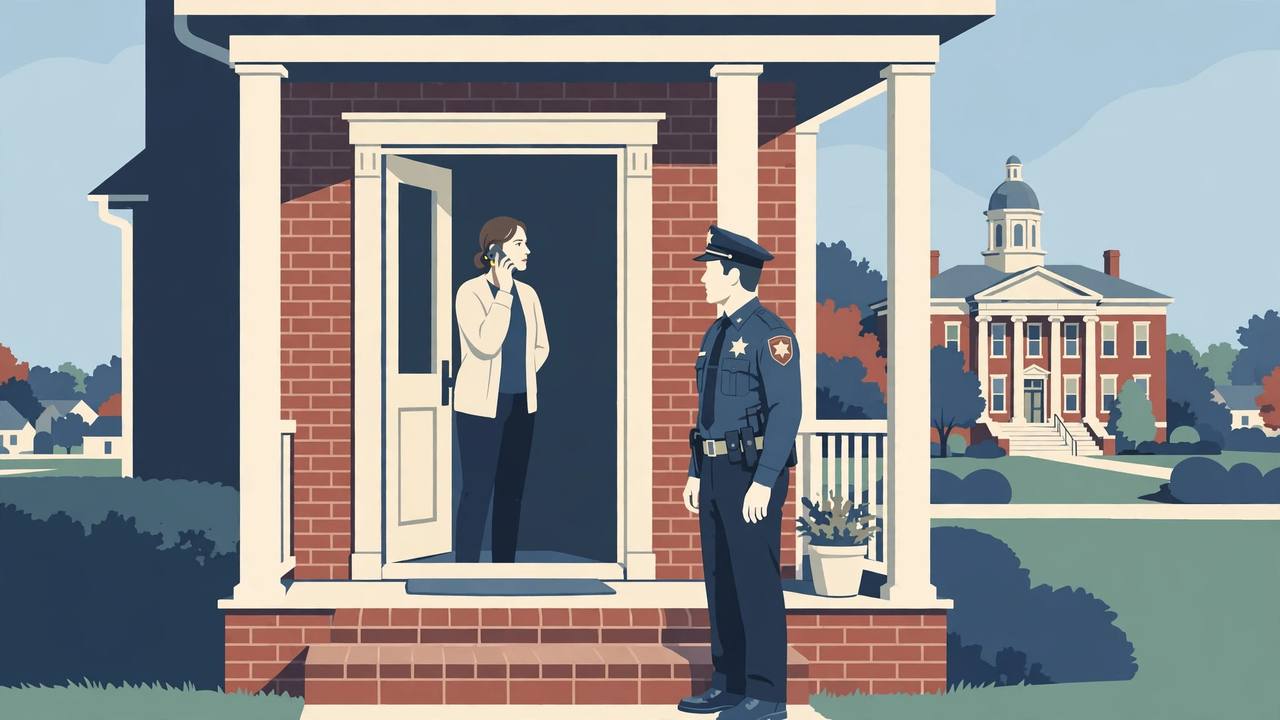
Cherokee County prosecutors have dropped the criminal case against Natasha Lopez, the Woodstock mother who was arrested in her own doorway in August 2025 after asking a sheriff's deputy to show her a warrant. On Thursday, November 12, 2026, Cherokee County Solicitor-General Todd Hayes filed a motion of nolle prosequi on the two misdemeanor obstruction counts against Lopez, and the State Court granted it, according to FOX 5 Atlanta and WSB-TV.
Source: FOX 5 Atlanta
Hayes said the prosecution depended heavily on the arresting deputy, former Cpl. Charles Mills, and that Mills's later conduct risked a jury being unable to fairly weigh his testimony. Announcing the decision, Hayes used the line prosecutors are trained on: “The responsibility of a prosecutor is to seek justice, not simply to obtain convictions,” FOX 5 Atlanta reported on November 12.
What happened at the doorway on August 30, 2025
The facts at the door, as reported by Atlanta News First and 11Alive, began with a traffic case. Mills came to Lopez's Woodstock home looking for her 21-year-old son, Joseph Helms, on traffic charges of speeding and reckless driving. Mills held an arrest warrant for the son, but court records reviewed by WSB-TV show no search warrant for the home had been signed when he went inside. Security video shows Lopez in the doorway asking to see a warrant. She called 911 and was arrested during that call. Deputies then swept and secured the house, and a judge signed a search warrant about 30 minutes after her arrest.
The Cherokee County Sheriff's Office disputes Lopez's account of the encounter. In a statement provided to CyberGuy, the office said Mills was in full uniform, in a marked patrol vehicle, and had identified himself, and that he believed evidence connected to the traffic investigation was inside the home and that his actions were permitted under established Fourth Amendment case law. Lopez was taken to the Cherokee County Adult Detention Center, processed and released on bond, and charged with obstruction of a law enforcement officer under Georgia law. The sheriff's office said prosecutors independently reviewed body-camera footage and determined there was probable cause, and a second obstruction count was later filed.
The fake Facebook page that undid the prosecution
What ended the case was not the doorway but a Facebook page. Lopez says an anonymous page called “Not So Noble” — a play on her own public page, Natasha Noble — harassed her family with personal information and AI-generated content, an account the sheriff's office disputes in part. At a September 18, 2026 motions hearing, Mills told a prosecutor's investigator that he had created and run the anonymous page while Lopez's case was pending. Prosecutors disclosed that admission on September 21 as Brady material — evidence bearing on a witness's credibility — and formally notified the sheriff's office the same day.
Sheriff Frank Reynolds placed Mills on administrative leave on September 22 and fired him on October 2, after an internal review found he was responsible for the page's content and had violated the office's code of conduct. “The personal actions of Charles Aaron Mills do not reflect the values and ethical standards of the Cherokee Sheriff's Office,” the office said in its statement to CyberGuy. CyberGuy also confirmed that Mills's wife was fired from the Blue Ridge Judicial Circuit District Attorney's Office on September 30, 2026, over policy violations, in an office that had recused itself from investigations involving social-media content about Lopez.
In October, a judge granted Lopez a 12-month stalking protective order against Mills. Cherokee Judicial Circuit District Attorney Erle Newton confirmed to CyberGuy that his office was assigned to investigate Mills's actions alongside the Georgia Bureau of Investigation, that the investigation remains ongoing, and that no criminal charges against Mills had been filed at the time of his response.
The court had already ruled against Lopez on the warrant question
The dismissal does not settle the constitutional question the case became known for. On October 21, 2026, the State Court rejected Lopez's challenges to the arrest and search: it found probable cause to arrest her son, held that exigent circumstances justified securing the home, and upheld the later search warrant. The court also found deputies had violated the body-worn camera policy, but ruled that violation did not warrant dismissal. Those rulings remain in place, which is why lawyers watching the case say the public should study them: asking to see a warrant at your own door is still, legally, an untested confrontation in this case, because the prosecution collapsed over its own witness instead.
Lopez has also described, in her account to CyberGuy, how a Flock license-plate camera system allegedly helped a deputy track her son to her home — her allegation, which the sheriff's office disputes as part of its broader disagreement with her characterization of the arrest and of how her complaints were handled. Her obstruction case is now closed. What remains open is the GBI and district attorney investigation of the fired deputy, and the protective order that runs for 12 months from October.
Lopez's two obstruction counts are dismissed and her criminal case is over. The joint investigation of former Cpl. Charles Mills by the Georgia Bureau of Investigation and the Cherokee Judicial Circuit District Attorney's office continues; no criminal charges against Mills had been filed in the reporting. The 12-month protective order granted in October remains in force.