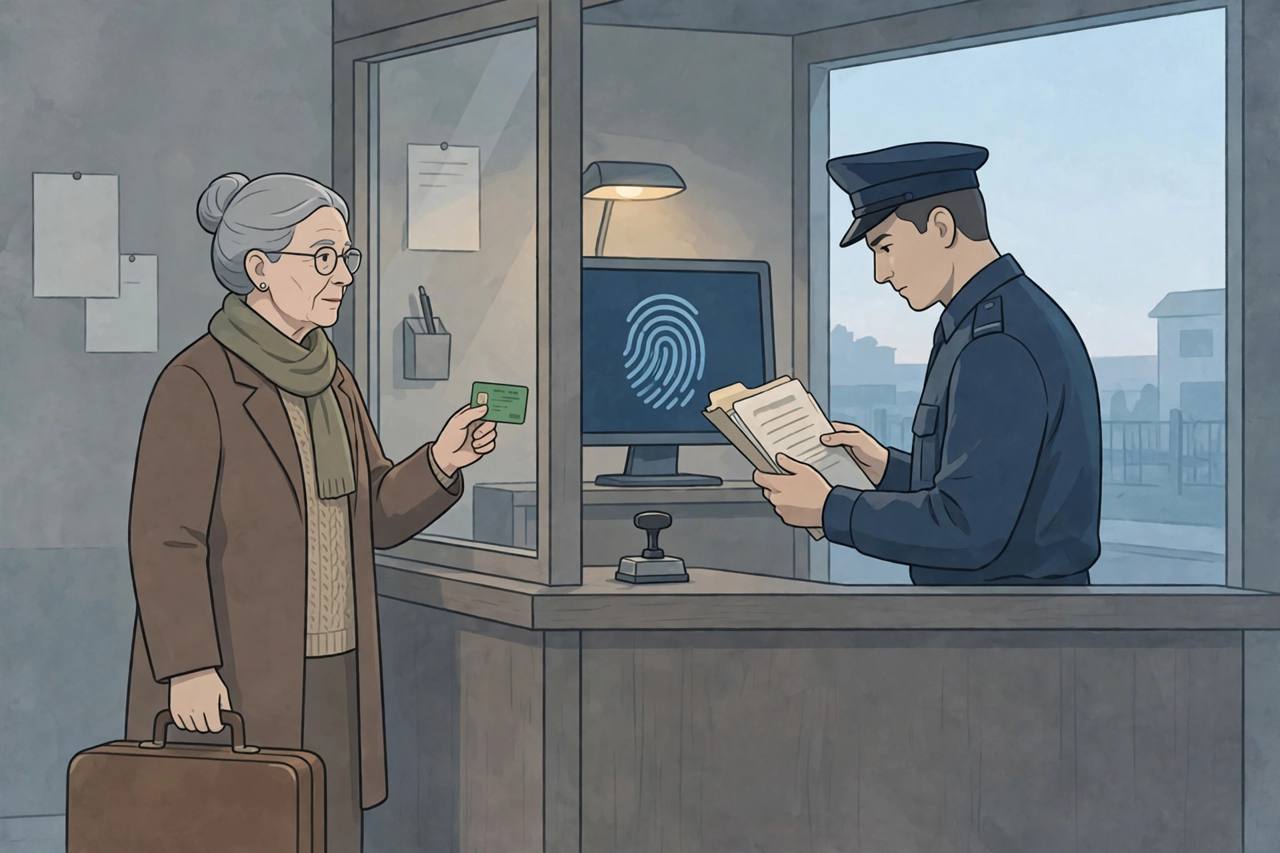
Longtime US green-card holders are being detained at border crossings and airports over criminal charges and paperwork questions dating back decades, according to a Washington Post investigation published on Tuesday, November 17. Attorneys across Texas and Florida told the newspaper that clients who had renewed their permanent-resident status, travelled abroad for years and lived in the United States for decades are now being flagged by fingerprint and database checks on their return — and in some cases held for weeks while the government argues they should lose the status they already hold.
Source: The Washington Post
The investigation is new reporting, published today. One case it examines — the October death in ICE custody of Dallas resident Emiliano Andrade Covarrubias — was reported at the time in October; the Post's reporting now places that death inside a much wider pattern of detentions built on old records, and adds cases, attorney caseloads and data-sharing practices that had not been reported together before.
A 1994 misdemeanour that came back at the border
San Juanita Guerra, now 75, had crossed into Mexico for three decades to fill prescriptions without a problem, the Post reported. She obtained her green card a decade before the incident at the centre of her case. In September 1994, after one of her teenage children, who had been struggling with suicidal thoughts, obtained a gun, Guerra took the gun and put it in her purse. Two days later, airport security at McAllen International Airport in Texas's Rio Grande Valley detected the unloaded pistol, and she was charged with unlawfully carrying a weapon, according to Hidalgo County court records cited by the Post.
Guerra said her attorney at the time advised her to plead guilty to the misdemeanour. She paid a fine, was briefly on probation, and the case was then dismissed. The conviction did not stop her renewing her status three times, and it never came up on hundreds of later trips to Mexico, her attorney Wendoli Rodriguez said. Guerra said a notary public had wrongly advised her that she did not need to disclose it on future applications.
That changed on March 2, when officials at the Progreso port of entry in South Texas took Guerra's fingerprints after she arrived having forgotten her green card at home. The biometric database flagged the 30-year-old conviction. ICE officers shackled her, and she spent 22 days in detention, where relatives say she barely slept or ate and became severely disoriented and weak. Her family borrowed $15,000 to secure her release after an immigration judge granted a bond request, and she was fitted with an ankle monitor that was later removed after she raised health concerns. Her case continues, with a hearing scheduled for later this month.
A Dallas father's death in custody
Emiliano Andrade Covarrubias, 56, a longtime Dallas resident who obtained his green card in 2019 and ran a contracting and painting business with his son, was stopped on June 26 while attempting to enter at Laredo, Texas. ICE spokeswoman Monica Yoas said in a statement that agents determined he had “obtained status through fraudulent means by failing to disclose his previous arrest during the review process,” and added that “he was receiving due process.” Dallas County records show he had pleaded no contest to a 2004 misdemeanour theft charge, received deferred adjudication — meaning it did not appear as a conviction on his record — served probation and had the option of having the charge expunged. His daughter Estefani Andrade said he had taken a ladder after a client failed to pay him.
Andrade Covarrubias spent months fighting his case as his health deteriorated, and was found unresponsive in his detention bed on October 17 at a South Texas detention centre and pronounced dead moments later. ICE said he had a documented medical history of diabetes, hypertension and anxiety and was receiving proper care; his daughter said it was clear from his deterioration that he was not receiving adequate care or his medications regularly. “We have always felt that the circumstances surrounding his case and the way he was treated deserved to be heard,” she said.
Attorneys say the net is widening
“I tell all my clients, if you have a green card, just stay home. Don't travel, it's not a good time for that,” said Jodi Goodwin, an immigration attorney in Texas. “They will use anything to try to detain someone.” Texas border attorney Jaime Diez said he has handled at least 100 cases in the last 18 months in which green-card holders were detained, and that in several, officers acted on information that proved incorrect — including a 65-year-old woman with a green card since 1987 who was detained for 10 days after returning from a church retreat in Mexico while officers questioned whether she had registered to vote in 1995; the case was dismissed because officers could not prove she had registered.
John Gihon, a former ICE attorney who now practises immigration law in Florida, described a client who had been a permanent resident for decades and accidentally registered to vote after receiving the forms in the mail. ICE detained him at the airport on a recent return trip; in court, Gihon showed the man had not falsely claimed to be a citizen, and the local supervisor of elections wrote a letter apologising for mistakenly processing the registration. “It wasn't the crime of the century,” Gihon said. “We won his case, and he kept his green card. But he didn't deserve to sleep on a pee-stained mattress in detention for weeks. That's unnecessary.”
The Post reported that states cooperating with the Department of Homeland Security, such as Florida and Texas, have granted the agency access to databases including criminal records and voter registrations, that federal agencies including the Transportation Security Administration are sharing information with DHS, and that officers use surveillance, digital-forensics and data-mining tools, including artificial intelligence, to pinpoint information that could lead to an arrest or to termination of permanent status — including matters such as tax evasion or staying outside the United States for more than six months.
DHS did not respond to the Post's request for comment on how many green-card holders it has detained. The agency has argued that reviews are essential for safeguarding the country and that no noncitizen should ever feel their stay in the United States is unconditional. Port officials in Texas said they have always conducted these checks and denied following any specific directives or arrest quotas from the Trump administration. The fraud and non-disclosure claims in individual cases are the government's allegations; several of the people detained dispute them, and attorneys say some records behind the detentions proved incorrect.
Under US immigration law, permanent residents must disclose any criminal history when seeking a green card, even if a charge was ultimately dismissed. Attorneys and advocates told the Post that many lawful permanent residents successfully challenge their detentions in immigration court and keep their green cards — but that being held for weeks or months is nonetheless a severe hardship for the person detained and their family. For Punjabi and other South Asian permanent residents in the United States, many of whom travel regularly to visit family, the attorneys' message in the investigation is direct: an old arrest, a dismissed case or a paperwork omission from decades ago can now surface at the border, and anyone with such a history is being advised by lawyers like Goodwin to get legal advice before travelling rather than after.
What happens next will play out case by case in immigration court: Guerra's hearing is scheduled for later this month, other detainees are fighting removal from detention or on bond, and DHS has not published a count of how many green-card holders have been detained under the wider checks. No blanket ban on travel by green-card holders has been announced; the risk described by attorneys is individual — it turns on what an old file, a database hit or an application from years ago contains when an officer pulls it up at a port of entry or an airport.