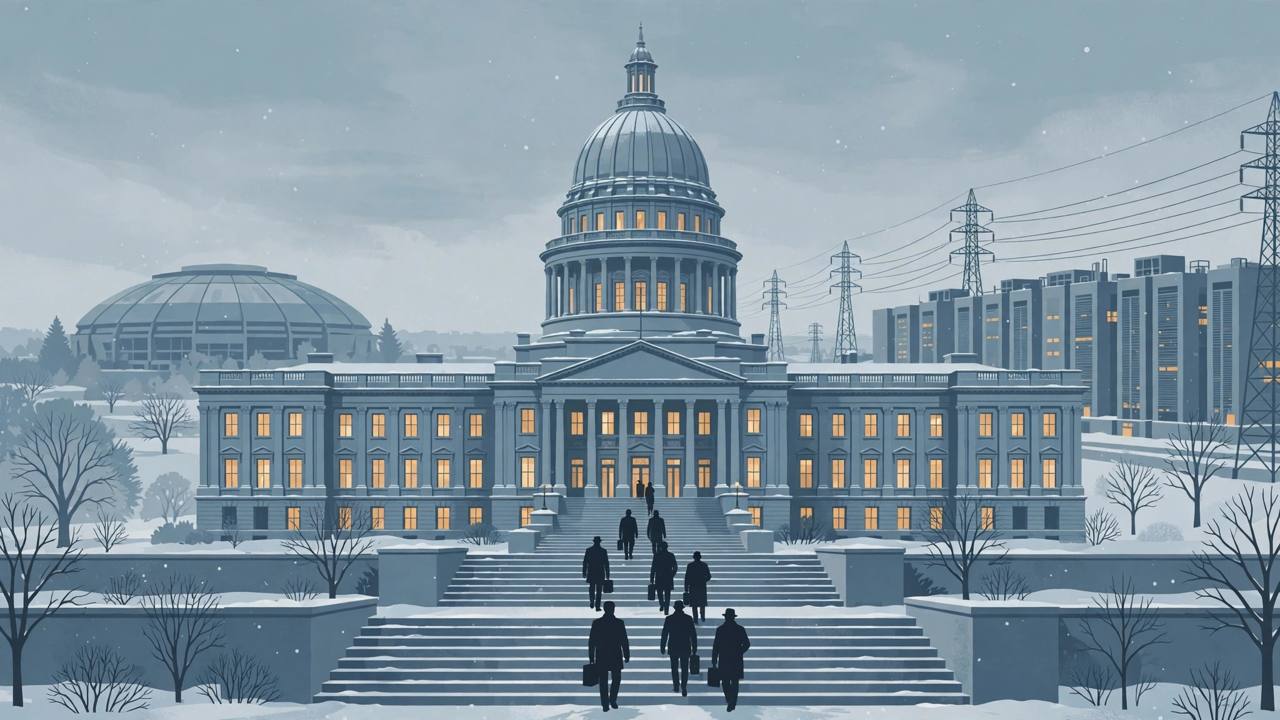
SPRINGFIELD, Ill. — The Illinois General Assembly returned to the Capitol on Tuesday, November 17, for a fall veto session that contains no major vetoes to override — and three of the most expensive unfinished questions in state politics. In six scheduled session days, lawmakers must decide how to try to keep the Chicago Bears from leaving for Indiana, whether to impose first-in-the-state rules on power-hungry data centers, and whether to find an extra $150 million that Chicago Public Schools says it needs to balance its budget.
Source: Chicago Tribune via Chicago Patriot
The Bears question: a stadium authority, not a tax deal
The stadium fight is a five-year saga, and negotiators say the shape of a deal has changed. The discounted payment-in-lieu-of-taxes framework the Bears long sought has largely been dropped, according to the Chicago Sun-Times. The model now being built would let Cook County municipalities with more than 70,000 residents — most notably Chicago and Arlington Heights — create stadium finance authorities. A privately financed stadium that is publicly owned and sits on public land would be exempt from property taxes, letting the two communities compete to host the team.
Source: Chicago Sun-Times
"There has been good progress made on a bill that would create a site-neutral and franchise-neutral approach to settling the stadium question," said state Sen. Bill Cunningham, a Chicago Democrat and the Senate's top stadium negotiator, whose earlier version passed the Senate 37-17 in the final hours of the spring session before stalling in the House. "Getting agreement between all the parties is less important than getting members of the General Assembly comfortable with any kind of approach," Cunningham said. "That's the consensus that has to occur."
Source: Focal News
Illinois is playing catch-up with Indiana. In February, Indiana's Republican-led legislature and Gov. Mike Braun passed and signed a law to help the Bears build in Hammond, just over the state line, and team Chairman George McCaskey and CEO Kevin Warren said the club would focus on a stadium there. Since October, Gov. JB Pritzker and legislative leaders have met Bears leadership, including minority owner Pat Ryan, and NFL Commissioner Roger Goodell. The team says it "appreciates the recent engagement from Illinois leadership" and expects "productive dialogue with both leadership teams in the coming weeks" — but it still has concerns about the state's commitment to fund upwards of $800 million in roads and other public infrastructure around a stadium, money that would be paid out over several budget cycles.
The geography is still wide open. The Bears own the former Arlington International Racecourse site in Arlington Heights, and suburban officials in Palatine and Rolling Meadows are demanding a seat at the table for any Arlington Heights stadium authority, since their towns would neighbour the proposed dome. In Chicago, developers have pitched three sites in recent weeks — the former Michael Reese Hospital site in Bronzeville, the former U.S. Steel South Works site on the Southeast Side, and a plan to replace the White Sox's Rate Field near Bridgeport — plus a revived lakefront dome south of Soldier Field. The Bears are not backing any of the developer proposals. Mayor Brandon Johnson's office has endorsed no specific site, but a spokesperson said the mayor knows "Chicago is and should remain the home of the Bears."
Data centers: the POWER Act and the fight over your power bill
Gov. Pritzker has called data-center rules his top priority for the session. The vehicle is the POWER Act — the Protecting Our Water, Energy and Ratepayers Act — Senate Bill 4016, sponsored by Sen. Ram Villivalam (D-Chicago), with a House companion, HB 5513, led by Rep. Robyn Gabel (D-Evanston). The bill was sent back to the Senate Assignments Committee on May 28 after missing the spring deadline, and a new co-sponsor signed on November 13. Under Pritzker's framework, large facilities would have to supply their own power and water, use closed water systems, disclose how much energy they use, and — in the version described by the governor's allies — pay 100% of their costs before connecting to the grid.
Source: Chicago Tribune via Chicago Patriot
"We have a bill that would curtail the use of any outside electricity, and instead require data centers to bring their own electricity with them — clean energy, and also require them to use closed water systems," Pritzker said earlier this month. "It should be up to local communities, whether or not they want a data center." The governor has frozen state tax incentives for data centers for now, but has not called for a construction moratorium. The stakes are large: state records show $983 million in lifetime tax benefits were already pledged to 27 data centers from 2020 through 2024.
The industry is spending to be heard. Tech companies that rely on data centers have poured at least $590,000 into contributions to Illinois candidates, lawmakers and party organizations this year, including more than $200,000 from Anthropic since mid-October and more than $300,000 from Google, while Meta set aside $750,000 this spring for independent expenditures. Labour unions, which value the construction jobs, have also kept contributing. Cunningham, who also works on energy issues, warned against going too far: "We could overregulate data centers. We could, for instance, pass a bill tomorrow making them illegal, and it wouldn't necessarily solve the problem because they will build in neighboring states and be on the same grid we're on, and use the same water sources we use." Republican Sen. Sue Rezin of Morris argued the debate should deliver property-tax relief from data-center revenue — she pointed to one facility in her district she said provides $30 million in new revenue every year — and guarantee local governments a say.
Chicago schools, a surprise surplus and a $2.4 billion hole
Chicago Public Schools is counting on an extra $150 million to balance a budget of roughly $10 billion. The CPS board passed that budget over the summer in what amounted to a gamble that Springfield Democrats would help; without the money, officials have said the district could face midyear cuts — layoffs, furloughs or a spending freeze. Pritzker has poured cold water on the request, especially without extra funding for other districts: "I am not certain that midyear we'll be able to do something that will meet only one school district's needs." Rep. Edgar Gonzalez, a Chicago Democrat, said the discussion "isn't dead" but is "very difficult because … where are we going to get the money?" Two numbers frame the argument: on Friday the governor's budget office said the state is on track to bring in about $1 billion more in tax revenue this year than expected when the budget was signed in June — money the governor's office wants to set aside against federal reductions to food, health care and disaster aid — while the budget year beginning July 1 is already facing an estimated $2.4 billion deficit.
A speaker's exit hangs over the session
Behind the policy fights, House Democrats must also choose a new leader. Speaker Emanuel "Chris" Welch announced on November 5 that he would not seek a fourth term with the gavel, a day after 26 Democratic House members signed a statement calling for a new speaker. A Chicago Tribune investigation this summer found that three years ago Welch knew of reported sexual harassment of a former staffer by then-Rep. Harry Benton but did not discipline him at the time, and later steered $1.4 million to Benton's re-election campaign; Benton resigned his seat July 3, and a legislative inspector general later found a "pattern and practice" of sexual harassment. Welch, of Hillside, plans to remain a state representative. State Rep. Kam Buckner has publicly entered the race to succeed him, and Reps. Eva-Dina Delgado, Jehan Gordon-Booth, Lisa Hernandez, Ann Williams, Marcus Evans and Jay Hoffman are also being floated. Democrats begin the session with expanded supermajorities from the November 3 election — a 78-40 House edge that could grow by about half a dozen seats once all votes are counted, and a 40-19 Senate edge set to grow by at least five.
What happens next: the House convened at 1 p.m. Tuesday and has already cancelled its Thursday sitting, according to The Illinoize, leaving this week's work to Tuesday and Wednesday before the session resumes December 1-3. Negotiators do not expect a vote on the stadium bill before the second week of the session, and some would not be surprised if it slips to a lame-duck session in January, before the new General Assembly is sworn in. The data-center bill is the one item with a scheduled Senate committee hearing this week. No high-profile Pritzker vetoes are expected to be taken up at all — which is why, in Springfield this week, the name of the session is the least accurate thing about it.