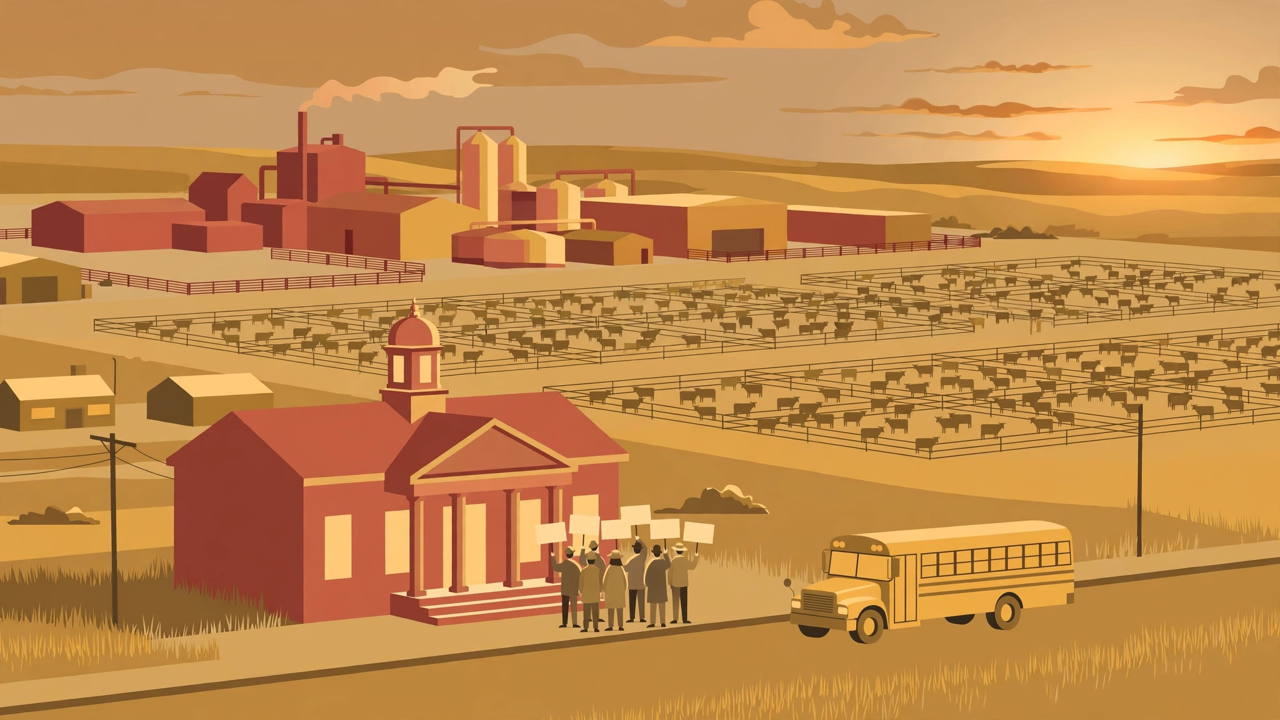
DODGE CITY, Kansas — Residents of southwest Kansas are demanding accountability for the federal immigration raids that swept their meatpacking towns in late September, detained 104 people and, by the count compiled after the November 3 election, helped swing three of the state's most conservative counties sharply toward the Democrat who won Kansas' U.S. Senate seat, Reuters reported on Friday, November 13, in an on-the-ground report from Dodge City, Garden City and Liberal.
Source: Reuters, via DevDiscourse
This is a follow-up report, not a repeat of election night. Awaaz Punjab reported on November 3 that Democrat Adam Hamilton defeated Republican Senator Roger Marshall — 553,023 votes to 491,822 at 93.8 percent reporting — becoming the first Democrat elected to the Senate from Kansas since 1932. What is new in Friday's reporting is the evidence and the voices connecting that result to the raids, the unanswered questions residents put to their own city commission, and the economic damage livestock groups say is still working through beef, dairy and grocery prices.
Source: Reuters, via DevDiscourse
The commission meeting: 'Our community is looking for reassurance'
Early last month, in a starkly lit meeting room, Amy Soberanes, a 25-year-old Mexican American business owner, stood to address the five members of the Dodge City commission, Reuters reported. It had been two weeks since U.S. Immigration and Customs Enforcement (ICE) agents descended on the city, and she and other community organizers peppered the commissioners with questions: What had they known? Why had the area been targeted? How would the city respond if it happened again? "Our community is looking for reassurance and direction," Soberanes told the commissioners. There were few answers that night, Reuters reported — and Soberanes says there still are not enough. "Our community wants people to be held responsible for what happened," she told Reuters.
Source: Reuters, via DevDiscourse
Federal immigration agents swept into this rural corner of Kansas in late September and detained 104 people, according to the local U.S. Attorney, Reuters reported. Representative Sharice Davids' office, in a letter to Homeland Security Secretary Markwayne Mullin, described the same operations — in Dodge City, Garden City and Liberal — as resulting in 104 arrests and sparking widespread panic; Kansas Capital News, summarising the U.S. Attorney for Kansas, identified the operation dates as September 22-24 and named it in Davids' account as the three-day Operation Safe Community. The Hispanic communities of the three towns — dominated by meatpacking plants staffed by a mostly immigrant workforce — were hardest hit.
Source: Rep. Sharice Davids, davids.house.gov
What happened at the plants on September 22
Carlos Rivera was working at the National Beef packing plant on September 22 when he heard from truck drivers that ICE agents had been spotted around town, he told Reuters. During the next shift change, some departing employees were detained by agents waiting on the street outside the plant, Rivera said. As news spread, others fled back inside, and many spent hours in the cafeteria until the agents left. Company switchboards were tied up over the following days with workers calling out, Rivera said, and regional cattle and livestock groups reported workforce disruptions at feedyards, dairies and meat processors, resulting in millions of dollars lost.
Source: Reuters, via DevDiscourse
City Commissioner Rick Sowers told Reuters he was on an early-morning walk when he noticed flashing lights on multiple vehicles outside a neighbour's house and masked agents banging on the doors. "I just don't perceive that as an appropriate measure for a document case," Sowers told Reuters, referring to immigration documents. The lack of communication from the federal government had put him in a difficult position, he told people at the October 5 commission meeting.
Source: Reuters, via DevDiscourse
Officials say they were kept in the dark; DHS says cooperative agencies were advised
DHS said in its statement to Reuters that ICE "advised cooperative local agencies" ahead of its operation in southwest Kansas, but did not specify which agencies. Nick Hernandez, the first Hispanic city manager of Dodge City, told the commission meeting that city officials learned about the operation from social media. They began calling state and federal legislators for information, he said; forty-eight hours later, Republican U.S. Senators Jerry Moran and Roger Marshall of Kansas passed along information from DHS that the agents were leaving. "Never during the operation did we find out who was actually in charge," Hernandez told the meeting, according to Reuters.
Source: Reuters, via DevDiscourse
Even Marshall, long a supporter of President Donald Trump's immigration policies, blasted the raids, saying in a statement that police "were not given advance notice or the level of cooperation we would expect," causing "mass disruptions to local communities and businesses," Reuters reported. Hamilton, his opponent, called the raids a "disaster" and said Kansans were "fed up" with Marshall being a "mouthpiece for the president." In his victory speech, Hamilton recalled a woman in Dodge City who told him some parents were too afraid to pick their children up from elementary school. "This was not OK," he said. Hamilton will be the first Democratic senator to represent Kansas since 1932 when he takes office in January.
Source: Reuters, via DevDiscourse
The election swing, in full
On November 3, Kansas elected a Democrat to the U.S. Senate for the first time in nearly a century when Hamilton ousted Marshall. The three counties most affected by the ICE raids swung toward Hamilton by more than 20 points on average from President Trump's 2024 vote share, results compiled by Reuters and USA Today showed. Reuters described the shift as a striking backlash to Trump's immigration crackdown in one of the country's most conservative states. Trump, after his party's midterm losses, has sent mixed signals, Reuters reported: he told "60 Minutes" his deportation campaign may have been "too tough," and then promoted Stephen Miller, architect of his immigration strategy, to be his next chief of staff. Lauren Bis, a White House spokesperson, said in a statement that Trump's "commonsense immigration agenda has delivered the most secure border in history." Asked for comment, DHS told Reuters: "We will continue to enforce our nation's laws and remove illegal aliens from American communities."
Source: Reuters, via DevDiscourse
A family deported, a community that organised
Karla Flores and her husband Alfredo Arrieta went shopping at Walmart on the day the operation started, planning to hunker down at home, she told Reuters. Arrieta crossed into the U.S. illegally in 2022 and found work as a mechanic in Dodge City; Flores overstayed a tourist visa and worked as a cleaner. They were pulled over by immigration agents shortly after leaving the store. Before being handcuffed, Flores called her brother, who arranged to have their three children picked up from school and taken to a relative's house. A week later, when their middle son turned 15, people banded together to throw him a party. "We were really impressed by the amount of support from the community," Flores said. She and her husband were deported to Mexico after five weeks in ICE custody, and spoke to Reuters by phone. Their two youngest children have joined them; their eldest, aged 17, is living with Flores' brother. "They're still dealing with the aftermath," Arrieta said of his children. In its statement, DHS said "parents have a choice if they want to be removed with their children or ICE will place the children with a safe person the parent designates."
Source: Reuters, via DevDiscourse
In the weeks after the raids, New Frontiers, a local nonprofit, delivered hundreds of meals to affected families — and helped register residents to vote, Reuters reported. "We thought we were untouchable" because of the area's meatpacking plants and their dependence on immigrant workers, Soberanes said, adding she had never seen people so politically energised.
Source: Reuters, via DevDiscourse
Background: the Golden Triangle of Beef
Dodge City gained national prominence in the 1800s as a stop for pioneers heading to the American West, Reuters reported. Cattle feedlots eventually sprouted on the open plains, and in the 1980s meatpacking companies began building massive plants — first employing Vietnamese and Laotian refugees and, later, migrants from Mexico and Central America. Dodge City is now 67 percent Hispanic, according to the U.S. Census. The region's nickname in the industry is the Golden Triangle of Beef, and Davids' letter put its weight plainly: southwest Kansas is responsible for more than 20 percent of the nation's daily cattle slaughter.
Source: Reuters, via DevDiscourse
The economic bill: slaughter down, prices up
Davids, the 3rd District Democrat, wrote to Secretary Mullin that she had "grave concerns" about ICE's work in the three towns, expressed support for enforcement of federal immigration law, and argued it was unnecessary for ICE to paralyse the local agricultural economy, Kansas Capital News reported on October 15. Her office's release, citing U.S. Department of Agriculture reports, said the operations severely disrupted meatpacking plants, causing a nearly 16 percent single-day drop in fed-cattle slaughter and an overall 8.5 percent week-to-week decline. Local businesses were forced to temporarily close, and union representatives and economists warned halting plant operations would drive beef prices beyond ground beef's already elevated $7.16-per-pound average; her letter also noted ground beef prices up 7.9 percent year-to-year and the smallest cattle herd in decades. The Kansas dairy industry, her office said, accounts for more than $3 billion in economic impact and 11,000 jobs statewide.
Source: Rep. Sharice Davids, davids.house.gov
The Kansas Livestock Association concluded ICE had a "chilling effect on the legal, documented, skilled workers that put beef on the table and keep the cattle supply chain moving," Davids wrote. Its CEO, Matt Teagarden, who also chairs the American Business Immigration Coalition's Ag Council, returned to the warning after the election in a video published November 9: ICE agents arrested 104 people during September operations in southwest Kansas, including on roads leading to feedyards and dairies, he said. "This sent a shockwave across our industry that disrupted beef processing," Teagarden said. "When processing is disrupted, cattle prices go down, and beef prices go up." He added: "These workers are not just workers. They're valued members of our communities across rural parts of our state and across the nation. Their kids go to school with our kids. We go to church together."
Source: Texas Border Business — Teagarden / ABIC video, Nov 9
Davids' account, via Kansas Capital News, said the U.S. Attorney for Kansas identified five individuals taken into custody September 22-24 who had been convicted of crimes in other countries, lacked credentials to legally be in the United States and ought to be deported. A Wichita Eagle investigation found that four of those five individuals had been deported months before the raid, and the fifth was already in federal prison at the time of the raid, Kansas Capital News reported. That finding is the Eagle's, as reported by KCN; DHS has not, in the sources read for this report, answered it directly.
Why this matters beyond Kansas — including for truckers and diaspora readers
Southwest Kansas sits on the freight and food chain, not beside it: the first warning inside the National Beef plant on September 22 came from truck drivers who had spotted agents around town, according to Rivera's account to Reuters, and the disruptions livestock groups reported ran through feedyards, dairies and processors — the workplaces that load and receive the region's refrigerated and livestock freight. For Punjabi and other South Asian readers in the United States, including the many who drive trucks, work in food processing and logistics, or have family working on temporary or contested status, the Kansas argument now running in Congress is the practical one Davids put to DHS: enforcement that coordinates with local law enforcement and respects legal, documented workers, versus operations that local officials say they first learned about from social media.
What happens next
No new court date, hearing or federal answer to the Dodge City commission's questions was announced in the sources read for this report. What is scheduled is political: Hamilton takes office in January as Kansas' first Democratic senator since 1932, Davids has asked Secretary Mullin to commit to enforcement that coordinates with local agencies, and DHS has told Reuters it will continue to enforce the nation's laws. In Dodge City itself, Soberanes and the organisers who filled the commission room say the demand has not changed since October 5: reassurance, direction, and someone held responsible for what happened in September.