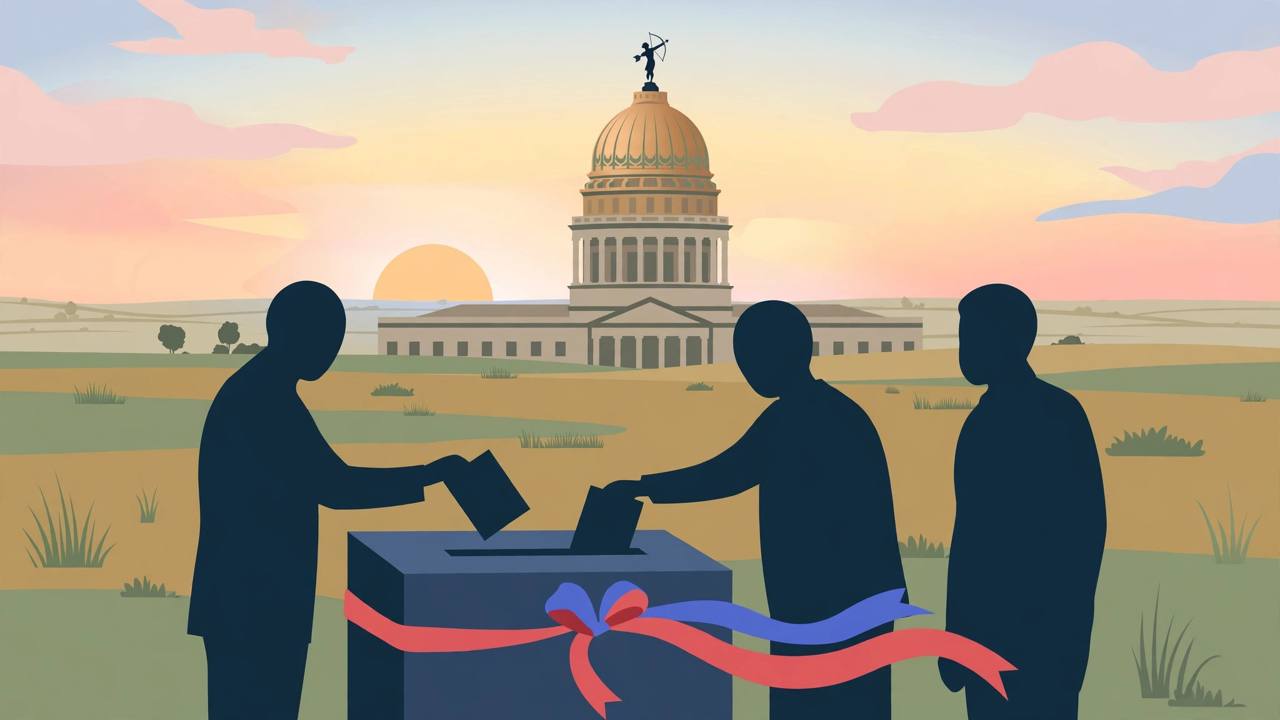
TOPEKA, Kansas — Democrat Cindy Holscher has been elected Kansas' next governor, the Associated Press reported on Thursday, November 12, calling a race that stayed undecided for nine days after the November 3 midterm elections and defeating Republican Ty Masterson, the president of the state Senate who carried President Donald Trump's endorsement.
Source: Associated Press via KVCR/KCUR, Nov 12, 2026
The call ends the deadlock this desk reported on election night, when neither candidate could be separated. Holscher, a 57-year-old state senator from Overland Park, declared victory the morning after the election, and her lead grew from about 5,500 votes on November 4 to more than 7,000 votes as all 105 Kansas counties reported updated unofficial results, including advance mail ballots postmarked by Election Day.
Updated Associated Press tallies during the count showed Holscher at 549,974 votes (50.3%) to Masterson's 542,929 (49.7%), with later totals widening the gap to roughly 7,600 votes. Kansas election coverage on Thursday reported that Masterson conceded the same day the race was called, after earlier saying the first count was not going his way but that he would let the audit process finish.
Source: Political.org, Nov 12, 2026 (Decision Desk HQ projection and AP tallies)
Why Kansas mattered nationally
Of the 36 elections for governor held across the country this year, Kansas was seen as the most likely to flip from Democratic to Republican control. Outgoing Governor Laura Kelly, a Democrat, was term-limited after eight years, and President Trump carried Kansas by roughly 16 points in 2024. Decision Desk HQ had rated the race as leaning toward Masterson, while the Cook Political Report moved it to a toss-up on October 27. The Associated Press noted that Democrats had already secured a majority of the nation's governorships for the first time in two decades even before the Kansas call.
The audit and what remains
Because the margin sits within 1 percentage point of the total votes cast, Kansas law requires a close-race audit, reviewing ballots in 10% of precincts in each county. County officials are expected to complete their canvasses by November 16, with statewide certification to follow. A full recount remains a theoretical option, but the state only covers recount costs in general elections when the margin is within 0.5 percentage points — a line Holscher's lead passed the day after the election. Governor Kelly has already called Holscher “Governor-elect,” and Holscher announced on November 10 that she had met Kelly and her team to begin transition work.
Two very different campaigns
Holscher, a legislator since 2017, ran on a populist pitch: fighting “sweetheart deals” for billionaires, opposing school vouchers in favour of more support for public schools, a moratorium on new data centres, and legalising cannabis to raise state revenue. She tied Masterson to the state Senate's role in a tax cut passed under former Republican Governor Sam Brownback that led to a series of budget crises and was later repealed. Masterson, 57, campaigned on lower property taxes, backed school vouchers, promised to be the “most pro-ag, pro-business, pro-oil and gas governor” the state has seen, and called Holscher the “most radical, liberal, socialist” Democrat ever on a Kansas ticket. “He likes to throw around a whole lot of labels,” Holscher responded. “You know why? Because that's all he's got.”
Kansas usually votes Republican for president and Congress, yet it has repeatedly split its ticket for governor. Holscher's win gives Democrats a third consecutive term in the governor's office — the first time a Democrat has been elected to succeed another Democratic governor in the state, according to Kansas coverage of the call — and keeps a Democratic veto in place over the Republican-led Legislature on taxes, education funding and Medicaid.
For Punjabi and other immigrant families in Kansas — including the trucking and meatpacking communities around Dodge City, Garden City and Liberal — a Democratic governor means the state's recent posture on immigration cooperation, school funding and data-centre development stays in place for another four years, with Holscher rather than a Trump-endorsed Republican setting the agenda in Topeka.
What happens next
County canvasses close by November 16, the close-race audit must be completed and certified, and Holscher is scheduled to take office on January 11, 2027, succeeding Kelly. Masterson remains the Kansas Senate's top Republican leader. The remaining questions are whether any recount is requested at the requesting party's own expense, and how the new governor's promised data-centre moratorium and cannabis plan fare in a legislature her party does not control.