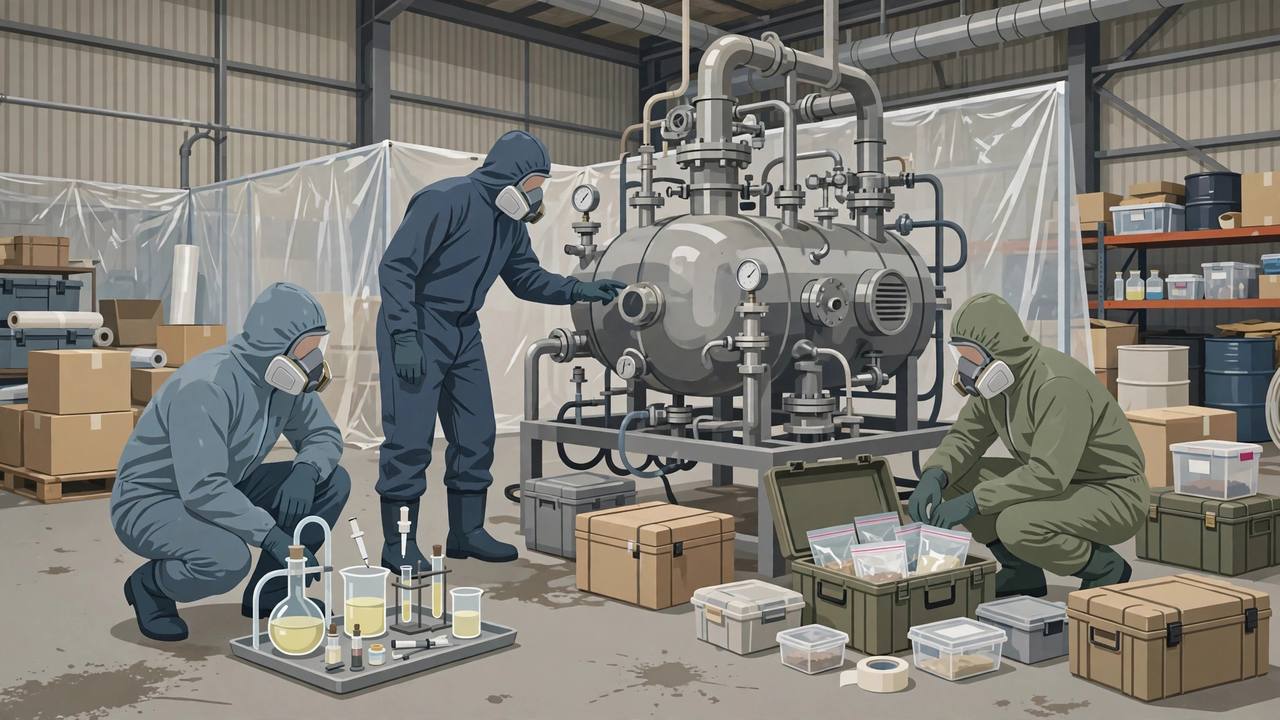
A Baton Rouge man has been arrested after investigators say they uncovered a large-scale, professional-grade fentanyl synthesis laboratory in East Baton Rouge Parish — a lab the U.S. Drug Enforcement Administration says is the largest domestic fentanyl synthesizing lab discovered to date in its New Orleans Field Division.
Source: Louisiana First News
Torrey Lewis Jr., 34, was arrested and booked into the East Baton Rouge Parish Prison, according to the East Baton Rouge Parish Sheriff's Office. He is accused of operating the clandestine lab. The charges against him are allegations, and the case will now move through the courts.
The sheriff's office said deputies conducted a three-month investigation into Lewis. The investigation stemmed from a fentanyl seizure by the Louisiana State Police, who later suspected Lewis as a supplier, according to the sheriff's office.
During the investigation, sheriff's agents conducted surveillance and operations in which Lewis reportedly distributed suspected fentanyl to multiple locations in the New Orleans area. Agents identified three properties in Baton Rouge as being associated with the alleged drug operation.
Search warrants were issued for a home on Cottage Hill Drive, a home on Mammoth Avenue and an apartment unit at a complex on Bluebonnet Boulevard, the sheriff's office said. It was during those searches that agents discovered the lab.
Professional-grade equipment, rifles and cash seized
According to the sheriff's office, the lab contained a complete 100-litre reactor system, high- and low-temperature liquid circulation equipment, an industrial evaporator and specialized lab equipment. The lab's estimated value is around $250,000.
Agents also seized 22.5 grams of fentanyl, 3 grams of cocaine, two hydraulic presses with fentanyl residue, a lab-grade pill-mixing machine with fentanyl residue, a digital scale with fentanyl residue, cutting agents and packing materials, two rifles and $8,531 in cash, the sheriff's office said.
DEA agents performed tests on the contents of the vessel and confirmed it to be fentanyl. They added that if the 58 litres discovered were successfully synthesized, that could produce 127 pounds of fentanyl powder, or nearly 569,000 fatal doses.
East Baton Rouge Sheriff Sid Gautreaux said: 'Fentanyl has devastated far too many families, and the individuals responsible for manufacturing and distributing it have no regard for the lives they destroy. We will continue to pursue these operations aggressively, working across jurisdictional boundaries to protect the people we serve. This case sends a clear message: Those who choose to manufacture and traffic these deadly drugs will be held accountable.'
DEA New Orleans Field Division Special Agent in Charge John P. Scott said: 'Shutting down a clandestine fentanyl laboratory of this scale removes a severe threat from our communities. Fentanyl is driving unprecedented devastation across our region, and dismantling this operation disrupts a dangerous supply chain before more lives are lost.'
Why the DEA's 'largest in the division' label matters
The DEA's New Orleans Field Division covers Louisiana, Alabama, Arkansas and Mississippi. The agency says this is the largest domestic fentanyl synthesizing lab discovered to date within that four-state division — a measure of how far fentanyl production has moved inside the United States, from finished drugs crossing borders to synthesis operations set up in American neighbourhoods.
For Baton Rouge residents, the case is also a local one: the three searched properties were ordinary homes and an apartment in the city, and investigators allege distribution reached from Baton Rouge to multiple locations in the New Orleans area, about 80 miles away.
Lewis was booked on charges of operating a fentanyl clandestine lab, possession with intent to distribute Schedule II drugs, possession of drug paraphernalia, illegal carrying of a firearm with drugs, and money laundering, according to the sheriff's office.
What happens next: Lewis remains accused, not convicted, and is presumed innocent unless proven guilty in court. The reports reviewed did not announce a first court date. The sheriff's office and the DEA say cross-jurisdiction work against fentanyl manufacturing and trafficking operations will continue.