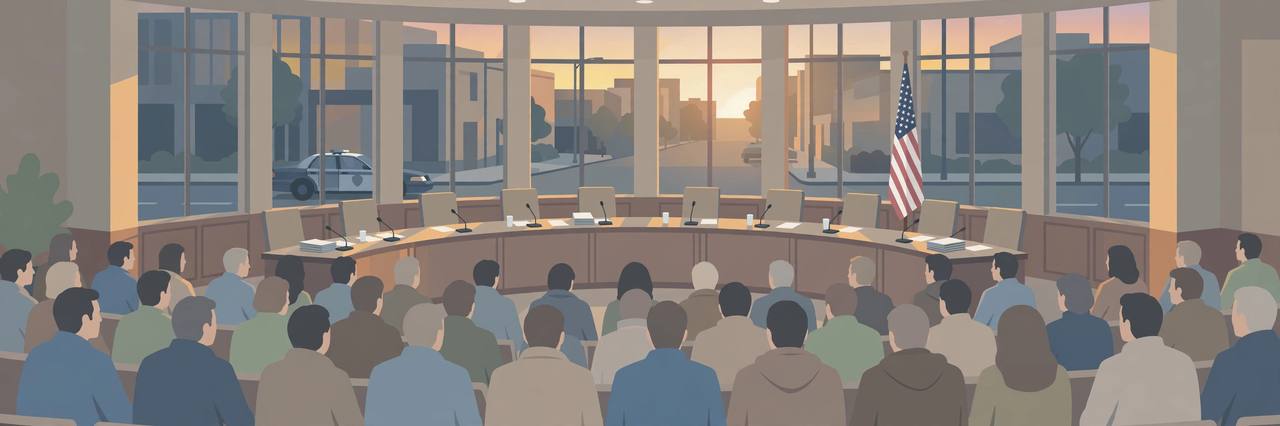
The Kalamazoo City Commission voted on Monday night, November 23, to keep a $490,000 federal grant for police patrol vehicles — but only with safeguards and a formal letter telling the U.S. Department of Justice that the city does not intend to honour the grant's immigration-enforcement conditions. The decision came after more than three hours of public comment from over 100 residents, almost all of them urging the city to give the money back.
The commission first voted 5–2 on November 16 to accept the award, from the Justice Department's Bureau of Justice Assistance under its fiscal year 2026 Byrne Discretionary Community Project Grants programme. Two commissioners then asked for the decision to be reconsidered, and a special meeting was called. At that meeting, a motion by Commissioners Jae Slaby and Vice Mayor Drew Duncan to rescind the grant and take it back failed 3–4. A second motion — to accept the grant with administrative safeguards and a reservation-of-rights letter — passed 4–3.
The money is meant to replace ageing, high-mileage patrol vehicles for the Kalamazoo Department of Public Safety and pay for outfitting, including emergency lighting, communications, mobile data and safety equipment. The award was made on September 30, 2026, and covers October 1, 2026, through September 30, 2027. The department handled more than 122,000 police-related calls and more than 14,000 fire and emergency medical calls in 2025.
The two conditions at the centre of the fight
Two of the grant's 52 conditions address immigration enforcement. Condition 51 bars using grant funds to stop government agencies or officials from sharing citizenship or immigration-status information with the Department of Homeland Security. Condition 52 bars using grant funds to disclose federal law-enforcement-sensitive information in order to conceal or shield people from federal detection. Each condition says it applies only to the extent it does not conflict with federal law or a court ruling.
Those conditions are being challenged in federal court by a coalition of states including Michigan. Attorney General Dana Nessel joined an amended lawsuit over immigration-enforcement conditions on public safety grants in August. City Attorney Aaron Leal told commissioners that Chief U.S. District Judge John McConnell Jr. of Rhode Island ruled in the states' favour from the bench at a November 4 hearing, but the written order has not yet been issued and could take a few weeks. Federal court rulings in New Jersey have also struck down the stipulations, according to the city's account.
City Manager Malcolm Hankins told the commission the city will withhold all spending from the grant for now, and bring the matter back if the court outcome goes against the city. Until the federal budget for the project is cleared, the city can draw down no more than 10 percent of the award — $49,000 — and vehicle purchases must follow federal clearance and the city's purchasing rules. Leal said nothing prevents the city from returning the money, though he could not say how that might affect future federal funding.
A divided room
More than 100 residents spoke during the meeting, some from outside the city, and all but two urged the commission to reject the grant. Speakers raised fears of deportations and of local police being drawn into immigration enforcement. Commissioners Chris Praedel and Jeanne Hess were repeatedly interrupted by protesters while arguing for the amended proposal, and Mayor Dave Anderson repeatedly warned the crowd to stay quiet or face removal. As the local station WKZO put it, everyone in the room agreed on two things — that the immigration-enforcement conditions were bad news and that the risk to residents should be minimised — and sharply disagreed on how to do it.
The fight is not new. In April, the same commission effectively turned down a $1.25 million grant through the Justice Department's Community Oriented Policing Services hiring programme — money for 10 additional public safety officers, with the city contributing another $270,000 — after removing it from the March 2 and April 6 agendas over the same immigration conditions. With the November 24 acceptance deadline for the smaller grant, Monday's special meeting was the commission's last chance to change course.
The conditions Kalamazoo is fighting were already blocked by a federal judge earlier this month in a case brought by New Jersey and 22 other states. Read the earlier ruling
What happens next
Tuesday, November 24, is the deadline to accept the award. The city now waits to see whether the Justice Department appeals the rulings striking down the conditions, and for Judge McConnell's written order. If the rulings hold, the city can spend the $490,000 on patrol vehicles under the safeguards it adopted. If they are stayed, narrowed or reversed, the commission has said it will revisit the decision — and, if needed, give the money back.
For immigrant families in Kalamazoo and across Michigan, the question is whether local police will share immigration-status information with federal agents. The commission's answer for now is to take the money for police cars while betting the courts will strike the conditions before a dollar is spent — and to keep the spending frozen until the courts speak.