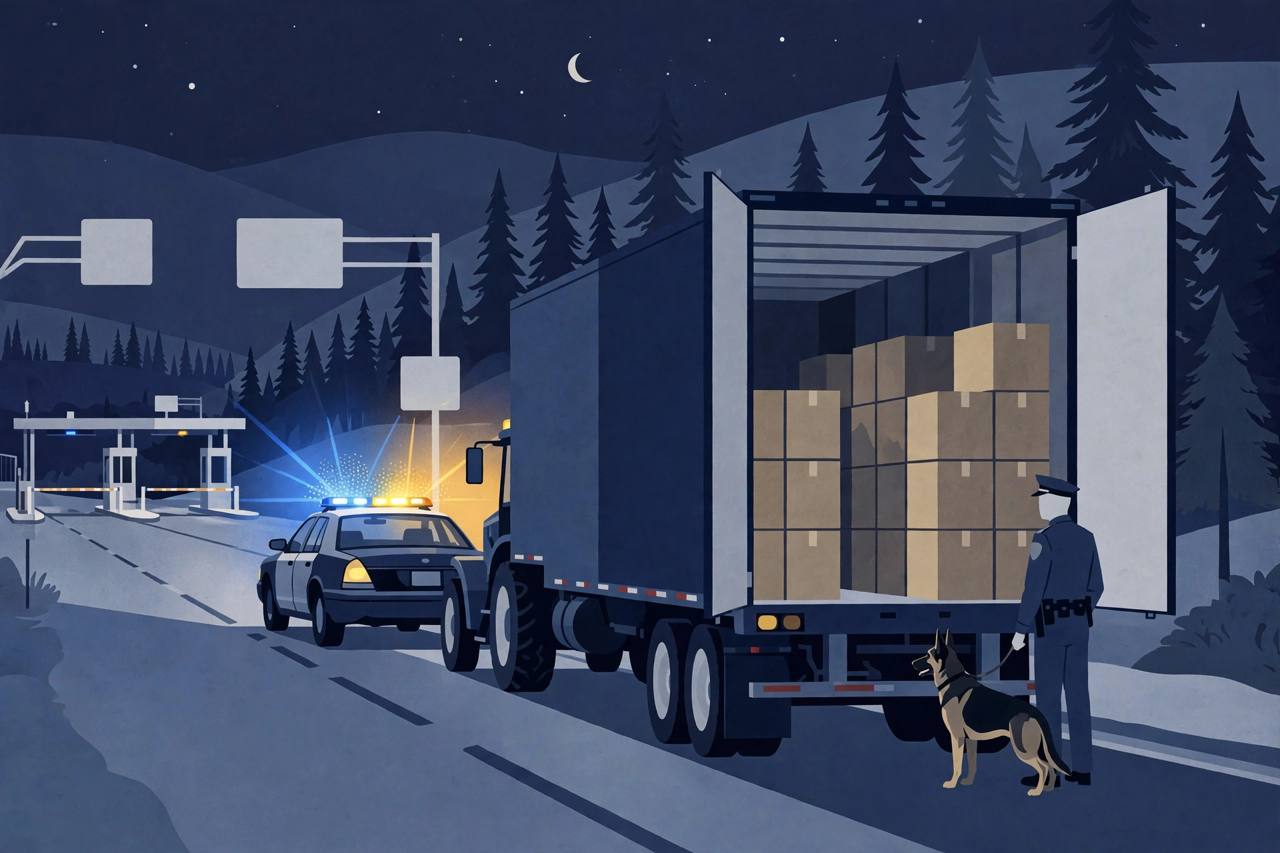
A Canada-bound tractor-trailer carrying a load listed as cardboard cartons was carrying something else entirely, according to a federal criminal complaint: about 93 kilograms of suspected cocaine, found after a Michigan State Police trooper stopped the truck in Kimball Township, near Port Huron, in the early hours of October 31.
Source: Commercial Carrier Journal
The driver, Kawal Preet Singh, was stopped at approximately 12:20 a.m. for traffic violations, court documents state. The manifest he presented said the trailer was hauling “non-corrugated folding cartons” from Laredo, Texas, to Belleville, Ontario, Canada. The tractor-trailer was Ontario-registered, according to trucking-industry reporting on the complaint.
A Homeland Security Investigations (HSI) officer arrived with a K9 to assist with the stop and conducted an open-air sniff of the trailer. The dog alerted around the rear trailer doors, and inside, officers found bags holding numerous bricks of a white powdery substance wrapped in cellophane and vacuum-sealed plastic, according to the complaint. Field testing of the substance tested positive for the presence of cocaine, and the total weight of the suspected cocaine was approximately 93 kilograms — about 205 pounds.
Source: Overdrive
The trailer seal that changed colour
Singh was taken to the St. Clair County Sheriff's Office, where, according to the complaint, he told investigators he had picked up the pre-loaded trailer in Laredo and that it was locked with a white seal. He said he stopped at a truck stop in Ina, Illinois, and still observed the white trailer seal, and later made two stops at travel centres in Battle Creek, Michigan, but did not conduct a walk-around inspection before leaving.
Only after he was pulled over, Singh said, did he realise there was a different, yellow seal on his trailer. Investigators, however, had timeline evidence of their own: licence plate readers along the route showed the trailer with a white seal in Campbell, Texas, on October 29, and without a white seal on October 30 in West Terre Haute, Indiana, and an image from Battle Creek showed a yellow seal on the trailer. “Singh was unable to explain these discrepancies between his statement and the photographic images of the seals,” the criminal complaint added, according to Commercial Carrier Journal's reading of the court documents.
The charge — and what happens next
Singh has been charged with knowingly and unlawfully possessing with intent to distribute more than 5 kilograms of a mixture or substance containing a detectable amount of cocaine, a Schedule II controlled substance. The criminal complaint was filed on November 2 in the U.S. District Court for the Eastern District of Michigan. Under federal law, a charge at the 5-kilogram level carries a mandatory minimum sentence of 10 years in prison if a defendant is convicted — but this case is at the complaint stage, the first step in a federal prosecution, and no conviction has been recorded.
Source: On The Road Trucking
The charge against Kawal Preet Singh is an allegation set out in a criminal complaint. It has not been proven in court, and he is presumed innocent unless and until he is proven guilty.
Why this border lane matters to truckers
The route in the manifest crosses two of the busiest commercial frontiers in North American trucking. Laredo, Texas, is the top truck gateway on the U.S.–Mexico border, and Port Huron, minutes from where the stop happened, is the Michigan end of the Blue Water Bridge into Sarnia, Ontario — one of the heaviest truck crossings between the United States and Canada. Kimball Township sits in St. Clair County, on the approach roads to that crossing, and loads moving from Laredo to Belleville, Ontario, pass through exactly this corridor.
For the Punjabi and South Asian trucking families who make up a large share of Ontario's and the border states' driving workforce, cases like this one land close to home: a pre-loaded, sealed trailer is the everyday reality of cross-border freight, and the seal is the driver's main proof that a load was not touched after pickup. Investigators in this case treated the change from a white seal to a yellow seal — and the gap in the photographic record — as the central question the driver could not answer. Nothing in the reporting alleges that any carrier, dispatcher or second person has been charged, and no other arrest has been reported in connection with the load.
What happens next runs through the federal court in the Eastern District of Michigan, where the complaint has been filed: the case will move through the early federal stages on the complaint, and prosecutors must present the charge through the grand-jury process if it is to proceed as a felony prosecution. The reports do not name a next court date. The agencies named in the reporting are the Michigan State Police, which made the stop, and Homeland Security Investigations, whose officer and K9 searched the trailer.