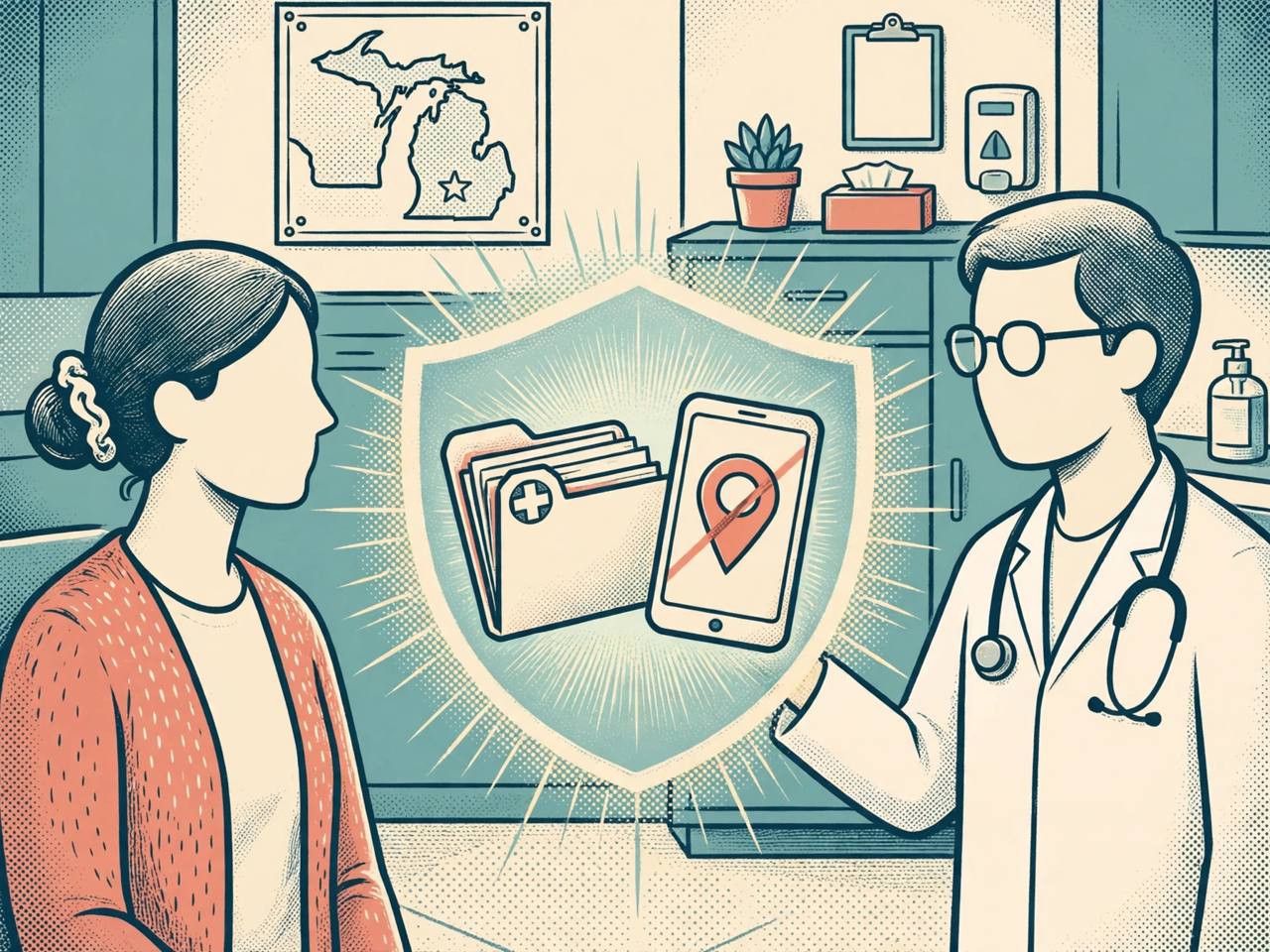
LANSING, Michigan — Governor Gretchen Whitmer on Thursday signed Executive Directive 2026-4, ordering every executive department and agency in Michigan state government to review how it collects, keeps and stores reproductive health care data — and to put that data under maximum protection, including restrictions on sharing geolocation information and other data with commercial organizations and federal agencies.
Source: Office of Governor Gretchen Whitmer, State of Michigan
"Over the last eight years, I've fought like hell to protect Michiganders' reproductive freedom," Whitmer said. "This executive directive is another important step in keeping our patients and providers safe. Data misuse is a growing threat, and we must make sure that reproductive care data never lands in the hands of people who could weaponize it. I'm proud to sign this executive directive to secure Michiganders' reproductive health data and strengthen patients' confidence as they seek reproductive care."
What the directive covers
The order is deliberately broad about what counts as reproductive care. The governor's office said it includes, but is not limited to, prenatal care, childbirth, postpartum care, contraception, sterilization, abortion care, miscarriage management and infertility care. That means the review reaches far beyond abortion records: the data generated by a pregnancy check-up, a fertility clinic visit or a pharmacy contraception prescription all fall inside the review the directive orders.
The directive builds on a step Whitmer took in 2022, when she called on big-tech companies to protect health and location data. The concern behind both moves is the trail modern care leaves behind — appointment records in state systems, location data from phones, and information held by insurers and apps — and who can obtain it, buy it or demand it.
Background: from Dobbs to Proposal 3 to a data fight
BACKGROUND: When the U.S. Supreme Court's 2022 Dobbs decision overturned Roe v. Wade, abortion law returned to the states — and data became a front line, because patients cross state lines for care that is legal in one state and criminalized in another. Michigan voters answered in November 2022 by approving Proposal 3, which wrote reproductive freedom into the state constitution by 56.7% to 43.3%. Whitmer's administration then repealed Michigan's 1931 abortion ban and signed the Reproductive Health Act, which removed statutes her office describes as politically motivated and medically unnecessary.
The data-privacy piece has been moving on a second track. Michigan lawmakers have considered a Reproductive Health Data Privacy Act — Senate Bill 1082, sponsored by Senator Mallory McMorrow — that would bar collecting or processing a person's reproductive health data without informed consent and would restrict geofencing around care facilities, as Michigan Advance reporting summarised by Route Fifty and the Senate Fiscal Agency's bill analysis describe. A separate push, backed publicly by Whitmer, would strengthen protections in law rather than by directive. Separate research has shown why the issue is live: a 2021 International Digital Accountability Council study of 152 period-tracking apps found some were sharing unencrypted personal information with third parties without fully disclosing it.
Source: Route Fifty / Michigan Advance
The record the governor's office is standing on
Thursday's release listed the administration's earlier actions: signing a law prohibiting employers from discriminating against women because they have had an abortion; signing bills decriminalizing surrogacy and protecting IVF; filing a proactive lawsuit and petitioning the Michigan Supreme Court to protect abortion access; winning a restraining order and then a preliminary injunction to prevent nurses and doctors from being prosecuted for providing reproductive health care; enabling pharmacists to prescribe hormonal birth control; signing an executive order refusing to extradite women and abortion providers who come to Michigan seeking care; new protocols so EMS responders can carry emergency contraception; and expanding the Plan First family-planning program and the RxKids initiative to more than 50 communities from Detroit to the Upper Peninsula.
Why it matters in Michigan — and what happens next
Michigan is one of the states patients travel to for care that neighbouring states restrict, and it is also home to a large Punjabi and South Asian community in metro Detroit whose members use the same clinics, pharmacies and health apps as everyone else. Health-data rules decide whether a visit stays between a patient and a provider, or whether the record of it can be sold, shared or demanded by an agency in another jurisdiction. The directive speaks only to data the state itself holds and handles — it does not by itself regulate private apps — which is why the parallel legislation in Lansing still matters.
WHAT HAPPENS NEXT: Departments and agencies must now carry out the comprehensive review the directive orders and tighten their policies to the maximum protection standard it sets. Because this protection rests on an executive directive rather than a statute, its durability is a live question: Michigan voters elected a new governor in this week's midterm elections, and a successor taking office in January 2027 could keep, change or revoke executive actions of this kind — making the fate of the proposed Reproductive Health Data Privacy Act in the legislature the longer-term guarantee to watch.