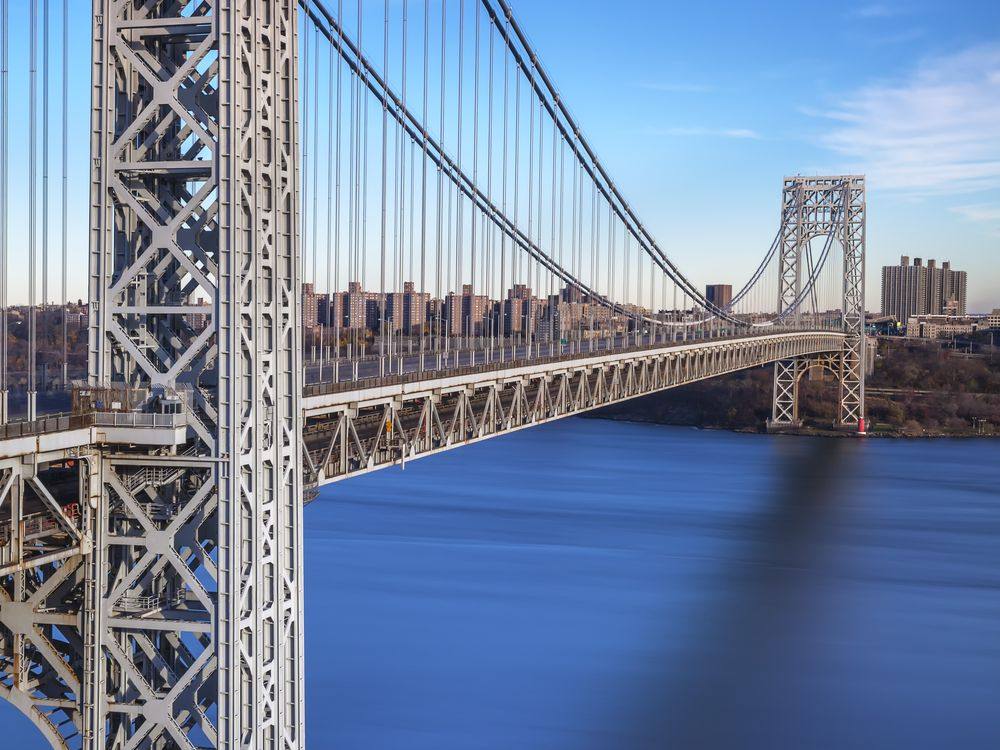
A Manhattan judge on Monday revoked the $1 million bail of retired New York City police detective Victor Romero and ordered him held without bail, sending the 62-year-old to jail as he awaits trial on a second-degree murder charge in the road-rage shooting of Con Edison worker Koran Irvine on the George Washington Bridge.
A Manhattan grand jury indicted Romero on second-degree murder on October 27, upgrading the case from manslaughter. Read that report here. Read the earlier report
What happened in court on Monday
Romero pleaded not guilty before Manhattan Supreme Court Justice Kathryn S. Paek at his arraignment on Monday, November 23. Prosecutors asked the judge to revoke his bail and hold him in custody, arguing that new evidence in the case pointed to an attempted cover-up — and the judge agreed, ordering Romero remanded to Rikers Island.
Manhattan Assistant District Attorney Matthew Sears told the court that prosecutors now have more evidence than when Romero was first charged, including surveillance video and forensic findings. He asked for Romero to be held without bail, calling him a flight risk. Romero's lawyers opposed the request, telling the judge that the 62-year-old is diabetic and needs daily glucose monitoring.
The new evidence prosecutors showed the judge
According to prosecutors, a 15-second surveillance clip shows Romero and Irvine driving side by side on the bridge approach before Romero pulled into Irvine's blind spot and fired into his car. Sears also said video recorded on the morning after the shooting shows Romero wiping down the driver's side of his car and the driver's seat area — while not cleaning the rest of the vehicle. When police approached him later that day and asked about the car, he told them he “didn't get into an accident,” prosecutors said in a court filing.
Prosecutors also said a semiautomatic pistol found in Romero's home matched the bullet recovered from Irvine's body and a shell casing discovered in Romero's own car. The Associated Press reported that a message seeking comment was sent to Romero's attorney.
The shooting on the bridge
The killing happened on the evening of October 20, 2026, as Irvine, 46, drove home from work in his Volkswagen Golf near the Manhattan approach to the George Washington Bridge. Prosecutors say Romero and Irvine got into a near-collision during a merging dispute on an on-ramp, and that Romero then tailed Irvine's car, pulled up alongside it in Irvine's blind spot and fired a single shot through the back passenger window as both motorists headed toward New Jersey.
Irvine was shot in the torso. The bullet pierced his heart and both lungs, and he died at the scene. Romero drove off, authorities said. He was arrested the next day.
From manslaughter to murder
Prosecutors initially charged Romero with the lesser offence of manslaughter, and he was released on $1 million bail on October 23. But a grand jury then indicted him on a second-degree murder charge at prosecutors' suggestion — a step up that the victim's family had publicly demanded. Monday's arraignment was on that murder indictment, and with the bail revocation Romero will now wait for trial in custody rather than at home.
Who the two men were
Romero spent six years with the New York Police Department before retiring in 2001. He had been wounded years earlier in an off-duty shootout with men attempting to rob his family's laundromat. At the time of the shooting he was working as a security guard and driver for the hedge fund QVT Financial, according to court records and news reports.
Irvine, a father of two from Valley Cottage in Rockland County, worked as an electrical utility employee for Con Edison. He was on his way home from work when he was killed. Dozens of his relatives, friends and fellow Con Edison union co-workers packed the courtroom on Monday, and as many as 100 supporters gathered outside, cheering when the judge ordered Romero held without bail.
Family reaction: “It's not going to bring him back”
Irvine's family had publicly pushed for a murder charge, and his relatives and their lawyer said Monday's arraignment was a step toward justice. “But it's not going to bring him back,” his sister Zeria Irvine said, choking up, to journalists outside the courthouse. Supporters shouted “shame,” “coward” and “murderer” at Romero as he entered court.
What happens next
Romero is scheduled to return to court in February. If convicted of second-degree murder, he faces a possible prison sentence of 15 years to life, up to a maximum of 25 years to life. The indictment is an allegation, not a finding of guilt: Romero has pleaded not guilty and is presumed innocent unless prosecutors prove the charge at trial.
The case has drawn national attention because the accused is a former police detective who was free on a seven-figure bond for a month after the killing — and because prosecutors say the new video and forensic evidence show a deliberate attempt to hide what happened on the bridge.