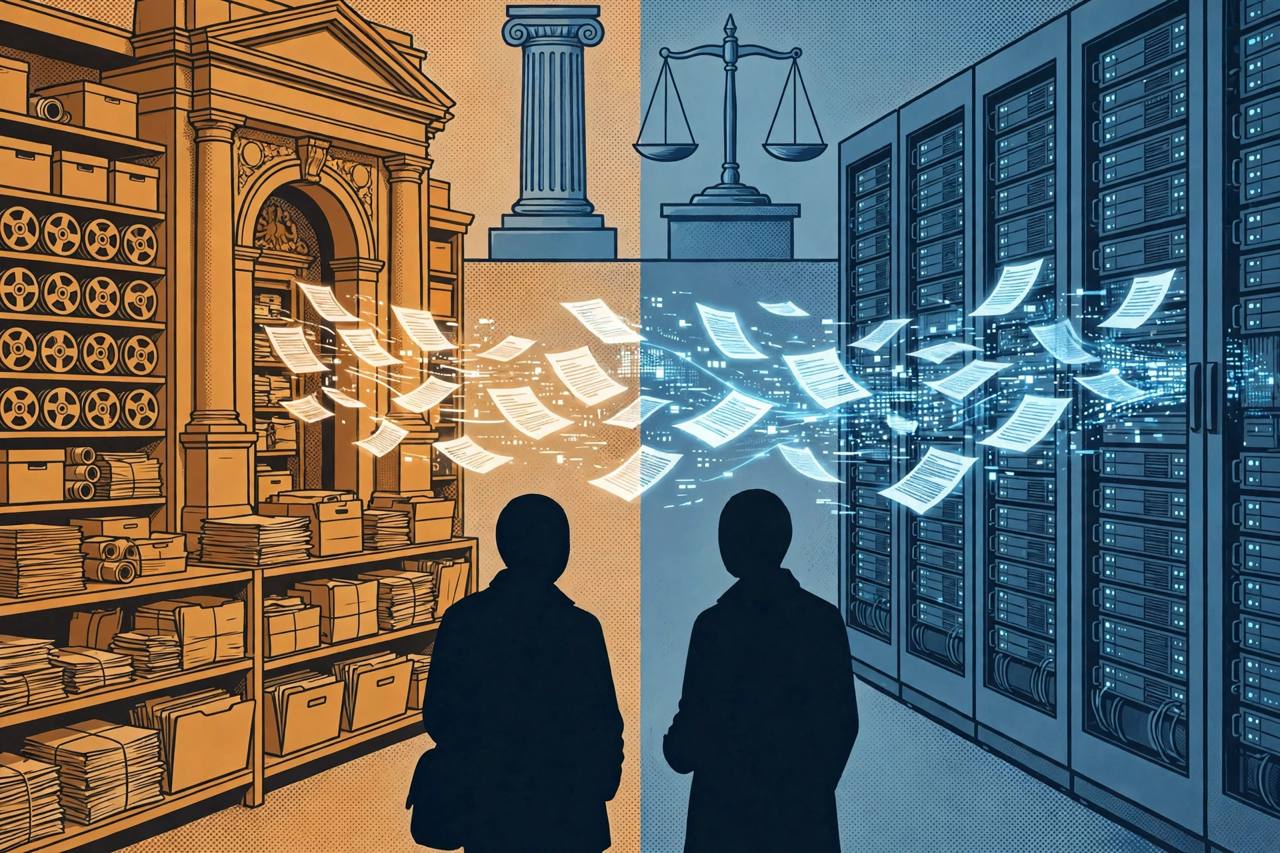
Pennsylvania's Supreme Court will not review the fight over who owns the digital copies of the state's historical records. In a one-line per curiam order dated November 12, 2026, in Pennsylvania Historical and Museum Commission v. Ferretti (Office of Open Records), Nos. 247 and 248 MAL 2026, the court denied requester Alec Ferretti's petitions for allowance of appeal, according to RTKL Decisions, a Pennsylvania Right-to-Know Law journal published by Schnee Legal Services.
Source: RTKL Decisions (Schnee Legal)
The practical effect is immediate: the Commonwealth Court's en banc decision of March 31, 2026, stands. That ruling held that the scans, indexes and metadata Ancestry.com created from the Historical and Museum Commission's microfilm are not public records of the Commission under Section 506(d)(1) of the Right-to-Know Law, so the Commission cannot be ordered to obtain and hand them over as a single public dataset.
A 2022 request for birth, death and other scanned records
The case began in September 2022, when Ferretti, a New York resident and a board member of Reclaim the Records, asked the Pennsylvania Historical and Museum Commission for all documents scanned, and all indexes and metadata created, under a 2008 contract between the Commission and Ancestry, including birth and death records, the Commonwealth Court's opinion records.
Source: Commonwealth Court opinion via Pennsylvania Office of Open Records
Under that 2008 licensing agreement, Ancestry scanned and indexed the Commission's microfilm at its own expense, which the record put at about $3.25 million. The Commission received a digital copy and free on-site access for up to 20 simultaneous users at the State Archives. A 2016 addendum moved the data, nearly 45 terabytes, onto Ancestry's servers after the Commission found it would cost roughly $297,000 to $321,000 a year to maintain it itself.
Access for ordinary researchers does not change with this week's order. Pennsylvania residents can still view the records free through the State Archives' Ancestry page by entering a Pennsylvania zip code, and anyone can use them free in the State Archives Reading Room, according to the case record summarized by RTKL Decisions.
Source: RTKL Decisions (Schnee Legal)
How the case moved through the open-records system
The Commission first denied the request, saying it did not possess the records and did not have to create them. It later added arguments of insufficient specificity, the Section 708(b)(24) exemption for library, archive and museum materials, and a claim that the request was a complex and extensive dataset for which it could charge fair market value. Ancestry intervened in the case and raised the Section 708(b)(11) exemption for confidential proprietary information.
After an earlier appeal was remanded, the Office of Open Records issued its Final Determination Upon Remand on September 17, 2024. The office held that, by contracting with Ancestry to digitize records in its care, the Commission had delegated a governmental function under the History Code, so the records were presumptively public under Section 506(d)(1). It directed the Commission to obtain the records from Ancestry and produce them, and it rejected the exemption and fee arguments.
Why the Commonwealth Court reversed that decision
The en banc Commonwealth Court, in an opinion by Judge Stacy Wallace, reversed. It held that Section 506(d)(1) reaches a record held by a contractor only when the agency has contracted with that party to perform a governmental function on the agency's behalf, applying SWB Yankees LLC v. Wintermantel (2012) and Department of Public Welfare v. Eiseman (2015) to ask whether the Commission had delegated a substantial or core part of its role, rather than signing a routine service agreement.
Source: Commonwealth Court opinion via Pennsylvania Office of Open Records
The court gave three reasons for answering no. First, the History Code charges the Commission with preserving public records, not digitizing them, and the State Archivist attested that the Commission preserves its originals on site in microfilm and hard copy. Second, the agreement itself separated the Commission's ownership of its original records from Ancestry's ownership of the digital images and indexes, which Ancestry licensed back to the Commission on narrow terms, and the 2016 addendum gave the Commission only a right to request copies. Third, unlike the stadium authority in the SWB Yankees case, which ceded its entire operating role to a private operator, the Commission did not hand Ancestry its preservation function; Ancestry invested its own money, and the Commission does not hold the requested records or own Ancestry's work product.
The court also agreed that the Office of Open Records had erred in finding that Ancestry's indexes and metadata were already available to the public, noting the Commission's statement that the metadata for each scan is not available to the public through the Ancestry portal. The court remanded the case with directions to deny the request, denied Ferretti's interim request for counsel fees, and did not reach the exemption or fee issues.
A denial of allowance of appeal is not a ruling on the merits, and it does not mean the Supreme Court agreed with the Commonwealth Court's reasoning, RTKL Decisions notes. Its practical effect is still significant: the en banc Ferretti decision now stands as the Commonwealth Court's word on vendor-created digitization of archival records in Pennsylvania.
What happens next, and why it matters beyond one request
The November 12 order ends the appeal. On remand, the Office of Open Records is directed to deny Ferretti's request, and the underlying originals — the microfilm and hard-copy records the Commission itself holds — remain public records in the agency's hands. For requesters, the lesson in the case is to target the records an agency actually holds or controls, such as the originals, the microfilm, the contract itself and any copies the agency has received, rather than a vendor's derivative work product.
For family-history researchers in Pennsylvania, including immigrant families tracing births, deaths and arrivals across generations, the day-to-day position is unchanged: the State Archives route to the Ancestry collection stays free for Pennsylvania residents and in the Reading Room. What is settled against requesters is the bulk claim — that a private company's scans, indexes and metadata, created at its own expense of about $3.25 million and owned by it under the contract, must be released as the agency's own public records. For agencies across the state, the ruling makes the wording of digitization contracts decisive: who owns the output, whether public money changes hands, and whether the vendor is performing a statutory duty or a service the agency was never required to provide.