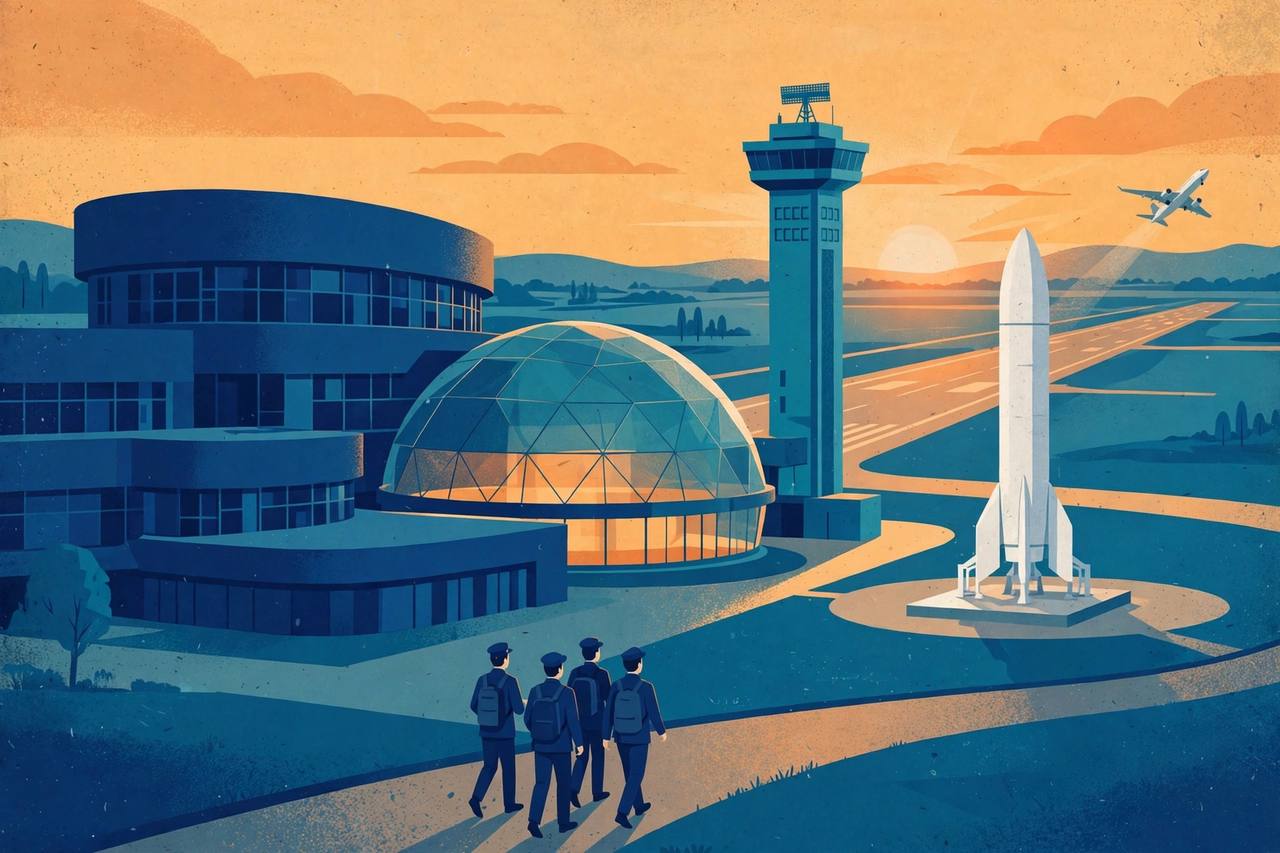
Pennsylvania has formally asked the federal government to build the new United States Space Academy (USSA) in the Pittsburgh area, submitting a proposal on Monday, November 16, that offers 300 acres of public land beside Pittsburgh International Airport and a $285 million investment commitment, the Shapiro administration announced.
Source: 28/22 News (WHTM)
The bid was announced jointly by Governor Josh Shapiro, U.S. Senator Dave McCormick, Pennsylvania State University, the Keystone Space Collaborative (KSC) and Pittsburgh International Airport (PIT). NASA had invited every state to submit one official, state-sponsored request to host the academy, and Monday was the deadline for proposals. According to NASA, a permanent location will be selected after the requests are reported to the President for a decision.
A 300-acre campus beside the runways
Under Pennsylvania's plan, the academy would be built at Southfield Business Park, on several hundred acres of developable, publicly owned land next to the airport in southwestern Pennsylvania. The bid's own materials describe the wider Southfield tract as roughly 900 acres under one public owner, with the campus buildings on 300 of them, and place the site along the airport's southwest runway, in the Findlay Township and Moon Township area.
Source: Moon Pulse
Construction would break ground in 2027, but students would arrive years before the permanent campus is finished. A first class of 300 students would start in 2028 at an interim campus — the former Pittsburgh Technical College in North Fayette Township, which the governor's office says already has housing for 384 students, a laboratory and classroom space. The permanent campus would then open in fall 2031 with 1,200 students.
Where the money would come from
Of the $285 million headline figure, $85 million would come from the Commonwealth itself. The governor's office breaks that public money down as $30 million for site preparation, $11 million for water infrastructure upgrades and $45 million for regional transportation improvements. The remaining $200 million is a commitment to raise a private endowment — a fundraising target for scholarships, faculty chairs and laboratories, not money already in hand.
Source: Pennsylvania Capital-Star via Horsham Now
What students would study
Penn State would lead the academy's curriculum, working with six other research universities across the commonwealth, in fields including life sciences, space-related research, robotics, artificial intelligence and advanced manufacturing. The academy is envisioned as a NASA-led civilian federal institution preparing scientists, engineers, astronauts, pilots, operators, entrepreneurs and civil servants for the aerospace sector.
"Penn State is honored to have been selected to support the Commonwealth's pursuit of this initiative and to lend our expertise in research, academics, and workforce development," said Penn State President Neeli Bendapudi. "Our proposed curriculum would provide students with critical hands-on experience and the skills they need to meet the rapidly changing workforce needs."
Source: Onward State
"The Commonwealth of Pennsylvania powered the first industrial revolution nearly 200 years ago and made the arsenal of democracy the most powerful manufacturing base in the world. Pennsylvania is now uniquely positioned to welcome the United States Space Academy — building off our robust space industry and world-class research universities — to launch the next generation of America's scientists, engineers, astronauts, and servicemembers and ensure America remains the global leader in space. My Administration is all in and we've assembled a bipartisan team of Pennsylvania leaders who are committed to the Space Academy's success here in our Commonwealth."
Why Pittsburgh, the backers say
Senator McCormick said Pennsylvania "has the talent, technology, and industrial strength to help America win the race for space dominance." Pittsburgh International Airport chief executive Christina Cassotis pointed to the airport's "abundant real estate options and proximity to two military bases on-site" — the 911th Airlift Wing and the 171st Air Refueling Wing are both based at the airport. The bid's concept sketches, which the bid itself says are not final designs, show a mission control centre, an astronaut training complex with an underwater pool and a spacecraft test facility. Pennsylvania also named a backup site: the Bellwether District in Philadelphia, the former Philadelphia Energy Solutions refinery site.
What has to happen before anyone breaks ground
The academy does not exist yet in law. President Donald Trump signed an executive order on August 28, 2026, establishing the USSA and setting up a presidential commission, chaired by NASA Administrator Jared Isaacman, to work out how it would be run, what it would teach and where it should go. The commission's report to the President is due around December 26 — 120 days after the order — according to the Congressional Research Service, and it is ultimately Congress that would have to create and fund the academy; the executive order alone cannot do that. Pennsylvania is not alone in the race: published reports name bids or campaigns from Texas, Florida, Alabama, Ohio and Maryland, plus a private proposal in Nevada, and a bill filed by Florida Senator Ashley Moody would require the permanent campus to be in Florida.
What happens next is a federal decision, not a state one. If Pennsylvania's bid is chosen, the Shapiro administration says the project could bring billions of dollars in combined public and private investment and create thousands of new jobs for Pennsylvanians — figures that are the administration's own projections, not guarantees. The governor's office also notes the academy would be the nation's sixth service academy and its first new one since 1955, alongside the U.S. Army War College at Carlisle in Cumberland County.