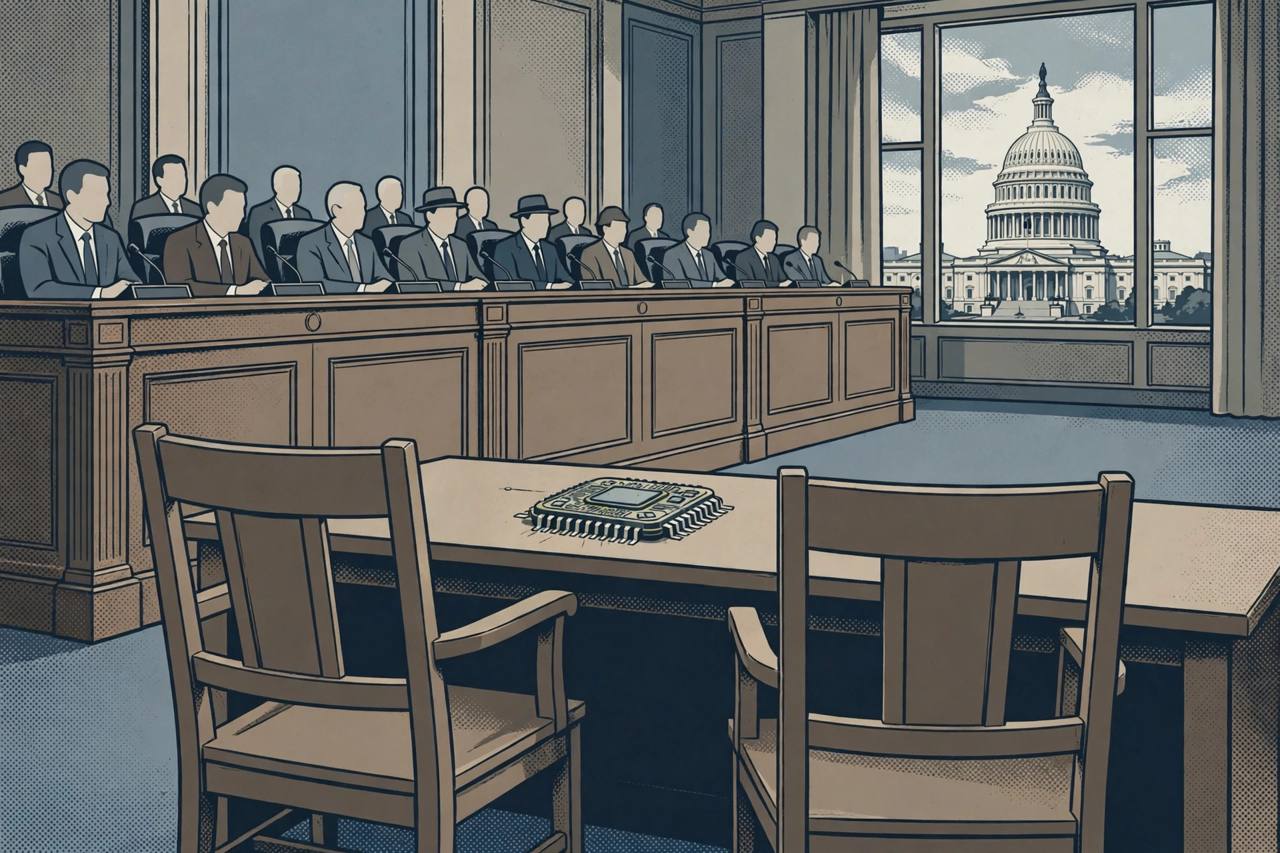
Congress moved within hours of Jensen Huang's resignation as chief executive of Nvidia to demand his testimony, as Senate Banking Committee Chairman Tim Scott sent letters on Thursday, November 12, asking Huang to testify on December 3 and Commerce Secretary Howard Lutnick on December 10 — and warning Huang that the committee could subpoena him if he does not appear voluntarily.
Source: Reuters via Nakoda News
'Recent reports raise serious concerns about our national security and the protection of sensitive US technology,' Scott wrote on X. 'The American people deserve answers.' Politico first reported the December 3 and December 10 dates in Scott's letters, according to Nakoda News, which cited Reuters reporting.
This story follows an earlier development readers have been following on this site: Huang stepped down on Thursday after reports of a romantic relationship with businesswoman Alice Huang, whom US authorities suspect of spying for China. That suspicion is an allegation, not a finding. Attorney General Todd Blanche said on Thursday that the Justice Department had not reached a conclusion on whether she spied for Beijing, China has denied that she is a spy, and Alice Huang could not be reached for comment, Reuters reported.
What the Senate wants to examine
Scott's letter to Huang says the requested appearance concerns recent public reports that raise significant national security concerns, citing New York Times reports from October 29 and November 6 and a Wall Street Journal report from November 11 on Alice Huang and an alleged Chinese spy plot, according to a summary of the letter by ShiftDelete. The letter says the committee has jurisdiction over export controls, including their application to Nvidia's exports of advanced semiconductors, under Senate Rule XXV, and cites the Export Control Reform Act of 2018.
The letter to Huang warns, in the words quoted by ShiftDelete: 'Should you fail to appear before the Committee on a voluntary basis, the Committee is prepared to use all tools at our disposal, including subpoenas.' No subpoena has been issued. A former chief executive holds no immunity from congressional process, and the warning was directed at Huang, not at the sitting commerce secretary.
Lutnick, whose department licenses chip exports, was asked to appear on December 10 to examine export controls and the Commerce Department's handling of the case. A Commerce Department spokesperson said Lutnick 'has proactively agreed to appear voluntarily before the Banking Committee to address their questions,' according to NBC News reporting summarised by Superpower Daily. Lutnick has drawn bipartisan criticism over the administration's refusal to add dozens of Chinese companies to a key trade blacklist and over its oversight of Nvidia's exports to China, Reuters reported, and Scott's letter to Lutnick cites a Financial Times report from November 10 that Commerce delayed adding Megaspeed — the Singapore-based cloud company that buys Nvidia chips and that Alice Huang formerly led — to a trade blacklist.
A second, faster track in the House
Separately, the chairs of three House committees — Brian Mast of Foreign Affairs, John Moolenaar of the China select committee and Rick Crawford of Intelligence — wrote to Huang and Nvidia general counsel Tim Teter requiring closed-door transcribed interviews on December 1 for Huang and December 2 for Teter, or subpoenas to compel them. 'There are clear national security concerns that need to be addressed immediately,' the chairs wrote, according to Reuters.
The House chairs also asked Under Secretary of Commerce Jeffrey Kessler, who leads the Bureau of Industry and Security, to testify at a December 3 hearing. Mast said on Thursday that Huang had agreed to brief lawmakers before Thanksgiving, with the date and venue still being negotiated — an agreement that is separate from Scott's Senate request, on which Huang's representatives did not immediately respond, according to NBC News reporting.
The company, the market and the wider inquiry
Nvidia's board named finance chief Colette Kress interim chief executive after Huang's resignation, and new chair Harvey Jones has said the board has 'full confidence' in Kress and will consider internal and external candidates for the permanent job. The company heads into its November 17 quarterly results under that interim leadership. Nvidia has lost about $550 billion in market value over five days, its steepest five-day fall since it went public 27 years ago, and has said it has 'no reason to believe that either national security or Nvidia secrets were compromised,' with its own inquiry continuing, according to reporting by The Insight International citing BBC/EPA material.
The inquiry is also spreading beyond Nvidia. Bloomberg reported that federal prosecutors are examining whether entities tied to Alice Huang helped move Super Micro servers into China, a report on which Super Micro shares fell 12 percent, according to CNBC, both via Nakoda News. Megaspeed has denied wrongdoing and denied allegations that it smuggled banned chips into China. Senators Elizabeth Warren and Chris Coons have separately asked officials to preserve relevant records and confirm by November 17 that preservation instructions were issued, according to the Senate Banking Committee material cited by Superpower Daily.
President Donald Trump, who has backed Lutnick, spoke sympathetically about Huang on Thursday. In a White House interview reported by Bloomberg, Trump said Huang had called him and expressed remorse over what the scandal had done to his family, and, according to Fox News, questioned whether Huang needed to step down unless the woman was found to be a Chinese intelligence operative: 'If the woman was not a spy, perhaps it would be different.' The New York Times has reported that Trump called Huang on Tuesday and urged him to fight to keep his job.
The first scheduled appearance is the House closed-door interview on December 1, followed by the Senate Banking public hearing for Huang on December 3 and for Lutnick on December 10. Lutnick has agreed to appear; Huang has not publicly accepted Scott's request. The hearings will decide, in public, how far Congress presses export-control enforcement on advanced AI chips — the rules that govern the most valuable technology exports in the US economy.