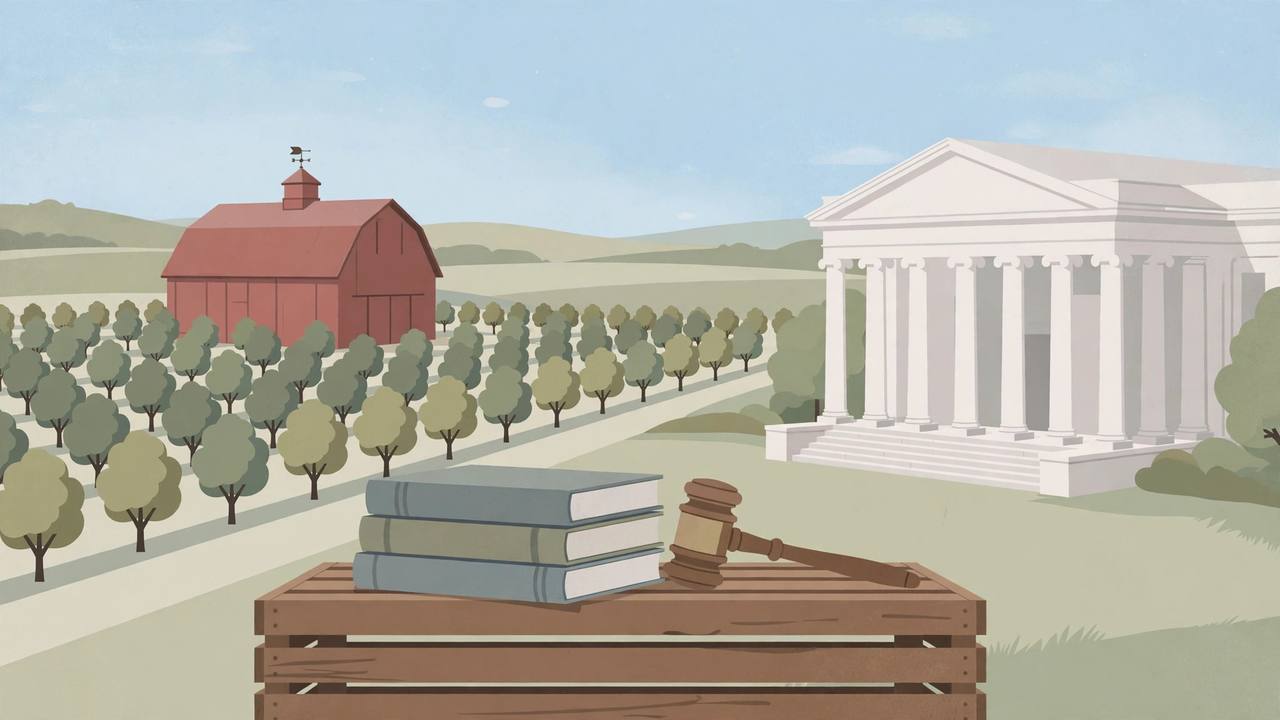
The United States Supreme Court will hear arguments on Tuesday, November 10, in a case that began with a Labour Department investigation of a family farm in South Jersey and now asks a question that reaches every farm in America that hires seasonal foreign workers: when the government says an employer broke the rules of the H-2A farmworker programme and owes money, who gets to decide — a federal court, or the Labour Department's own in-house judges? The case, Department of Labor v. Sun Valley Orchards, LLC, pits the Department of Labor against a fourth-generation family farm from the Swedesboro area that was ordered to pay more than half a million dollars in back wages and penalties, and that says it was put out of business by a process the Constitution never allowed.
Source: The Center Square, Nov. 7, 2026
The justices agreed to hear the government's appeal on April 27, 2026, and limited their review to two questions, according to the Supreme Court docket. The first is whether Article III of the Constitution — the article that vests the judicial power of the United States in independent federal courts — precludes the Department of Labor from adjudicating proceedings to collect monetary remedies from employers accused of violating the terms of employment of H-2A workers and of domestic workers employed alongside them. The second is whether the H-2A statute itself, 8 U.S.C. § 1188(g)(2), authorizes the department to adjudicate those claims at all. It is a certiorari grant and two framed questions, not a ruling: no side has won anything yet, and a decision is expected by June 2027.
Source: Supreme Court docket, No. 25-966, via supremecourt.report
How a 2015 Harvest Reached the Supreme Court
Sun Valley Orchards is a family-owned farm in the Swedesboro area of South Jersey that used the H-2A programme during the 2015 growing season. The H-2A programme allows American agricultural employers to hire foreign workers temporarily when there are not enough available U.S. workers, but the permission comes with federal conditions covering wages, housing, transportation, meals and other working conditions. After an investigation, the Labour Department's Wage and Hour Division concluded that Sun Valley had broken those conditions in serious ways: it said the farm failed to provide sanitary housing, transported workers using unsafe vehicles and unlicensed drivers, improperly terminated more than 20 workers during the growing season — before honouring the programme's guarantee that workers receive at least three-quarters of the work promised for the contract period — and made unlawful deductions from workers' wages for food and beverages.
Source: NJ Today, South Jersey family farm takes fight with Labor Department to Supreme Court
Sun Valley asked for a hearing before a Labour Department administrative law judge. After a four-day administrative trial, the judge found the farm owed $344,945.80 in back wages and $211,800 in civil penalties — $556,745.80 in total — and the department's Administrative Review Board later affirmed that result. The farm's lawyers say Sun Valley went out of business following the assessed damages. It then challenged the process itself in federal court, arguing that executive-branch officials should not be allowed to assess money damages against a family farm in the government's own tribunal.
Source: NJ Today; The Center Square, Nov. 7, 2026
Two Courts, Two Answers
The farm's constitutional argument failed first: a federal district court rejected it. But the Philadelphia-based U.S. Court of Appeals for the Third Circuit reversed that result in July 2025 — the judgment is dated July 29, 2025 — in a unanimous three-judge ruling. The appeals court reasoned that the Labour Department's claims looked like a traditional breach-of-contract action, and that back wages and civil penalties are remedies traditionally associated with courts, not agencies. On that view, the claims are private rights that Article III reserves to the judiciary, and they do not fall inside the 'public rights' category that Supreme Court precedent allows Congress to assign to executive agencies. The government then took the case to the Supreme Court, which granted review at the end of April 2026 and set the argument for this Tuesday.
(1) Whether Article III precludes the Department of Labor from adjudicating proceedings to collect monetary remedies from employers who have allegedly violated the terms and conditions of employment of H-2A workers and domestic workers in corresponding employment. (2) Whether 8 U.S.C. § 1188(g)(2) authorizes the department to adjudicate those proceedings. — Supreme Court docket, No. 25-966
Solicitor General D. John Sauer represents the government. Its position, as set out in the litigation, is that Congress has given administrative agencies like the Department of Labor authority to adjudicate worker issues, and that H-2A is a federal privilege: an employer may 'import an alien as an H-2A worker' only if it obtains federal certification and agrees to meet federal standards, including basic requirements for wages and working conditions. Enforcement of the conditions attached to that privilege, the government argues, is exactly the kind of public-rights matter that can be decided inside the agency that runs the programme, subject to court review afterwards.
Source: NJ Today, reporting the government's argument and the H-2A statute
The farm is represented by the Institute for Justice, with Robert Everett Johnson arguing its side of the case. Sun Valley contends that Article III assigns the federal judicial power to independent courts whose judges are nominated by the president and confirmed by the Senate — not to administrative judges employed by the very department bringing the claim. Its fight has drawn attention well beyond one farm: the dispute was featured in the Harvard Law Review, and workplace-law analysts, among them Alex MacDonald, co-chair of Littler Mendelson's Workplace Policy Institute, have treated the case to The Center Square as a significant test of how far agency adjudication can go. The farm's core complaint is structural, not factual: whatever the investigators found in 2015, it says, only a real court could lawfully turn those findings into a money judgment.
Source: NJ Today; The Center Square, Nov. 7, 2026
Why Farm Country — and Punjabi Growers and Workers — Are Watching
H-2A is the main legal channel through which American farms bring in seasonal labour, and it touches every part of the food economy this audience knows: the orchards and vegetable farms of New Jersey, the dairies and fields of upstate New York, and the vast farm belt of California's Central Valley, where Punjabi families are present on both sides of the fence — as farm owners and contractors who must comply with H-2A's housing, transport and wage rules, and as workers whose protections those rules are supposed to guarantee. If the Supreme Court rules for the farm, Labour Department findings like the ones against Sun Valley would have to be proven again in federal court before money could be collected, a slower and costlier route that worker advocates fear would weaken enforcement; if it rules for the government, the in-house system that produced the $556,745.80 order stands, and employers keep facing the agency as investigator, prosecutor and judge. Either way, the ruling will set the constitutional line for agency enforcement far beyond agriculture.
Source: Awaaz Punjab analysis of the docket and the parties' stated positions
What is solid
- Oral argument is set for Tuesday, November 10, 2026, in Department of Labor v. Sun Valley Orchards, LLC, No. 25-966
- An administrative law judge set the farm's liability at $344,945.80 in back wages and $211,800 in civil penalties ($556,745.80 total); the Administrative Review Board affirmed
- The Third Circuit ruled unanimously for the farm in July 2025; the Supreme Court granted review on April 27, 2026, limited to two questions
- No ruling has been issued; a decision is expected by June 2027
What is only claimed
- Whether the Constitution permits the Labour Department to adjudicate these money claims at all — the government says yes under the public-rights doctrine; the farm says Article III reserves them to the courts
- Whether the H-2A statute itself authorizes agency adjudication — the second question the justices took up
What happens next: the justices will question both sides on Tuesday morning in Washington, with Solicitor General D. John Sauer for the government and Robert Everett Johnson of the Institute for Justice for the farm. There will be no decision from the bench; rulings in argued cases typically arrive months later, and this one is expected by the end of the court's term in June 2027. For H-2A employers, nothing changes on Tuesday itself — the Labour Department's enforcement system remains in place unless and until the court rules against it — but every farm, labour contractor and farmworker organisation in the country will be reading the argument transcript for signs of which way the justices are leaning.