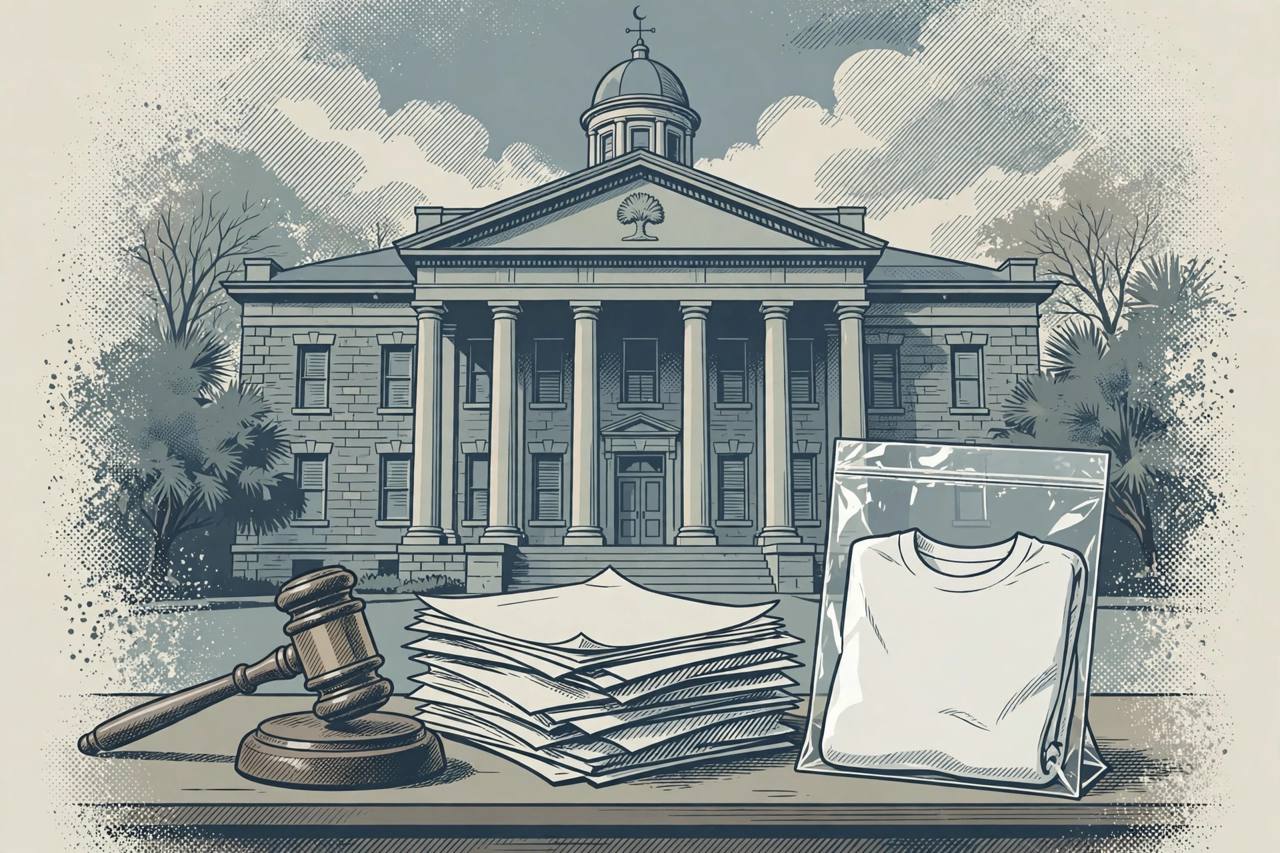
Attorneys for Alex Murdaugh are expected in court on Friday, November 13, to ask a judge to throw out the original murder indictments against him for the killings of his wife and son — arguing that the chief investigator in the case lied to the grand jury that charged him.
Source: Associated Press
Judge Debra McCaslin will consider the request at a pretrial hearing. Murdaugh, 58, is facing a retrial on the murder charges after the South Carolina Supreme Court threw out his convictions and life sentence, ruling that a court clerk improperly influenced jurors against him during his 2023 trial.
Prosecutors say Murdaugh killed his wife, Maggie, and his younger son, Paul, on the family's sprawling property in the South Carolina Lowcountry in 2021. Murdaugh is spending decades in prison for stealing millions of dollars from clients, and he has admitted in court that he is a thief, an insurance cheat, a bad lawyer and a longtime opioid addict — but he denies being a killer.
A longshot request that would not end the case
Even if Judge McCaslin grants what the Associated Press describes as a longshot request, it may not stop or even postpone the retrial. Prosecutors could seek a new set of grand jury indictments as soon as next month, and defence attorneys have said they will not stop them. The defence itself asks for dismissal without prejudice, meaning the state could present the case again and the April trial date would never move, according to an analysis of the defence memorandum by criminal defence attorney Danny Cevallos.
South Carolina Public Radio's report on the motion, cited by HeadlinesXtra, puts the retrial start on April 5, 2027, in Sumter County. A ruling for Murdaugh would, however, be another formal rebuke of the investigation's chief figure, State Law Enforcement Division (SLED) agent David Owen.
The blood-spatter claim at the centre of the motion
The defence says that when prosecutors sought the indictments in July 2022, Owen told the Colleton County grand jury that blood spatter was found on a T-shirt Murdaugh was wearing on the night of the killings. An earlier report from state agents said there were no blood stains, and no such evidence was introduced at the trial, the Associated Press reported.
According to the defence memorandum, summarised by Cevallos, SLED's own lab ran a confirmatory HemaTrace test on the stained cuttings in August 2021 and found no human blood, in a lab report dated November 10, 2021, that was addressed to Owen. Owen says he did not see that report until November 2022 — a year later. The defence also says expert Tom Bevel's first report called the stains consistent with transfers and not back spatter, before Bevel, after SLED agents flew the shirt to Oklahoma, reported more than 100 spatter stains. These are defence allegations set out in its filing; they have not been established as findings by the judge.
The shotgun-load claim
The defence's second complaint concerns ammunition. Owen told grand jurors that the same ammunition load — buckshot in one chamber and large birdshot in the other — that was used to kill Paul Murdaugh was found loaded in weapons all over the Murdaugh property, which, the Associated Press reported, was not the case. At trial, Owen admitted that a version of that claim he had put to Murdaugh in a 2021 interview was a ruse, saying he was allowed to use trickery to elicit a response — a technique police may use with a suspect, but, the defence argues, not in sworn grand jury testimony, where Owen conceded at trial that the testimony was not accurate, according to Cevallos's analysis of the filings.
The state's answer: 'simply incorrect'
Prosecutors have answered that they had plenty of other evidence supporting the murder charges, and wrote that 'a single mistake is not bad faith.' In its response, described by Cevallos, the state calls the defence 'simply incorrect': Bevel later reviewed the HemaTrace report, concluded the chemical used on the shirt can produce a false negative, and stood by his opinion, and the Benelli shotgun Murdaugh grabbed from the house that night did hold both a buckshot shell and a birdshot shell.
The other evidence Owen described to grand jurors included the video Paul Murdaugh recorded in which Alex Murdaugh's voice can be heard at the scene, contradicting his denials, and the family's mounting debts and Murdaugh's schemes to steal from clients and his law firm, which were close to being discovered. Prosecutors say Murdaugh killed his wife and son because he thought the sympathy generated by the killings would buy him time to cover up his thefts. The defence has repeatedly pointed to how little physical evidence prosecutors have — no DNA or blood was found splattered on Murdaugh or any of his clothes, even though the killings were at close range with powerful weapons that were never found.
Why South Carolina law makes dismissal hard
Legal analysis of the filings, by Cevallos, explains why the motion faces a steep climb. Under State v. Thrift, South Carolina courts 'do not inquire into the nature or sufficiency of the evidence before a grand jury,' with one exception requiring a colourable claim of prosecutorial misconduct — and no prosecutor was in the county grand jury room with Owen. Under State v. Needs, a trial court generally has no power to dismiss a properly drawn indictment before trial unless a statute allows it. The defence counters, in the same analysis, that the state leans on a first-trial conviction that has since been vacated, and that no transcript of the Colleton County grand jury exists, so both sides are reconstructing what was said from outlines.
The investigator himself is already under a cloud from another case. A judge last year threw out a different murder case Owen was involved in because the dead woman's mother told the agent about a suicide threat her daughter made days before she died that Owen never relayed to prosecutors or defence attorneys, the Associated Press reported. Owen abruptly retired in 2024, not long after he was honoured as State Law Enforcement Officer of the Year.
Judge McCaslin hears the dismissal motion on Friday, November 13. Whatever she decides, prosecutors can seek fresh indictments next month and the April retrial remains scheduled. Murdaugh remains in prison in any event: his murder convictions were set aside, but he is serving lengthy state and federal sentences for the financial crimes he admitted.