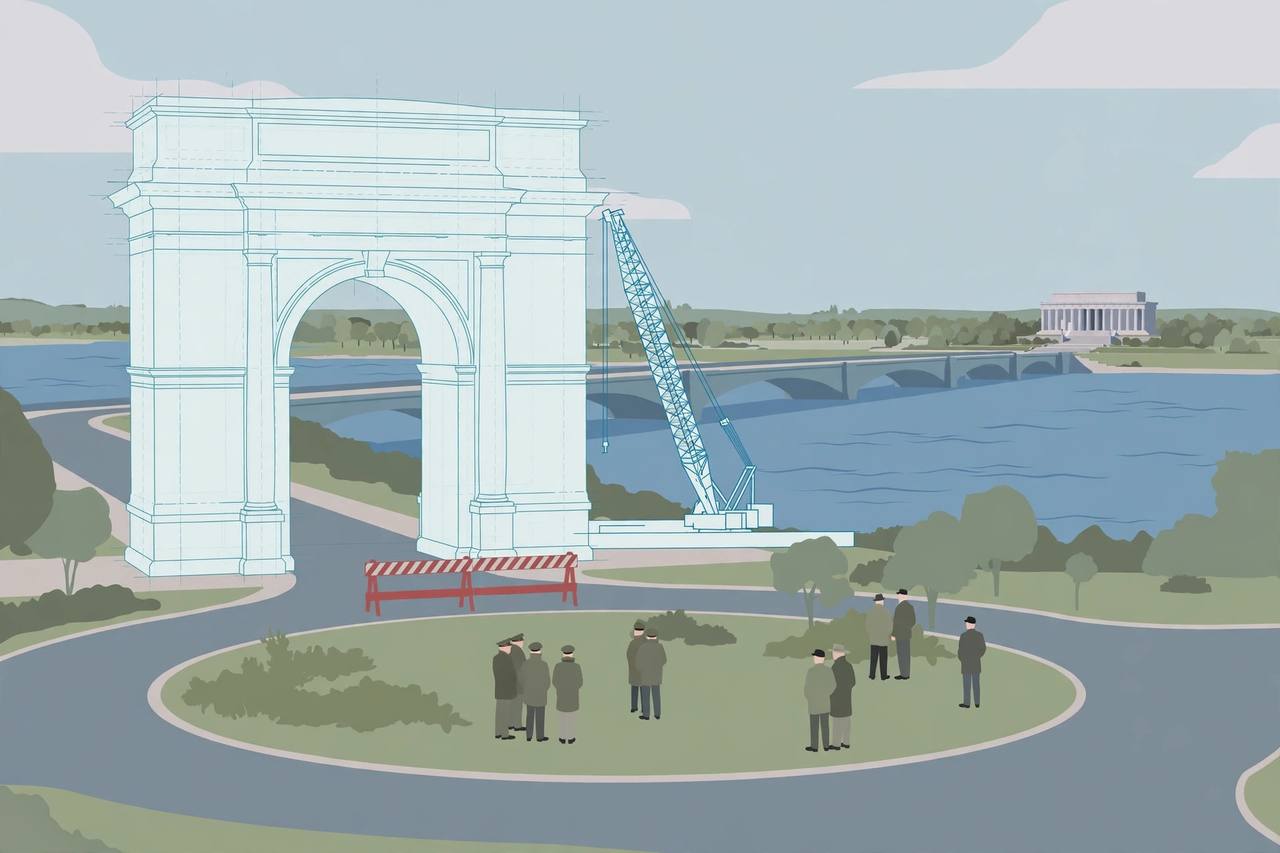
A federal judge blocked President Donald Trump's 250-foot triumphal arch late on Thursday night, less than two hours after a federal planning commission approved the monument — stopping, for at least 14 days, construction the administration had hoped to begin immediately at Memorial Circle in Washington, D.C.
Source: NPR, via KNKX Public Radio
U.S. District Judge Tanya Chutkan issued a 14-day temporary restraining order just before midnight, granting a request filed days earlier by the governments of the District of Columbia and Virginia. The order bars the government from “initiating, making, or otherwise effectuating any construction, excavation, demolition, land-disturbance, utility-installation, or roadway-closure activity, or any other construction-related activity at or near Memorial Circle” for the arch, and it requires the government to file a status report by Monday certifying that all employees and contractors have paused.
The ruling is the latest turn in a fight Awaaz Punjab has been following step by step. Earlier this year, three Vietnam War veterans and an architectural historian sued the government, arguing the arch is unlawful because Congress never authorized it — a case readers saw here when the veterans asked Judge Chutkan to halt the project before a November 5 construction start. Last weekend, the Democratic governments of D.C. and Virginia filed a similar lawsuit of their own, also reported here. Chutkan consolidated the cases and told the government to notify the court within an hour of the commission's decision, setting up Thursday night's 11th-hour ruling.
Nine hours of testimony, then a midnight ruling
The National Capital Planning Commission met virtually from 1 p.m. on Thursday because of the volume of public testimony: 131 people had signed up to speak. Minutes into the testimony the livestream crashed, stretching the meeting by about an hour. Over nearly nine hours, commissioners heard from dozens of veterans and their relatives, Democratic lawmakers, historic preservation experts and residents — most of them opposed. Critics said the arch would obstruct a protected view, insult service members buried at nearby Arlington National Cemetery, add risk to the capital's complicated airspace, and proceed without a confirmed cost or congressional approval.
Only a handful of speakers supported the project, among them Republican Reps. Andrew Clyde of Georgia and Brian Mast of Florida, both veterans. The commission began deliberating just before 10 p.m. and finished in under an hour. D.C. Council Chair Phil Mendelson, who sits on the commission, moved to postpone the vote until final site and building plans were submitted, saying, “We cannot approve final site and building plans until we have the final site and building plan.” The motion failed 4–8, and minutes later the commission gave the arch its final green light, 8–4. The administration notified the court within half an hour — and by midnight the green light had turned red.
In her 33-page opinion in the consolidated cases, Lemmon v. Trump and District of Columbia v. National Park Service, Chutkan found that D.C. and Virginia are likely to win. Federal law, she wrote, requires Congress to specifically authorize any monument on National Park Service land in the capital, and Congress has passed no such law for this arch. She questioned the administration's reliance on a 1925 law under which Congress approved a pair of 166-foot columns on Memorial Circle that were never built, and she scrutinized the administration's sudden emphasis on national security — a claim commission officials acknowledged was not supported by any analysis in the final submission, with an Interior Department official saying specific national-security functions had been filed under seal in court but that the Park Service “has not been privy to any national defense preparations.”
The judge also agreed the local governments face immediate harm: administration officials have said construction would run 20 hours a day, year-round, for two to three years. “The threatened harms will materialize as soon as construction begins, in part because the traffic disruptions will occur immediately,” she wrote. Memorial Circle is the traffic island at the Virginia end of Arlington Memorial Bridge, the crossing that links the Lincoln Memorial to Arlington National Cemetery, where hundreds of thousands of American service members are buried.
The restraining order is not a final ruling that the arch can never be built. It freezes all construction-related work for 14 days while the lawsuits proceed. Chutkan put off deciding a longer stay and a separate injunction request, so the legal fight continues on two tracks: the courts, and Congress, where a bill to ban and defund the arch already has 80 co-sponsors.
Anger from preservationists, defiance promised in Congress
Rep. Don Beyer, the Virginia Democrat who introduced the bill to prohibit and defund the arch, said: “While this decision prevents Donald Trump from immediately implementing his plans to create a monument to his own ego, the courts and Congress must put in place permanent safeguards to stop the Trump Administration from violating the law and proceeding with this project.” Beyer said he expects his bill's co-sponsors to grow from 80 to at least 200 in the new year. Robert Weissman, co-president of Public Citizen, which represents the veterans, told NPR Congress does not need to act to stop the arch because it never approved it — but added it would be fine if Congress took additional measures to block a project he called unlawful.
Brent Leggs, president and CEO of the National Trust for Historic Preservation, called the commission's night-time vote a “sham,” saying: “It undermines the democratic process, violates federal statute, and insults our nation's veterans who have made the ultimate sacrifice.” Jimi Shaughnessy of the National Parks Conservation Association said his group would take the fight to Congress “to ensure this arch is never built. Not here. Not ever.” Rep. Jared Huffman of California, the ranking Democrat on the House Natural Resources Committee, warned officials and companies advancing the project that they “will put themselves at legal risk.” Commissioners who backed the arch cast it as a tribute to the nation and those who served and dismissed concerns about D.C. height limits and federal environmental and historic-preservation law.
Why this fight matters beyond one monument
At about 250 feet, the arch would be taller than the Arc de Triomphe in Paris and would reshape one of the most symbolically loaded views in the United States — the axis between the Lincoln Memorial and Arlington National Cemetery. Its final cost is unknown; estimates reported on Thursday put it near $100 million, and the administration has not confirmed a figure. The legal question underneath the politics is a basic one about power in the capital: whether a president can build a permanent monument on federal park land without Congress ever voting to authorize it. That is the question Chutkan's opinion answers, for now, in the negative — and it is why opponents say the case will matter long after this particular arch is decided.
For drivers, the stakes are immediate and practical. Memorial Bridge is one of the main Potomac River crossings between downtown Washington and Arlington, Virginia. Two to three years of 20-hour-a-day construction at its Virginia end, with the roadway closures the judge's order specifically lists, would have meant daily disruption on a corridor used by commuters, tourists heading to Arlington Cemetery, and trucks moving through the capital region — disruption that is now paused for at least two weeks.
What happens next
The government must file its compliance status report by Monday. The restraining order then runs for 14 days, during which Chutkan is expected to weigh a longer block on construction and the veterans' injunction request. The consolidated lawsuits continue either way. In January, Democrats take their new House majority after this week's midterm sweep, and several lawmakers have vowed not only to block the arch but to investigate how it was approved. Awaaz Punjab will follow the Monday filing and the next court date as this story develops.