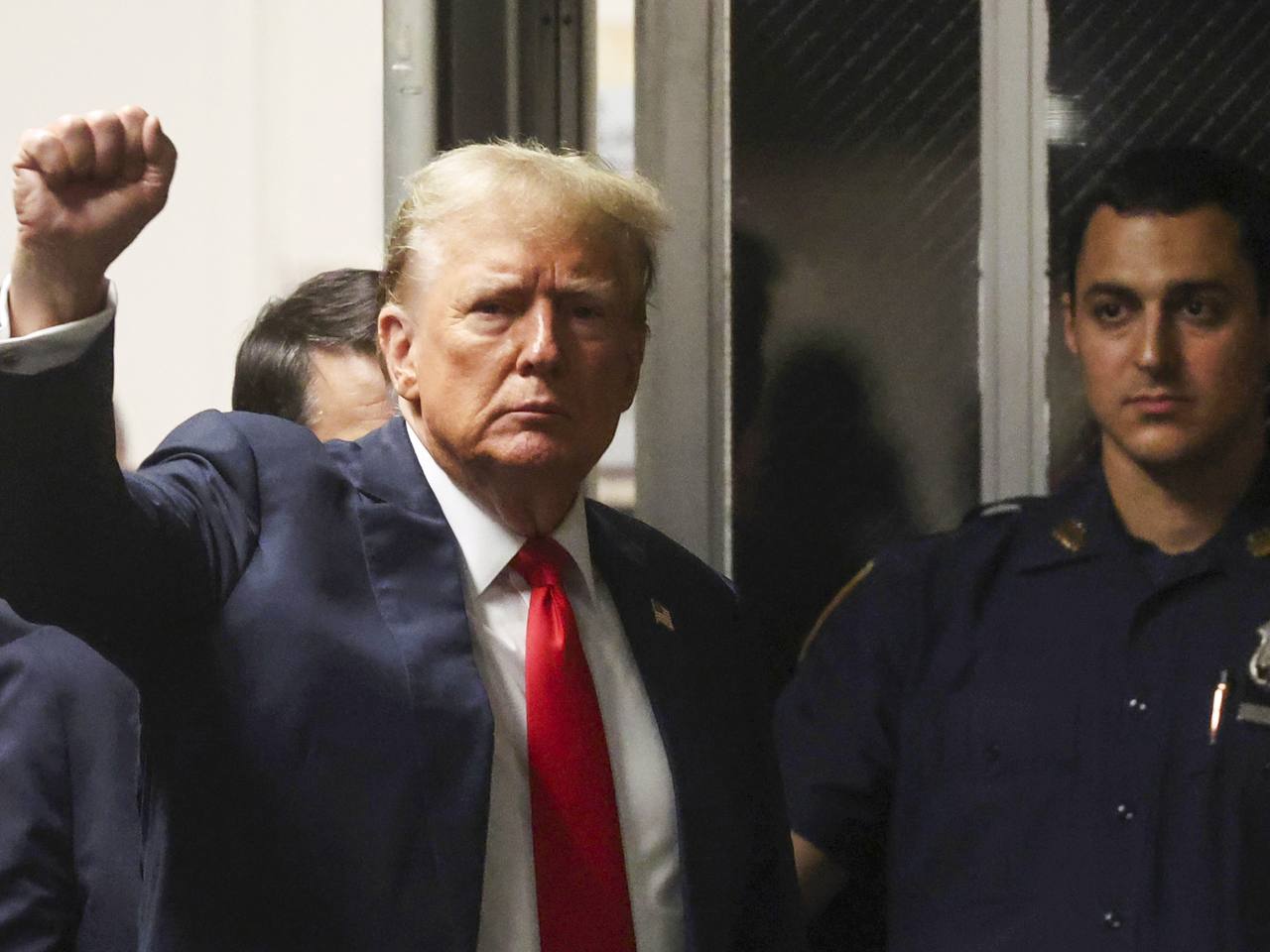
A federal appeals court on Monday gave President Donald Trump a new pathway to erasing his hush money criminal conviction, reviving his bid to move the case from a New York state court to a federal court, where he could seek to have the verdict dismissed on presidential immunity grounds.
Source: Associated Press
A three-judge panel of the 2nd U.S. Circuit Court of Appeals sent the case back to a lower federal court, ordering a judge to promptly rule on Trump's request to move the historic case out of state court, where he was tried and convicted in May 2024.
What the judges decided
In a two-page order, the panel said U.S. District Judge Alvin Hellerstein — who had repeatedly denied Trump's requests to move the case — had erred in his rulings. The judges found that Hellerstein was wrong to hold that removal to federal court is categorically unavailable in a state criminal case after a federal officer defendant has been convicted, and wrong to find that Trump had not shown good cause to make two attempts at moving the case — once after his indictment and again after his trial.
Hellerstein had rejected Trump's bid three times, most recently in August. In that decision he wrote that “paying hush money to an adult film star or engaging in a cover-up of an embarrassment are not subsumed in presidential immunity.” Hellerstein died in October at the age of 92, and the case has not yet been assigned to another judge.
The immunity argument at the heart of the case
If a federal judge decides the Manhattan federal court should keep the case, Trump could then argue that the verdict should be discarded because of presidential immunity. The Supreme Court ruled in July 2024 — weeks after his conviction — that presidents and former presidents cannot be prosecuted for official acts, and that prosecutors cannot use official acts as evidence that unofficial actions were illegal.
Trump's lawyer, Robert Giuffra Jr., told the appeals panel last week that prosecutors at the trial had used the type of official-acts evidence later barred by the immunity ruling, including testimony about his Oval Office conversations, workflow and social media posts. Giuffra also argued that the prosecution's description of the hush money payment as an illegal campaign contribution under the Federal Election Campaign Act belongs in federal court, not state court — and warned that without federal intervention, the president “will likely have to wait years” for state appellate courts to rule before he can take the matter to the U.S. Supreme Court.
Steven Wu, chief of the appeals division at the Manhattan District Attorney's office, urged the panel to uphold Hellerstein's ruling and leave the case in state court. Prosecutors have argued that Trump's dealings in the Daniels matter broke state laws and were not part of his official duties. The District Attorney's office declined to comment on Monday's ruling.
In a statement, a spokesperson for Trump's legal team said the president “appreciates the 2nd Circuit's prompt and correct ruling, as he continues to win against Democrat weaponization of our Justice System.”
The long road to this ruling
Trump became the first U.S. president convicted of a crime when a jury found him guilty in May 2024 on 34 felony counts of falsifying business records to obscure a $130,000 payment to adult film performer Stormy Daniels, whose allegations of an affair had threatened to upend his 2016 presidential campaign. He has denied any wrongdoing and was given no punishment. He first sought to move the case to federal court weeks after he was indicted in March 2023, and tried again after his conviction and the Supreme Court's immunity ruling.
The 2nd Circuit had already sided with Trump once before. After he appealed Hellerstein's second denial, the panel ordered the judge to reconsider, finding he had failed to weigh “important issues relevant” to the request. That panel, which also included Judge Raymond J. Lohier Jr., expressed no view on how Hellerstein should rule but instructed him to closely review evidence Trump claimed was related to official acts. The panel that ruled on Monday — Lohier and José A. Cabranes, appointed by Democrats, and John M. Walker Jr., appointed by a Republican — heard more than an hour of arguments a week earlier.
What happens next
A new federal judge in Manhattan must now promptly decide whether the federal court should retain the case. If the case stays in federal court, Trump can press his immunity argument there, and the 2nd Circuit would likely then evaluate the case on the merits. Meanwhile, Monday's decision set in motion a halt to Trump's simultaneous appeal in New York's state court system: the mid-level Appellate Division heard arguments on November 5 but has yet to rule, and Giuffra sent it a letter on Monday notifying it of the 2nd Circuit ruling and asking that no further proceedings occur in the state courts while jurisdiction is settled. The conviction remains in place for now.