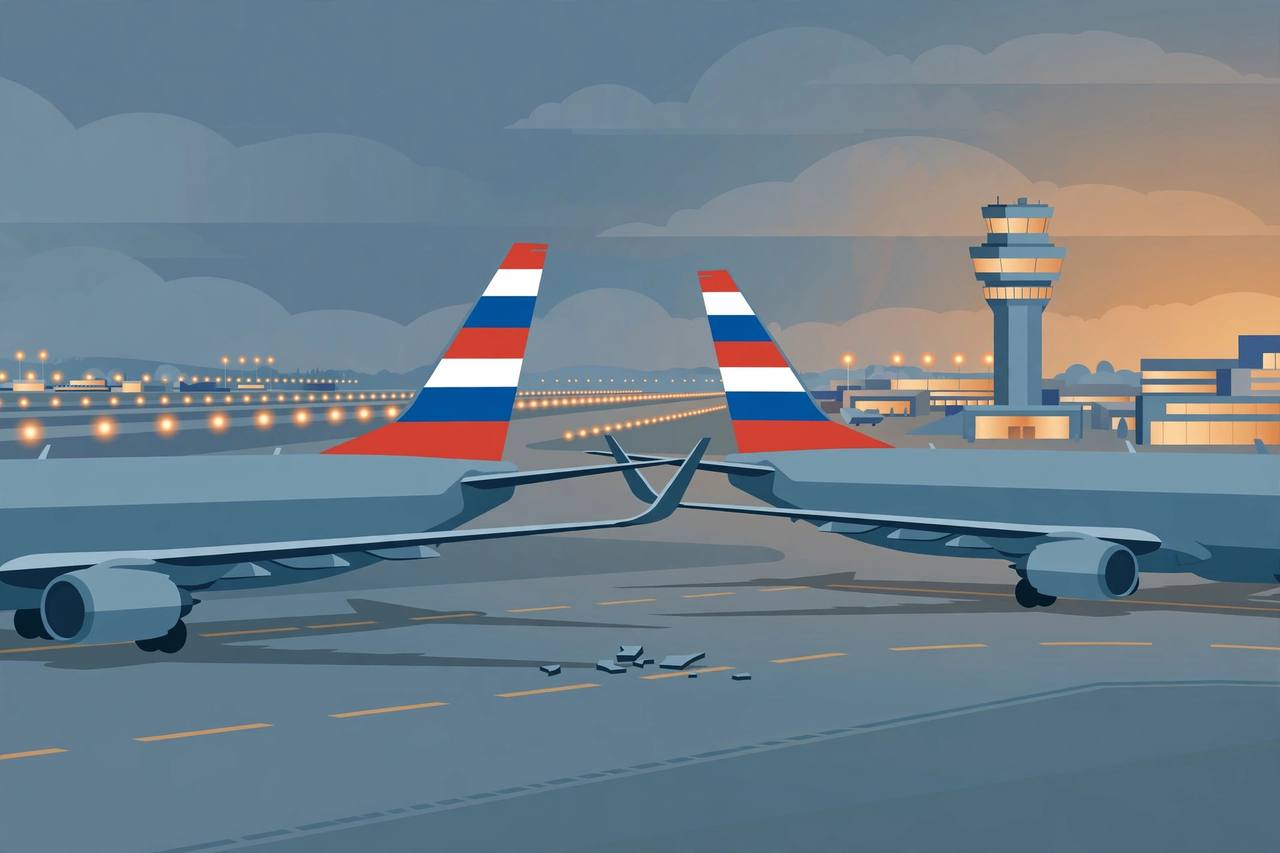
Two American Airlines Boeing 737s clipped wings while taxiing for departure at Ronald Reagan Washington National Airport on Friday evening, tearing the winglet off one jet and scattering debris across the taxiway — but no one on either plane was hurt, the Federal Aviation Administration said.
Source: CNN
The collision happened at about 5:10 p.m. ET on Friday, November 27, just short of Runway 19, the airport's longest and one of its busiest runways. American Airlines Flight 638, bound for Dallas/Fort Worth, was lining up for departure when its wing made contact with American Flight 2152, headed for Chicago O'Hare, which was waiting beside it.
Source: Simple Flying
Moments after the contact, the pilot of Flight 638 told air traffic control the aircraft had moved "slightly over the hold short line" and had "swapped paint" with the American jet next to it — adding that the crew was not sure whether the two planes were still attached to each other.
They were not. But the damage was more than a scrape: the winglet — the upturned outermost section of the wing — was torn clean off one of the jets. "We got debris off our right… the whole winglet is there," a pilot told the tower, according to the air traffic control recording.
Both jets pulled from service
Airport operations workers recovered the broken winglet from the taxiway, and both aircraft were able to taxi back to their gates under their own power. American Airlines said the wingtips of both Boeing 737-800s had made contact and that both planes were taken out of service for maintenance inspections.
Source: Simple Flying
Passengers from both flights were moved to replacement aircraft and departed for Dallas and Chicago later on Friday night. An inbound Envoy Air regional jet that was on final approach was ordered by the tower to go around while controllers sorted out the scene on the ground.
FAA investigating
The FAA confirmed it is investigating the incident. In a statement to CNN, the agency said no injuries were reported. American Airlines said in a statement: "While taxiing for departure at Ronald Reagan Washington National Airport (DCA), an American Airlines aircraft made contact with another American aircraft."
Source: CNN
A taxiway built for two — with little room for error
The taxiway leading to Runway 19 widens near the runway so that two aircraft can sit side by side while waiting to depart — an arrangement both jets were attempting on Friday. A Boeing 737-800 has a wingspan of 117 feet 5 inches (35.8 metres) including its winglets, so pilots must judge their clearance precisely. The hold-short line — four yellow lines painted across the taxiway, two solid and two dashed — marks the point beyond which an aircraft must not go without clearance to enter the runway.
It is the second time in less than 20 months that two American-branded aircraft have collided while waiting to depart from Reagan National, following a similar wingtip collision in April 2025.
An airport under the microscope
Reagan National has been under intense safety scrutiny since January 2025, when an American Airlines regional jet and a U.S. Army helicopter collided in mid-air over the Potomac River, killing 67 people. Congress has since agreed in principle on a mandate for ADS-B In cockpit safety technology, and the FAA has restricted helicopter flights near the airport.
What happens next: the FAA investigation will establish how the two jets came too close — whether it was a pilot misjudgement, a misread of the hold-short line, or a problem with the taxiway layout. Both aircraft will remain out of service until maintenance inspections are complete. Travellers through DCA were advised to check flight status, as the Friday-evening disruption rippled into departure delays across the airport.
What is solid
- No injuries were reported in the collision.
- Both aircraft were Boeing 737-800s — Flight 638 to Dallas/Fort Worth and Flight 2152 to Chicago O'Hare.
- One winglet was torn off and debris was recovered from the taxiway.
- The FAA is investigating the incident.
What is only claimed
- What caused the jets to come too close — the investigation has not yet determined whether it was pilot error, a misjudged hold-short line, or the taxiway layout.