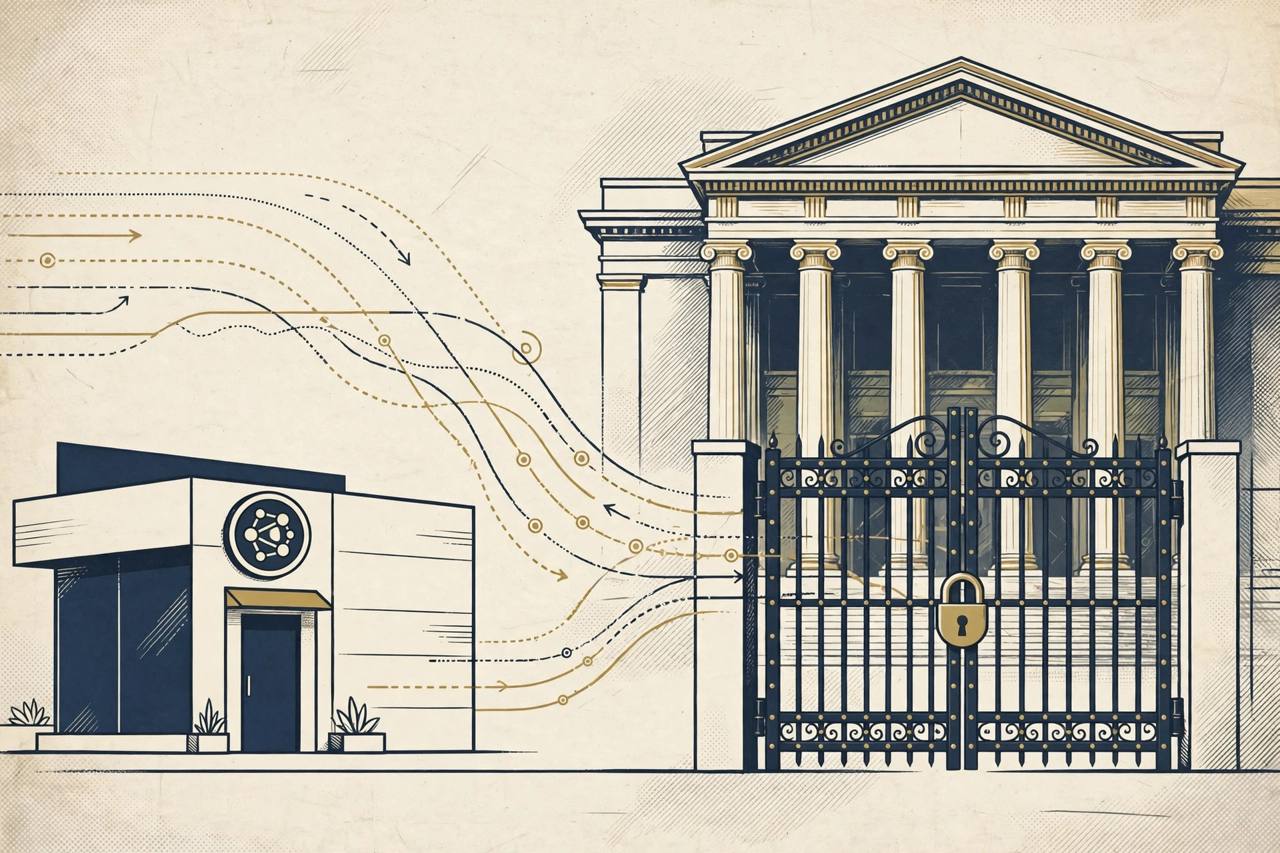
The U.S. Supreme Court on Monday, November 16, declined to hear Custodia Bank's appeal, ending the Wyoming crypto-focused bank's six-year fight for direct access to the Federal Reserve's payment system and leaving the Fed's gatekeeper power intact.
Source: Bloomberg via CryptoNews
The refusal leaves in place a ruling by the 10th U.S. Circuit Court of Appeals that the Federal Reserve Bank of Kansas City had the legal authority to turn Custodia away. Because the justices declined without comment, the lower court's reading of the law — that the Fed has discretion to reject even an eligible bank — now stands untouched in the circuit that covers Wyoming.
Source: Law360
What a master account is, and why banks fight for one
A master account is a bank's own account at a Federal Reserve bank. It lets a bank hold balances directly at the central bank, transfer funds and settle transactions through Fed services such as Fedwire, instead of routing every payment through a larger correspondent bank. For a small state-chartered bank built around digital-asset customers, that direct connection is the difference between running its own payment business and depending on a partner that can cut it off.
A six-year fight, step by step
Custodia is a special purpose depository institution, or SPDI, chartered in Wyoming — a state charter created for digital-asset banking. It filed its master account application with the Kansas City Fed in October 2020. After a long review, the Fed formally said no in January 2023, concluding that Custodia's crypto-focused business model introduced undue risk into the Fed's payment systems. Custodia sued the Kansas City Fed and the Federal Reserve Board, arguing the law gave the Fed no discretion to refuse an eligible institution.
A Wyoming federal district court sided with the Fed in March 2024. On October 31, 2025, a divided 10th Circuit panel upheld that decision 2-1, reading the plain language of the relevant statutes as granting the Fed discretion rather than imposing an obligation to open an account. The appeals court denied rehearing on March 13, 2026, and Custodia petitioned the Supreme Court on July 10, 2026, as case No. 26-62. The justices considered the petition at their November 13 conference and denied it in Monday's orders.
The legal question the court left with the Fed
The dispute centred on two laws: the Federal Reserve Act, which says a Reserve Bank "may receive" deposits from member and certain nonmember banks, and the Monetary Control Act of 1980, which requires the Fed to offer its priced services to eligible nonmember depository institutions. Custodia argued the 1980 act entitled every eligible bank to an account. The 10th Circuit majority disagreed, holding that the statutes grant Federal Reserve Banks discretion to reject master-account requests from eligible entities so the Fed can safeguard the financial system. Judge Timothy Tymkovich dissented, warning in the appellate case that the ruling gives the Fed unlimited power to refuse access — a warning the crypto industry repeated in supporting Custodia's petition.
The Trump administration urged the Supreme Court to turn the case away, arguing that the Federal Reserve Act grants reserve banks discretion to refuse deposits, and pointing to the Fed's push to issue limited-purpose, or "skinny," accounts to digital-asset banks instead. The Kansas City Fed granted Kraken Financial such a limited-purpose master account in March 2025. Custodia argues those limited accounts are not a substitute: they cannot use the Fed's automated clearing house function, balances are capped, and no interest is paid on them.
Declining to hear a case is not a ruling on the merits and sets no nationwide precedent. But it ends Custodia's lawsuit, keeps the 10th Circuit's pro-Fed reading in force, and means any change for crypto banks now has to come from the Fed itself or from Congress.
What happens next
For Custodia, the litigation road is over: there is no further appeal from a denial of review, and the bank must operate without the full master account it sought in 2020, through correspondent arrangements or any limited-purpose access the Fed chooses to offer. For Wyoming's SPDI sector and other digital-asset banks, the fight shifts from the courts to policy — the Fed's developing framework for limited-purpose accounts, and whether Congress writes clearer master-account rules into law. The Supreme Court's official public docket had not yet displayed the denial when the first reports appeared on Monday, according to one report tracking the case, a routine lag that does not change the outcome announced in the court's orders.
The decision also matters beyond crypto. Every new kind of state-chartered bank — payment companies, stablecoin issuers and fintech-chartered institutions — now knows that eligibility on paper does not guarantee a place inside the nation's payment plumbing, and that the central bank's risk judgment, not the applicant's charter, is the decisive test unless Congress says otherwise.