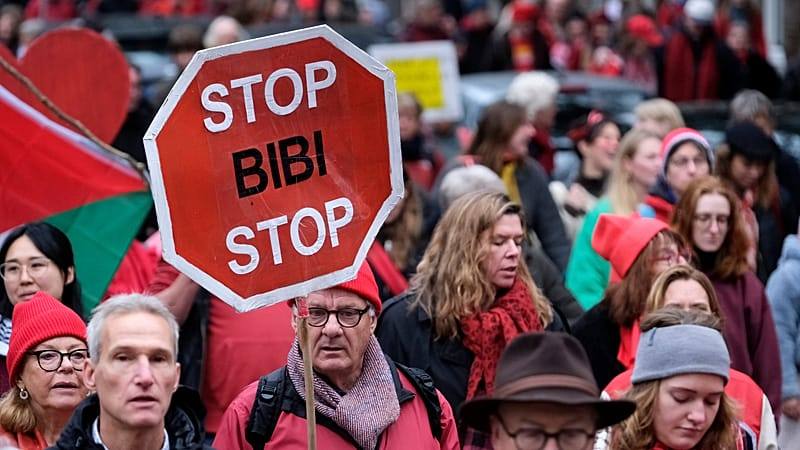
AMSTERDAM — Tens of thousands of people, many of them dressed in red, marched through Amsterdam on Sunday, November 8, in the fourth 'Red Line' demonstration, pressing the Dutch government to take tougher action against Israel over the war in Gaza, the Associated Press reported. The rally opened with speeches on Museumplein at 1 p.m. and the march that followed ran from about 1:45 p.m. to 4 p.m. through Amsterdam Zuid and Oud-West, filling Museum Square and the streets around the Van Gogh Museum under the theme 'No money for genocide'.
Source: Euronews / AP, Nov 8 2026; Magna Bureau, Nov 8 2026 — rally timing and route
How large the crowd was is itself disputed, and all three published figures are attributed here rather than settled. Amnesty International Netherlands, one of the organisers, said in an online post that more than 200,000 people took part. The Associated Press described the crowd only as tens of thousands. Organisers quoted by Agence France-Presse put attendance at about 20,000. No independent police estimate was reported in the coverage.
Source: Al Jazeera, Nov 8 2026 — Amnesty figure; AFP via Magna Bureau, Nov 8 2026 — organisers' lower figure
What the marchers demanded
The demonstration was organised by a coalition of 13 organisations, among them Amnesty International, Oxfam Novib, Save the Children, the peace group PAX and Doctors for Gaza, with The Rights Forum in the organising group. Their demands, as reported by AP and AFP, were threefold: extend the Netherlands' ban on trade with Israeli settlements to services and investment and push openly for the full suspension of the European Union's association agreement with Israel; stop all direct and indirect arms trade and military cooperation with Israel, including imports; and formally recognise Israel's conduct in Gaza as genocide. Israel rejects the genocide accusation and says its campaign followed the Hamas-led attacks of October 7, 2023, in which about 1,200 people were killed and 251 taken hostage.
Protesters waved Palestinian flags and carried placards reading 'Not in my name', 'Gaza is being starved' and 'Stop the Genocide', while chants of 'Free Palestine' echoed along streets closed to traffic. 'What is happening there is inhumane,' protester Mike van Dongen told the AP as he marched. 'As far as I'm concerned, [the Dutch authorities] are doing nothing. They don't dare take any serious steps.' AFP spoke with Steven Eisinger, a 33-year-old robotics engineer born in the United States who said he is Jewish and has family living in Israel; he said he attended to voice his backing for Palestinians and his opposition to genocide, and wanted all arms shipments to Israel to end.
A prime minister who once marched, now defending his record
Prime Minister Rob Jetten attended the May 2025 edition as D66 leader, but he did not take part on Sunday and said at his weekly press conference on Friday that it would be inappropriate in his role as prime minister. 'Every single day and every single week, we do what we can to alleviate the terrible situation there,' Jetten said, adding that his administration is 'exerting greater political and diplomatic pressure' on Israel to abide by its agreements on Gaza. Euronews reported that Jetten also said the government was pressing Hamas to respect security commitments.
Source: Al Jazeera, Nov 8 2026 — Jetten quotes; Euronews / AP, Nov 8 2026 — Jetten defence
The march lands on strained Dutch-Israeli relations. The Dutch foreign minister resigned last year after failing to secure new sanctions against Israel, and a new minority coalition government that took power in February introduced an import ban on products from Israeli settlements — settlements the Dutch government and most of the international community consider illegal — which provoked a diplomatic spat with Israel. Sunday's organisers want that settlement ban widened into the broader trade, investment and arms measures listed above, which the Jetten government has not adopted.
Source: Al Jazeera, Nov 8 2026 — resignation, coalition and settlement import ban
While Amsterdam marched, Gaza itself was dealing with a winter storm that flooded displacement tents across the Strip, with civil defence teams logging about 1,500 distress calls — the humanitarian conditions Sunday's protesters say Dutch and European policy must answer. Read the earlier report: Gaza winter storm floods tents, 1,500 distress calls
What is solid
- Tens of thousands marched in Amsterdam on Sunday, November 8, in the fourth Red Line protest, organised by 13 groups including Amnesty International, Oxfam Novib, Save the Children, PAX and Doctors for Gaza (AP; AFP; Al Jazeera).
- The marchers' demands were tighter trade restrictions on Israel including settlement services and investment, suspension of the EU association agreement, a halt to all arms trade and military cooperation, and recognition of Israel's conduct in Gaza as genocide — a characterisation Israel rejects (AP; AFP).
- Prime Minister Rob Jetten, who joined an earlier Red Line march as a party leader, stayed away on Sunday and defended his government's record at his Friday press conference (Al Jazeera; Euronews/AP).
What is only claimed
- The size of the crowd: Amnesty International Netherlands says more than 200,000 took part; organisers quoted by AFP put it at about 20,000; AP reported only 'tens of thousands'. No independent police figure was published in the reports used here.
- Whether Israel's conduct in Gaza amounts to genocide is the protesters' and organisers' demand and accusation; Israel rejects it and says its campaign is a response to the Hamas-led October 7, 2023 attacks. Casualty figures cited are Gaza Health Ministry figures as reported by AP and Al Jazeera.
What happens next
The Red Line coalition has now filled Amsterdam or The Hague four times — organisers put the earlier crowds at more than 100,000 in The Hague in May 2025, 150,000 there in June 2025 and 250,000 in Amsterdam last October — and Sunday's march keeps the same three demands in front of a minority government that has so far gone only as far as the settlement-products import ban. The next test is whether the Jetten government widens that ban to services and investment or moves on arms cooperation, the two steps protesters named first; neither was announced on Sunday. For Gaza, the march changes no facts on the ground — the ceasefire in place since October 2025 has still seen more than 1,550 Palestinians killed on Gaza Health Ministry figures reported by AP — but it adds the Netherlands to the list of European capitals where Gaza policy is now a standing street mobilisation rather than a one-off protest.