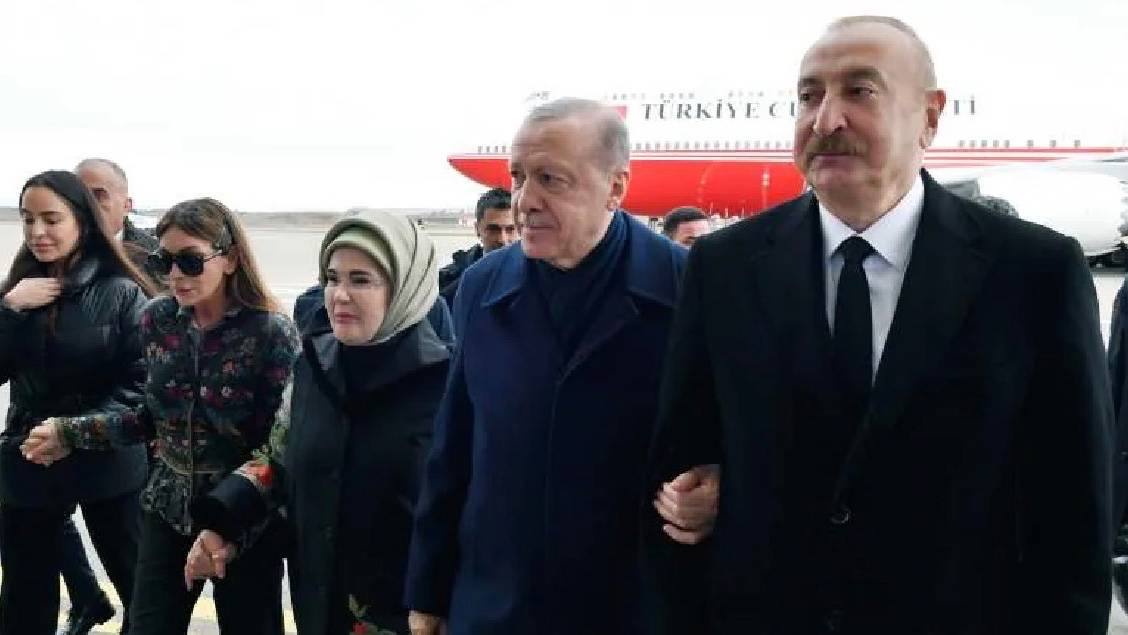
Turkish President Recep Tayyip Erdogan travelled to Azerbaijan's Karabakh region on Sunday, November 8, to mark the country's Victory Day, and used the visit to stage a public show of unity with President Ilham Aliyev after weeks of unusually open tension between the two close allies.
Source: AFP via Bangkok Post
Erdogan arrived in the Fuzuli district, which Baku recaptured in 2020 from Armenian separatist forces, and was welcomed at Fuzuli International Airport by Aliyev and First Lady Mehriban Aliyeva, with a guard of honour lined up at the airport. Azerbaijani media reported that the two presidents then walked arm in arm, chatting, as they left the airport. Erdogan was accompanied by his wife, Emine Erdogan, Foreign Minister Hakan Fidan, National Intelligence Organization (MIT) chief Ibrahim Kalin and other senior officials.
Source: Anadolu Agency via Daily Imroz
Aliyev laid a wreath at the Victory Monument in Khankendi in tribute to Azerbaijani soldiers and officers killed in the 2020 war, and described the liberation of Shusha on November 8, 2020 as the decisive moment of the conflict. November 8 marks Azerbaijan's capture of Shusha, a victory achieved with Turkish backing, and is observed every year as Victory Day.
Source: Brussels Reporter
An alliance 'eternal and unshakable'
After a bilateral meeting in Shusha, Erdogan and Aliyev held a joint press conference. Aliyev declared: 'The Turkey-Azerbaijan alliance is eternal and unshakable.' Referring to the 2020 war, he said: 'For 44 days, you and the brotherly Turkish people stood by our side. This will never be forgotten.'
Source: Agos
Erdogan said the bond between the two countries, described by the motto 'One nation, two states', was 'an everlasting torch that draws its strength from our shared past and illuminates our future'. He said Azerbaijan's 44-day Patriotic War had 'opened the door to a new era in the South Caucasus', and warned: 'Those who seek to weaken the brotherhood we strengthened through the alliance established by the declaration we signed in Shusha on June 15, 2021, will never achieve their goals — neither yesterday, nor today, nor tomorrow.'
Source: Agos
The rift the visit was meant to close
Tensions flared in September, when Baku revised school uniform regulations to prohibit additions deemed incompatible with secular education, effectively barring Islamic headscarves from classrooms. Erdogan's government has dismantled restrictions on hijabs in Turkey. The move sparked protests at home and drew criticism from Erdogan's ruling AK Party, including presidential adviser Oktay Saral, who demanded Azerbaijan reverse the restrictions. Aliyev's ruling Yeni Azerbaijan party denounced such comments as 'interference in Azerbaijan's internal affairs', and Baku declared 31 Turkish nationals, including an opposition lawmaker and party leaders, persona non grata over critical social media posts.
Source: AFP via Bangkok Post
Erdogan subsequently dismissed Saral, but Aliyev stayed away from the October 30 summit of Turkic leaders in Ankara — despite a personal invitation from Erdogan — and instead sent Foreign Minister Jeyhun Bayramov. Ahead of Sunday's visit, Erdogan congratulated 'dear brother' Aliyev on Azerbaijan's 'great victory' in the 2020 war, and said he hoped the trip would provide an opportunity to take 'necessary steps'. 'There is no obstacle that the brotherhood between Turkey and Azerbaijan cannot overcome,' he told reporters on Thursday.
Source: AFP via Bangkok Post
Erdogan had announced on Thursday that he planned to travel to Baku on November 8 for Victory Day, after the headscarf row and the skipped Ankara summit opened a rare public crack between the allies. Read the earlier story: Erdogan plans Baku visit after headscarf row
Analysts say the quarrel also reflects deeper disagreements. Elkhan Shahinoglu, head of the Baku-based Atlas Research Centre, told AFP that Azerbaijan 'does not see itself as the younger brother in this alliance and insists on relations between equal partners'. Gonul Tol, an analyst at the Washington-based Middle East Institute, said the hijab dispute was 'a symptom of a deeper rift', with tensions also running over Azerbaijan's sovereignty, Ankara's influence in Baku, diverging policies toward Israel, and Turkey's rapprochement with Armenia.
Source: AFP via Bangkok Post
Baku has forged strong military and economic ties with Israel, which supplied Azerbaijan with weapons during its 2020 war with Armenia — a relationship that has angered Ankara, which has grown increasingly hostile towards Israel over the war in Gaza. Turkey is also seeking to normalise relations with Armenia, whose border it closed in the 1990s in solidarity with Azerbaijan. Despite the friction, the two allies remain closely bound by military and energy ties, and Turkey serves as a key transit route for Azerbaijani oil and gas exports to Western markets.
Source: AFP via Bangkok Post
What happens next
The visit's programme included bilateral talks in Shusha, visits to the Khojaly Genocide Memorial and the Khankendi Victory Monument, and an official dinner. No new agreement was announced in the first reports of the day. What matters now is whether the public display of unity translates into concrete steps — including on the headscarf dispute and the 31 Turks barred from Azerbaijan — or whether the deeper disagreements analysts identified continue to simmer.
Source: Europesays / Daily Sabah