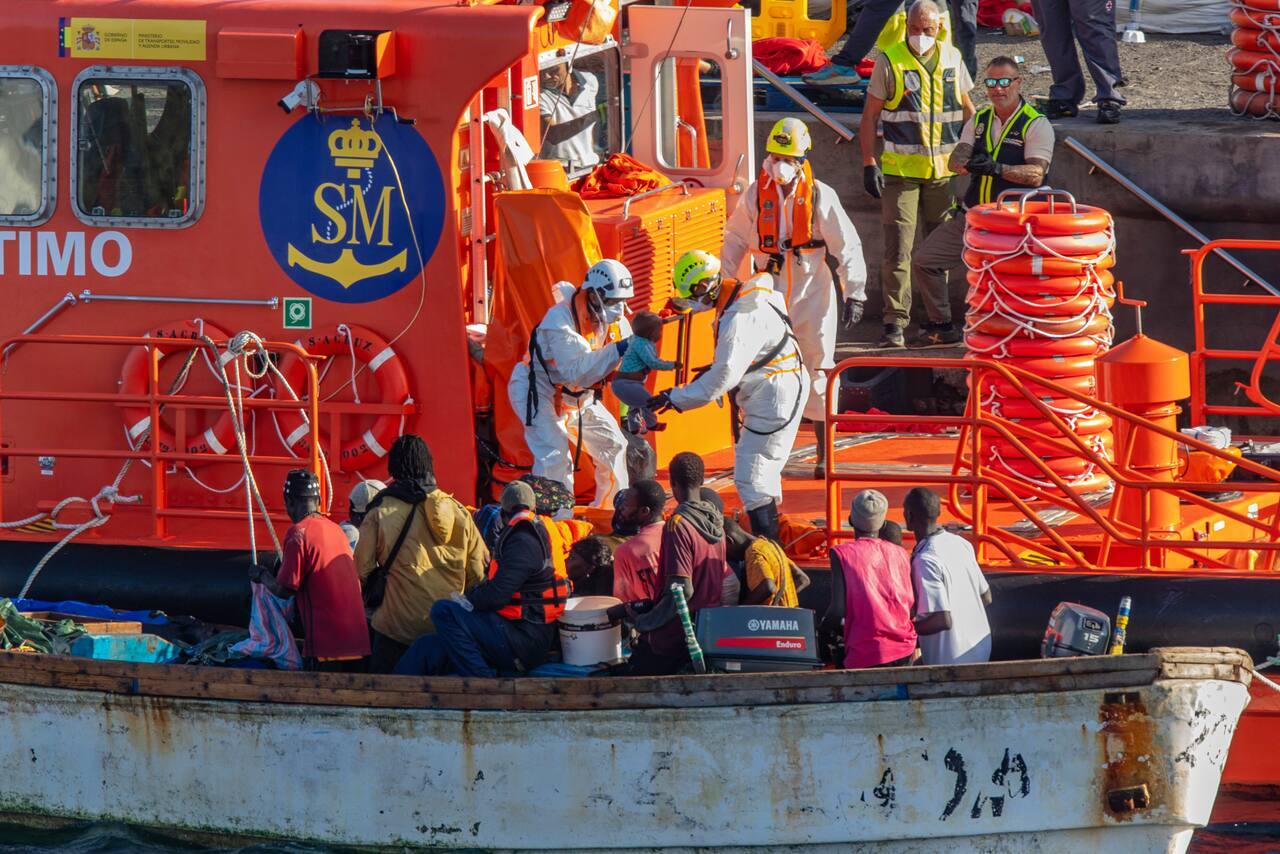
Nearly 2,000 migrants arrived on Spain's Canary Islands on Tuesday, a record high for migrants reaching the Atlantic archipelago on a single day, Spanish authorities said. The maritime rescue service said 1,990 people arrived on 15 different boats as search and rescue vessels accompanied one dinghy after another to the small island of El Hierro. Updated official tallies later put the one-day total at 2,121.
Source: Associated Press
"Sadly, this is a historic day," Fernando Clavijo, the Canary Islands' regional leader, said in an interview with Spanish radio Cadena Ser. He said El Hierro, the westernmost member of the archipelago, with a population of about 12,000, could not handle such a large influx of people, many of whom arrived exhausted and in poor condition.
Children among the arrivals
There were around 100 minors among Tuesday's arrivals, including a four-day-old baby who had been born during the journey, Clavijo said. The arrivals were moved to reception facilities on the island, and transfers of adult migrants to Tenerife and mainland Spain were stepped up.
Clavijo said he was satisfied overall with the transfer of adult migrants to mainland Spain, but added that he had asked for help from other regions to take in unaccompanied minors who need to be cared for by the authorities.
El Hierro had already set a single-day record earlier in November. Read our earlier report on that day. Read the earlier record story
Why November brings the surge
Departures from West Africa are seasonal, and November often sees spikes in numbers as many leave before the ocean becomes rough during winter. The seas have been calm recently, which has contributed to the high number of departures, and Clavijo noted the sailing conditions were favourable, with a full moon. Most of the boats that arrived on Tuesday were from Senegal and Gambia, he said.
The Canary Islands lie about 105 kilometres from the nearest African coast, but many migrants take longer routes to evade security forces. The journeys can last days or weeks, and the route is extremely dangerous — thousands have died attempting the crossing, with many boats missing their target and drifting into the open Atlantic.
More than 26,000 people have reached the Canary Islands this year, with half of that total arriving in November alone. The previous single-day record was hit just two weeks before, when 1,400 people arrived at Gran Canaria on November 7.
Migration dominates Spain's election week
The surge in arrivals came just before Spain holds a national election later this week, when migration will be a major concern for many voters. Spain's conservative Popular Party is aiming to unseat the ruling Socialist-led central government, and would likely have to form a government with the far-right Vox party, which is campaigning heavily on expelling migrants.
Without mentioning Vox, Clavijo, who belongs to the regional Canary Coalition party, denounced any attempts to demonise the migrants, calling it "a xenophobic discourse of bad people". He also criticised a recent deal by Austria, Denmark, Germany, Greece and the Netherlands to send migrants to Rwanda, calling it "ridiculous" and saying "Europe is on the wrong path".
What happens next: transfers from El Hierro to Tenerife and the Spanish mainland are continuing, and regional officials are pressing Madrid and other Spanish regions for help with reception and with unaccompanied children. Spain's prime minister has said he expects the number of boats arriving on El Hierro to decline in the coming weeks, but with the election days away, the record day is certain to stay at the centre of the campaign.