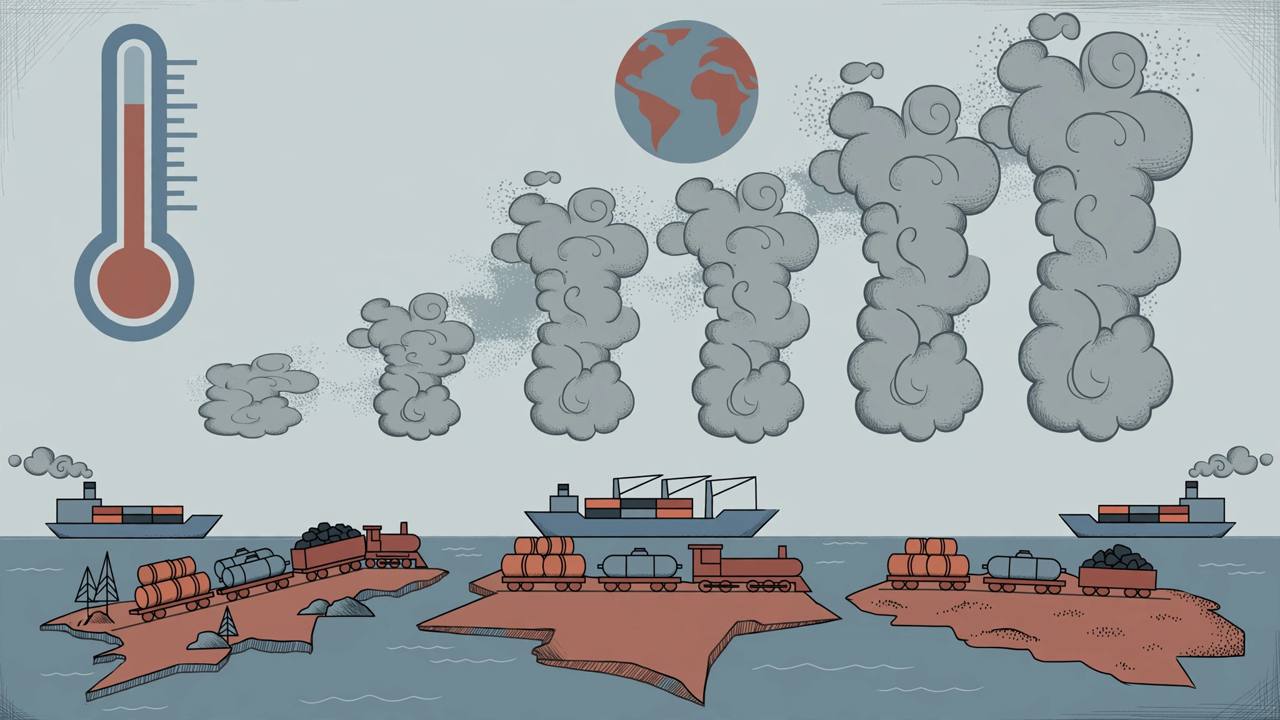
Russia, Saudi Arabia and Australia are the largest exporters of carbon dioxide (CO2) emissions in history, a Carbon Brief analysis published on Tuesday reveals, based on fossil fuel exports since 1850 that have been burned in other countries.
Source: Carbon Brief
The analysis uses extraction-based accounting: instead of counting emissions in the country where coal, oil and gas are burned, it assigns them to the country that extracted the fuels. Carbon Brief's figures are based on a dataset compiled by Robbie Andrew, a senior researcher at the Norwegian climate institute CICERO, covering 1850 to 2025; Andrew notes the dataset is a draft release based on available data, and population figures come from the UN Population Fund.
Russia tops the list, responsible for more than 70 gigatonnes of CO2 produced by burning its exported fossil fuels through the end of 2025. Saudi Arabia comes next with about 60 gigatonnes, and Australia is third with more than 25 gigatonnes, slightly ahead of Venezuela. Other major CO2 exporters over the 175 years include Venezuela, Iran, Norway, the United Arab Emirates and Canada, Carbon Brief said. Between them, the major coal, oil and gas producers have exported hundreds of billions of tonnes of CO2.
Source: The Guardian
How the rankings change when exporters carry the carbon
Counting exports reshuffles historical responsibility. The United States and China retain the largest overall responsibility for historical warming under extraction-based accounting, despite both having been net CO2 importers since 1850 — the US a major oil importer until after the shale revolution of the early 2000s, and China still a major oil and gas importer. Russia remains third overall, gaining responsibility for an extra 69 billion tonnes of CO2 from its exports. The United Kingdom becomes the fourth-largest historical emitter, climbing above Germany because of Germany's reliance on fossil fuel imports.
Saudi Arabia becomes responsible for the world's fifth-largest share of historical warming once its fossil fuel exports are included, which increase its cumulative emissions more than fourfold. Australia also climbs into the top ten largest emitters, with its share of historical emissions more than doubling. Countries that drop down the rankings because they rely on fossil fuel imports include Germany, India, France and COP31 host Turkey. Japan is the sharpest example: sixth-largest emitter on a territorial basis, but only 34th on an extraction basis, because it is almost completely reliant on fossil fuel imports. On a per-person basis, small oil and gas exporters stand out — Brunei, Kuwait, Qatar, Norway and Trinidad and Tobago have the highest extraction-based emissions per person.
"At the end of the day, it's not solely the responsibility of extracting countries that fuels are combusted; it's joint responsibility between extractors, producers and consumers," Robbie Andrew told Carbon Brief, noting that responsibility for past decisions is shared by many actors — oil production in the Middle East, for example, was historically developed by and for western powers.
Released as Australia co-presides over COP31
The timing sharpens the politics. Australia is co-president of this year's UN climate summit, COP31 in Antalya, Turkey, alongside the host nation, and has been under pressure for continuing to expand its fossil fuel production ahead of the summit. At COP31, Australia issued the first draft of a potential summit outcome on Monday, calling for "the immediate transition away from fossil fuels in energy systems", the Guardian reported. Climate Analytics published an analysis on Tuesday indicating Australia has no apparent plans to reduce its domestic fossil fuel extraction despite presiding over COP31, according to Tasnim's report of the findings.
Source: Tasnim News Agency
Saudi Arabia pushed back on the framing. A representative of the Saudi energy ministry told the Guardian that the kingdom accounted for approximately 1% of historical global CO2 emissions generated within its borders, and pointed to peer-reviewed research published in the journal Science that identified Saudi crude oil as having comparatively low upstream carbon intensity.
Carbon Brief notes there are many ways to assign historical responsibility — territorial emissions, consumption of imported goods, colonial rule, or per-capita counts — and that this year is expected to be around 1.5C hotter than pre-industrial temperatures, with next year forecast to be the hottest on record at around 1.7C of warming. What happens next is at Antalya itself: COP31 negotiators must decide whether the summit's final text keeps Australia's draft call for an immediate transition away from fossil fuels, against resistance from major producers — the same producers this analysis puts at the top of the historical export table.