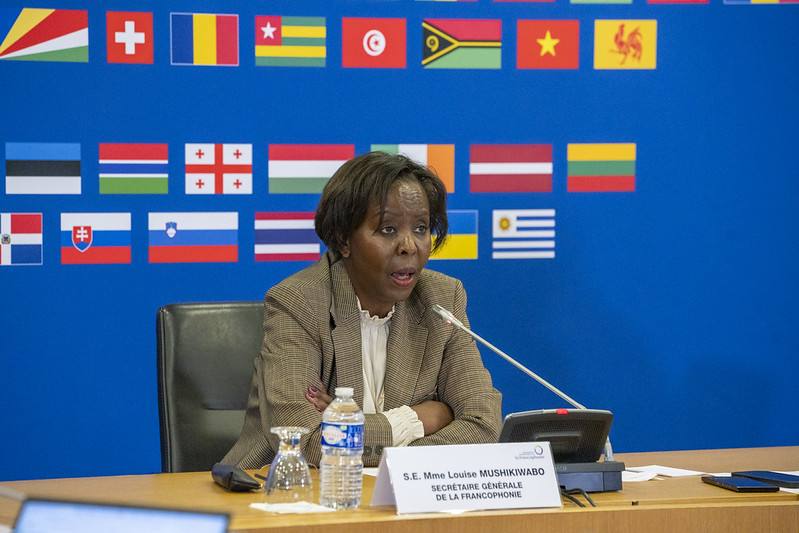
Leaders of the Organisation internationale de la Francophonie (OIF) opened a three-day summit in the Cambodian capital, Phnom Penh, on Sunday with a fight over the organisation's top job threatening to split the French-speaking world, the Associated Press reported. The summit runs through Monday under the slogan “Reinvest in Peace for Shared Prosperity and Lasting Stability”.
Source: Associated Press via Al Jazeera
The OIF is a loose confederation of 90 states and governments where French is spoken or widely used, with 53 full members, five associate members and 32 observers. About 20 leaders are expected in Phnom Penh, including Canadian Prime Minister Mark Carney, Vietnamese President To Lam, Rwandan President Paul Kagame and DR Congo President Felix Tshisekedi. French President Emmanuel Macron, who chaired the last summit in 2024 and hands the chair to Cambodia, arrived on Saturday and met Cambodian Prime Minister Hun Manet, AP reported.
A vote on Monday, and a threat to walk out
On Monday the leaders will choose the OIF's next secretary-general for a four-year term. Rwanda's Louise Mushikiwabo, who has led the organisation since 2019, is seeking a third term. The Democratic Republic of Congo has threatened to leave the OIF if she is re-elected — an exit that would be a heavy blow: with a population of more than 110 million, the DRC is the most populous country where French is an official language, roughly 40 million more people than France itself.
In a bid to defuse the row, the DRC on Saturday withdrew its own candidate, Juliana Lumumba — the daughter of Congolese independence hero Patrice Lumumba — and backed Romania's former prime minister Dacian Ciolos instead, saying the move would allow “consensus around a unifying candidacy”. DR Congo Foreign Minister Therese Kayikwamba Wagner announced the position in Phnom Penh, saying Kinshasa was ready to pull its candidate if Rwanda also withdrew its nominee in favour of a consensus pick, News Central reported.
Source: News Central
Rwanda refused. Foreign Minister Olivier Nduhungirehe said Mushikiwabo would stay in the race, and Kigali said Macron had asked Kagame to withdraw her candidacy and that the request was rejected, AFP reported. Mauritania's former minister Coumba Ba is also running. Macron's office said most members agreed on the need for consensus and that he would take the issue up with his African counterparts. France is the biggest contributor to the OIF's 2026 budget of 71.7 million euros (about $79 million — yaani lagbhag 7.17 crore euros), AP reported.
Why Kinshasa and Kigali are at odds
The leadership fight is inseparable from the war in eastern Congo. The DRC, the United States and United Nations experts say Rwanda backs the M23 armed group, one of about 100 armed groups fighting in the mineral-rich east. Rwanda denies the allegation. That dispute has now spilled into an organisation built around a shared language, turning a normally quiet election into a test of whether the bloc can hold together.
A Congolese walkout would follow other fractures: Mali, Niger and Burkina Faso announced their withdrawals from the OIF in March 2025 after being suspended over military coups. The summit is also a moment in the spotlight for host Cambodia, a de facto one-party state: UN Special Rapporteur Tom Andrews urged delegates to press for the release of detained activists, saying, “No one should be detained for defending human rights, reporting on matters of public concern, or voicing critical opinions.” Macron is due to visit the Angkor World Heritage Site on Monday before leaving for Malaysia.
What happens next
The secretary-general election is scheduled for Monday, the summit's final day. If Mushikiwabo wins a third term, attention will turn to whether Kinshasa carries out its threat to quit — a decision that would remove the Francophonie's largest French-speaking nation and deepen the organisation's split with Africa, where most of its members and most of the world's French speakers live.