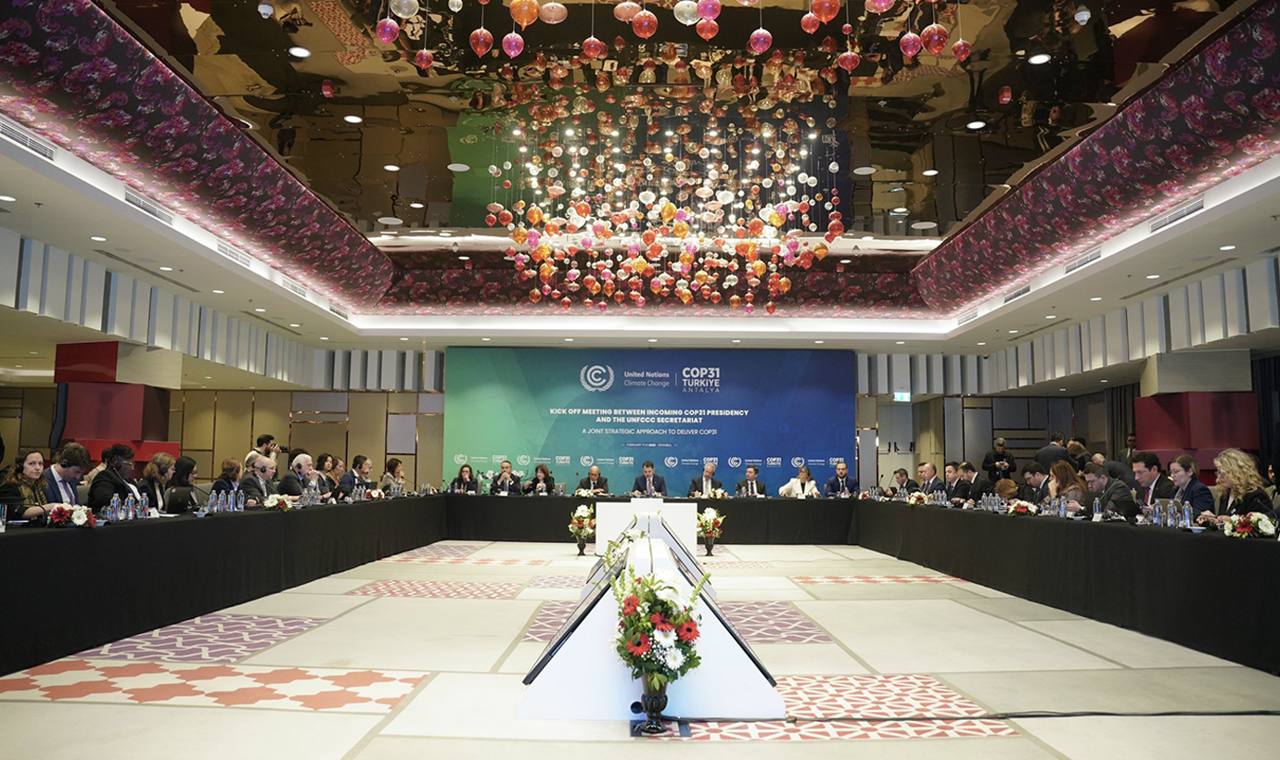
ANTALYA, Türkiye — The COP31 Presidency on Monday, November 16, launched a package of technology actions for the climate summit's second week, headlined by the Antalya Artificial Intelligence Pledge — a voluntary framework asking governments, companies and organisations to make AI part of the climate solution while cutting the technology's own environmental footprint — alongside an AI-Enabled Cleantech Initiative and an Antalya Green Industrialisation Compact.
Source: COP31 Presidency statement, via Ghanaian Radar
The pledge, developed by Türkiye's COP31 Presidency in cooperation with the International Telecommunication Union (ITU), the UN agency for digital technologies, was formally launched at the High-Level Green Digital Action Roundtable on AI on November 16, the ITU confirmed. It sets out action in four areas: powering and building AI infrastructure and hardware sustainably; designing, managing and procuring AI responsibly across its lifecycle; supporting assessment and reporting of AI systems' environmental impacts; and strengthening financial support and technical infrastructure for AI for climate action, particularly in developing countries, least developed countries and Small Island Developing States.
Source: International Telecommunication Union (ITU)
Signatories can add voluntary commitments on energy and environmental disclosure, low-emission power for AI infrastructure, green data-centre requirements, resource-efficient AI design, circularity and e-waste, skills development and computing capacity. The Presidency said early supporters from governments, academia, civil society and the private sector had already signed at launch, and endorsement remains open between COP31 and COP32. The pledge is voluntary and creates no binding obligations — a limit critics noted when it was first announced in September.
COP31 President Murat Kurum said: “Industry and technology must be part of the climate solution. We need to electrify industry, adapted to the starting point and strategic choices of each country. At the same time, we need to ensure that the rapid growth of AI is powered and deployed responsibly and used for the benefit of climate actions.” ITU Secretary-General Doreen Bogdan-Martin said: “AI is a powerful tool for tackling the climate crisis, but it must be used responsibly. The Antalya AI Pledge galvanizes international action towards sustainable, accountable AI innovation that benefits everyone, especially the most climate-vulnerable nations.”
Green industrialisation package
The Green Industrialisation Compact emphasises investment and practical outcomes for near-zero and low-emission industrial production, recognising that countries and industries start from different positions. It sits alongside the Least Developed Countries Green Industrialisation Facility (LDC-GIF), presented on November 12, which combines project development, technology matching and transfer, capacity support and links to finance under the UN Technology Bank for LDCs, hosted by Türkiye, and guidance issued the same day by the Presidency, the OECD and the 50-country Climate Club on country platforms for industry transformation. UNIDO Director General Gerd Mueller said: “No country should have to choose between development and climate action. Green industrialization is key to reducing emissions while building the clean technology industries, skills and quality jobs of the future in every region.”
The Presidency, ITU, UN-Habitat and the UNFCCC will also launch a call to action on using AI, digital twins and the Internet of Things to accelerate urban climate action, inviting governments, cities, companies and universities to back measures for smart, resilient cities. Together, the Presidency said, the actions support its 35-by-35 ambition to raise electricity's share of final energy consumption from about 23 percent today to 35 percent by 2035.
Science 'front and centre' as negotiations begin in earnest
As the voluntary action agenda launched, the negotiated track entered its decisive phase. COP31 President of Negotiations Chris Bowen said he is working with Parties to make progress across the agenda as the summit enters week two, and called for science to stay front and centre: “The latest science tells us that we will overshoot the 1.5-degree goal, but science also shows that we can return to safer temperatures if we work together and act with urgency.” Research into the Paris Agreement overshoot by Professor Johan Rockström was presented at the summit on Monday.
What happens next runs on two tracks. Endorsement of the AI pledge stays open until COP32, with implementation cooperation planned to begin immediately after COP31 — so its test will be whether signatories publish the energy and environmental disclosures it asks for. In the negotiating rooms, ministers arriving for the final week must settle the summit's cover agreement by November 20, including the contested questions of fossil fuels, climate finance and how the text treats the expected overshoot of 1.5°C.