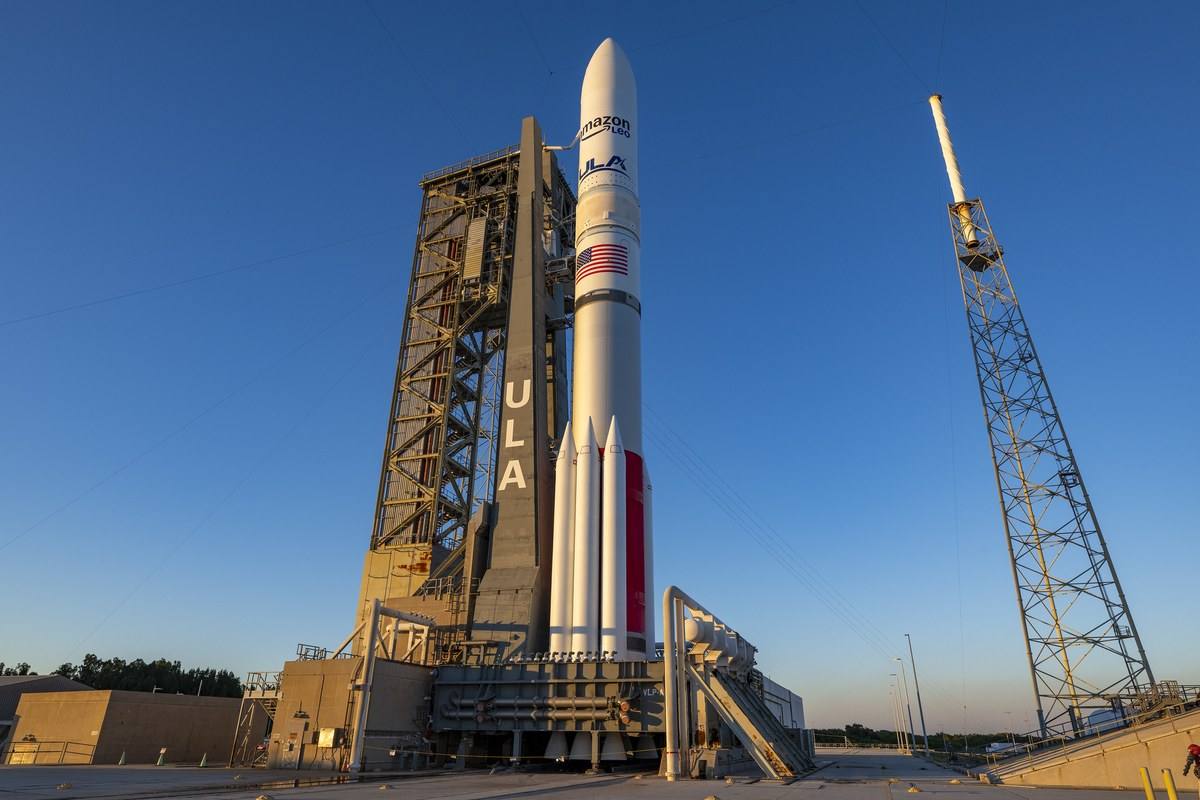
A Vulcan rocket owned by United Launch Alliance (ULA), the joint venture of Boeing and Lockheed Martin, failed shortly after liftoff from Florida on Sunday, destroying its payload of 40 satellites from Amazon's Leo internet network in the launch company's first outright mission failure, Reuters reported.
Source: Reuters
The 214-foot rocket blasted off from Space Launch Complex 41 at the Cape Canaveral Space Force Station at 12:40 p.m. Eastern time, riding 3.8 million pounds of thrust from six Northrop Grumman strap-on solid-fuel boosters and two methane-burning BE-4 engines built by Jeff Bezos's Blue Origin, Spaceflight Now reported. The flight, designated LV-01, was Vulcan's fifth since its January 2024 debut, its first in nine months, its first with six solid boosters — and the first of 38 Vulcan launches Amazon has bought for its Leo constellation.
Source: Spaceflight Now
Anomaly 10 minutes into the flight
"Based on data received by our Launch Director, we confirm that the Vulcan vehicle launched from Space Launch Complex 41 suffered an anomaly 10 minutes into the flight and failed to deliver the Amazon mission to orbit," ULA said in a statement issued about 50 minutes after liftoff. "Every flight generates data, and every flight teaches us something. Since the anomaly just occurred, we don't have any specific data yet to understand what occurred today," the company added.
The six solid boosters appeared to perform normally, burning out and falling away about a minute and 40 seconds into the flight, according to Spaceflight Now and GeekWire. But the first stage appeared to burn longer than ULA's pre-launch timeline called for, and after it separated, a telemetry-driven animation showed the hydrogen-fuelled Centaur upper stage — powered by two RL10 engines — making unusual orientation adjustments early in its planned 12-minute 15-second burn. ULA has not said whether the countdown hold called at T-minus 20 seconds over an unexplained technical issue, or the delays that scrubbed Friday's attempt (a gaseous nitrogen plant failure) and Saturday's (ground network problems), played any role.
A 20-year perfect record ends
ULA was formed in 2006 from Boeing's Delta and Lockheed Martin's Atlas rocket programmes and had kept a 100% mission success record ever since. Sunday's loss ends that streak. The failure is expected to lead to a lengthy technical investigation that grounds Vulcan for months, Reuters reported, deepening a US launch bottleneck as SpaceX's Falcon 9 — the world's most active rocket — heads toward retirement and is no longer accepting new bookings. Blue Origin is working with ULA on the investigation, according to a person familiar with the matter cited by Reuters, and NASA Administrator Jared Isaacman offered his agency's help on X, writing that "Artemis, Moon Base, and the nation need ULA."
Vulcan had already been under scrutiny. Its solid-booster nozzles failed on flights in October 2024 and in February 2026 on a US Space Force mission; both payloads still reached orbit, but the Space Force paused Vulcan's national-security launches pending analysis, and Sunday's rocket flew with an improved nozzle design. Its BE-4 engines had also been retrofitted to fix the oxygen-valve problem blamed for a launchpad explosion of Blue Origin's New Glenn rocket in May — the same engine family powers both rockets. ULA has not identified any of these systems as the cause of Sunday's failure.
Amazon's race against Starlink slips again
Amazon called LV-01 an inaugural mission and stood by its partner: "There is risk with any launch, and that's especially true for inaugural missions like LV-01. ULA has been a trusted partner for Amazon, and we believe they'll learn from this mission and deliver on their long-term plans for Vulcan." Amazon has deployed roughly 400 Leo satellites across 14 launches since 2025 — about 12% of the 3,236 satellites it needs for global service coverage — while SpaceX's Starlink already has more than 11,000 satellites and millions of customers, Reuters reported. Amazon has also booked 24 launches on Blue Origin's New Glenn, 24 on Europe's Ariane 6 and 13 on SpaceX's Falcon 9; its next Leo launch, an Ariane 6 carrying 36 satellites, is targeted for November 23 at the earliest, GeekWire reported.
Source: GeekWire
ULA and Blue Origin engineers will work through flight telemetry to find the cause, set corrective action and only then return Vulcan to flight — a process Reuters says could keep the rocket off the market for months. The US Space Force's pause on Vulcan national-security payloads, which was awaiting this mission's performance, also remains unresolved.