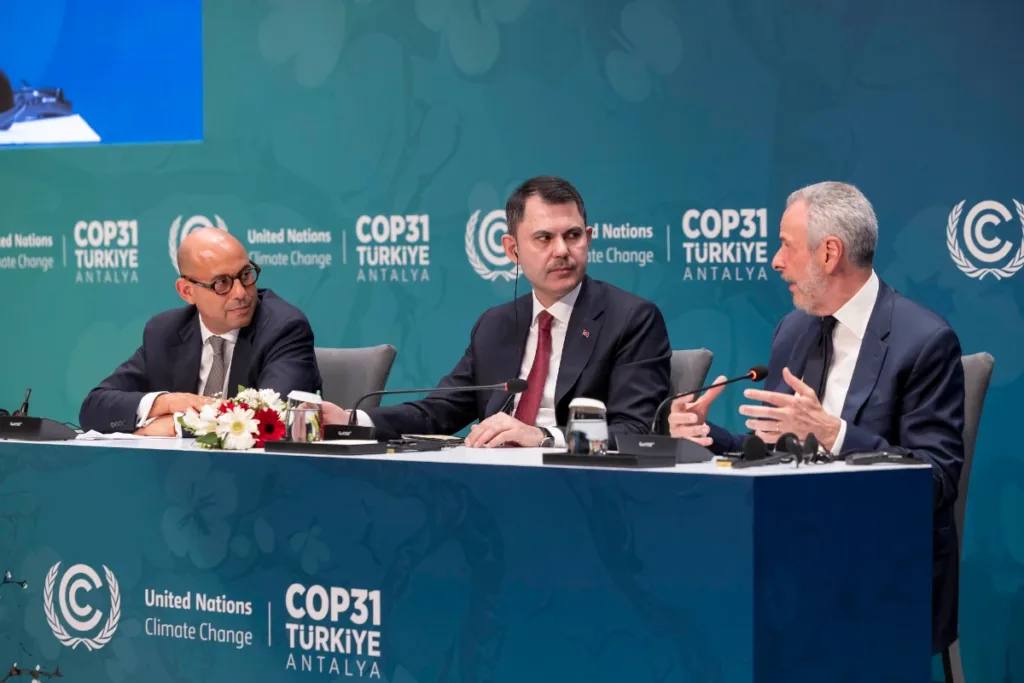
Negotiators at the COP31 climate summit in Antalya, Türkiye, received their first draft texts on a just-transition mechanism and on adaptation finance late on Friday, setting the terms of the fight for the summit's second and final week. The texts were issued by the Australian-led presidency — Australia leads the formal negotiations while Türkiye hosts — and ministers now take over the most divisive questions, with the conference due to close on Friday, November 20.
Source: AsiaToday / AT Network
Nearly 200 countries are working through 165 negotiating mandates in Antalya, where the talks run from November 9 to 20. As the summit passed its midway point on Saturday, UN climate chief Simon Stiell urged delegates to confront the hardest questions without delay: "As we head into the second week, I urge Parties to move swiftly to the hardest issues and to avoid tactical delays. There is no collective success without compromise from every Party."
Just-transition draft draws fire: a mechanism 'in name only'
The just-transition draft sets up a mechanism in two tiers, whose main outputs would be a knowledge hub, published reports, an annual meeting and help matching national requests with support that already exists. It creates no new funding of its own. Australia's Climate Minister Chris Bowen, who leads the formal negotiations, described the text as comprehensive.
Campaigners disagreed sharply. Amiera Sawas of the Fossil Fuel Treaty Initiative described it as a mechanism "in name only", and the Climate Action Network said in its COP31 bulletin that the text "breaks the promise of Belem" and should be sent back for redrafting, arguing it could not serve as a basis for negotiation. The least developed countries want political guidance kept apart from practical delivery, while advocates argue any mechanism should be led by governments and funded through grants, so it does not add to the debts of poorer nations.
Adaptation finance: $120 billion a year, or a review
A separate draft on the global goal on adaptation would triple finance for adaptation to at least $120 billion a year by 2035 — yaani roughly 12,000 crore dollars a year. A second option in the same text would instead open a review of the target's baseline, size and scope, with findings reported to a later summit. African delegations are expected to resist that option, and the Climate Action Network urged negotiators not to delay the goal further.
The argument turns on the starting point. Rich nations promised at Glasgow to double adaptation finance to about $40 billion a year by 2025, and tripling that figure produces the $120 billion number. But the COP30 agreement in Belem set no baseline, and the UN Environment Programme estimates developing countries need at least $305 billion a year. African negotiators also failed to secure a standalone agenda item on tripling adaptation finance; Dr Antwi Amoah of Ghana, who chairs the African Group of Negotiators, confirmed the proposal was not adopted, with developed countries preferring to handle the question through a broader climate finance work programme.
Finance work programme stalls on its own mandate
Disagreement over that wider programme has itself stalled substantive discussion. A 104-paragraph draft circulated on November 14 offers three possible timelines for the Climate Finance Work Programme on Article 9.1 of the Paris Agreement — ending at COP33, concluding in 2027 at COP32, or leaving the timeframe open. The Group of 77 and China, speaking for 134 developing countries, called for agreement on scope and working methods before substantive talks began, while the European Union, Britain, Canada, Norway and Switzerland argue the arrangements were already settled in the Belem decision.
Fossil fuels and electrification still divide the room
The presidency has also published a summary of options for the summit's main cover decision, including advancing the transition away from fossil fuels — a document campaigners have dismissed as a wishlist, with none of its contents agreed. Australia is promoting a pledge to raise electricity to 35% of final energy use by 2035, from 23% today; the head of the EU delegation told Reuters Europe backs the goal but that "for the EU, electrification must use clean energy sources", while Türkiye wants an electrification proposal at the centre of any deal without requiring the extra power to come from renewable sources. The United States has skipped the talks for a second year, although a 19-member group of Democratic members of Congress is attending.
Outside the conference centre, thousands marched through Antalya in the rain on Saturday to demand climate justice as the summit reached its halfway point. Read: Thousands march in Antalya as COP31 hits its midpoint
What happens next
The presidency is collecting submissions over the weekend and plans a first draft of the cover decision early next week, although no date for a formal draft has been confirmed. Ministers will then take up the most divisive questions in the final days: whether the $120 billion adaptation figure survives, whether the fossil-fuel language holds, and whether the just-transition mechanism gains funding of its own will show how much of week one survives into the final text.