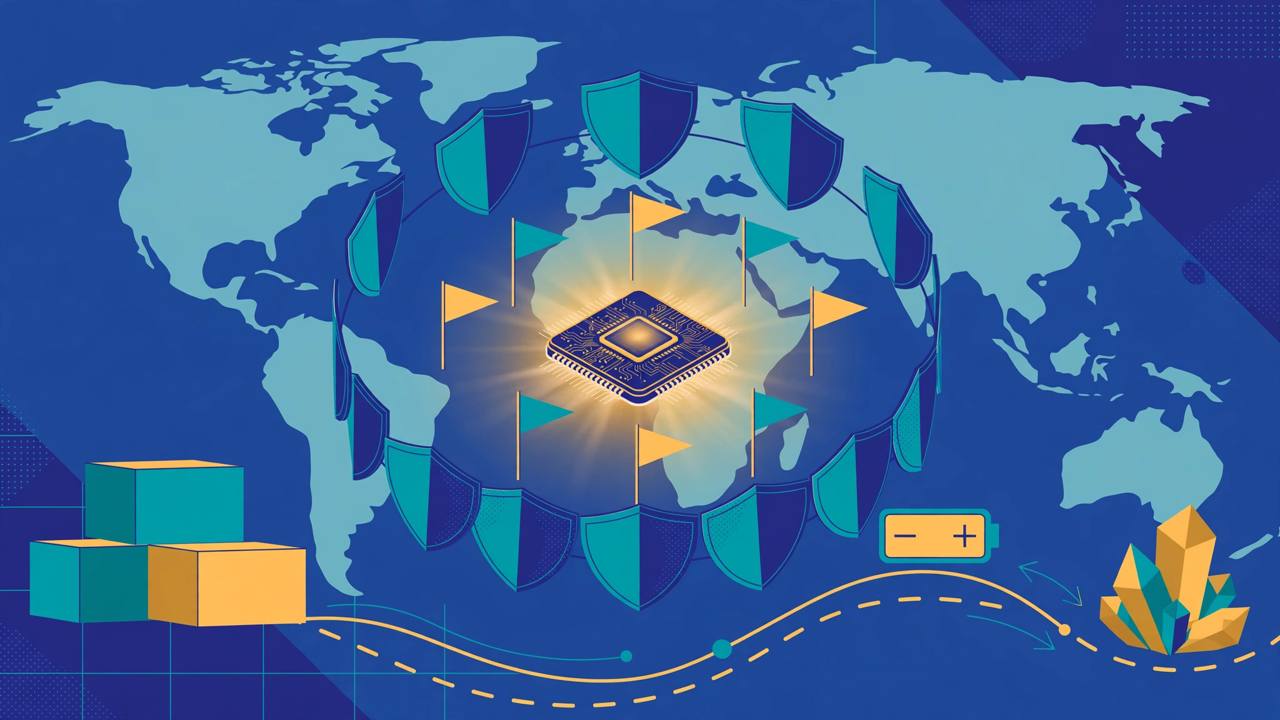
The United States and eight partner countries have signed a new declaration to shield the technologies behind artificial intelligence from China, the Financial Times reported on Sunday. The agreement — the San Francisco Declaration on the Secure Foundations of Enduring Prosperity — was signed in San Francisco on November 15, expanding the US-led Pax Silica initiative.
The nine signatories are the United States, Japan, Australia, Israel, the United Kingdom, South Korea, India, Qatar and the United Arab Emirates. Germany, Sweden, the Netherlands and the European Commission are expected to sign next week, according to Jacob Helberg, the US under secretary of state for economic affairs, who negotiated the pact and briefed the Financial Times.
What the declaration does
Under the declaration, the signatories will build a joint list of sensitive technologies and critical infrastructure that need protecting — the industrial foundations of the AI economy, from advanced semiconductors to critical minerals, energy and industrial capacity. They will coordinate measures to improve supply security and develop new industrial and investment hubs linked to artificial intelligence.
The aim is to reduce strategic dependence on China, which dominates much of the supply chain for critical minerals and rare earths used in chips, electronics and clean energy. The declaration commits the group to identify the technologies that deserve protection from theft or unauthorised transfer to actors who could use them for military or intelligence advantage.
Pax Silica, launched by the US State Department in 2025, already counts 25 signatories to its original declaration, with Taiwan participating without signing, according to the State Department's Pax Silica page. Sunday's step moves the coalition from broad declarations to naming the specific technologies it will defend together.
Timing: days before Trump meets Xi
The pact lands days before US President Donald Trump is due to meet Chinese President Xi Jinping at the Asia-Pacific Economic Cooperation (APEC) summit in Shenzhen, which opens on November 18. The leaders are expected to hold their third meeting this year, with trade, technology and the future of the US-China relationship at the centre of the talks.
India's presence among the signatories is notable for readers in India and the diaspora: New Delhi is being brought inside a US-led technology-security bloc at a moment when Washington is also pressing its allies to reduce reliance on Chinese supply chains.
What is not yet public
As of Sunday evening, the State Department had not published the new declaration on its Pax Silica release feed — its most recent entry was still Paraguay's accession on October 23 — so the account of what was signed rests on the Financial Times report and Helberg's briefing. The declaration's full text, and the joint list of protected technologies, have not been published yet.
What happens next
The next test comes in the week ahead, when Germany, Sweden, the Netherlands and the European Commission are expected to add their signatures. The joint list of sensitive technologies will show whether the pact has real teeth — and the Trump-Xi meeting in Shenzhen will show whether Beijing treats it as a provocation or as a bargaining chip in the wider US-China talks.