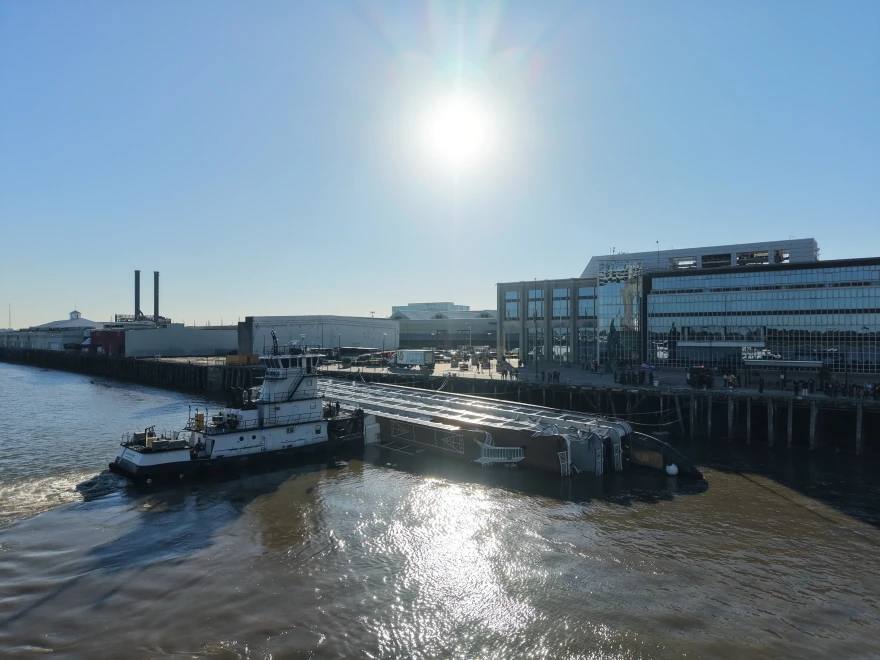
NEW ORLEANS, Louisiana — The Port of New Orleans has sued the owner and operator of the tanker Atlantic Asphalt and won a federal seizure order against the ship, two days after the tanker struck the docked river cruise paddlewheeler American Heritage on the Mississippi River and sent it rolling onto its side with nearly 200 people aboard. Awaaz Punjab reported the collision itself on Friday, November 13; this report covers the legal action, the hospital update and the salvage operation that have followed it.
Source: NPR / Central Florida Public Media
The lawsuit, filed by the Board of Commissioners of the Port of New Orleans, seeks at least $1 million in damages from the tanker's owner, Nave Shipping SA, and its management company, Thome Ship Management. It says the Thalia Street terminal, where the American Heritage was docked in front of the port's administration building, suffered significant damage: “The extent of said damage remains under investigation, but physical damage is currently estimated to exceed [$1 million], with additional substantial direct, indirect and consequential damages anticipated.” The port says it also expects to pay for clean-up, surveys, repair, replacement and salvage work.
What happened on Friday
The American Heritage, a 150-passenger paddlewheel riverboat christened in 2015 and operated by American Cruise Lines, had arrived in New Orleans on Friday morning at the end of a weeklong Mississippi River cruise and was docked at the Thalia Street terminal for passenger disembarkation, with travellers set to spend one more night aboard before heading home. At about 12:30 p.m., the northbound Atlantic Asphalt — which reportedly lost power or steerage as it passed under the Crescent City Connection bridge, with a pilot from the New Orleans-Baton Rouge Steamship Pilots Association (NOBRA) aboard — veered sharply and struck the riverboat's aft section. Within minutes the American Heritage listed, rolled onto its side and sank partially in the low-stage river.
Source: WorkBoat
Harbor Police Chief Melanie Montroll said 87 passengers and crew were able to get off before the ship capsized, and rescuers pulled the remaining people — more than 100 in total, according to Mayor Helena Moreno — from the river in about 30 to 45 minutes. Harbor Police officers were first into the water, joined by the port's fire boat Gen. Roy S. Kelley and towing and barge crews who reached the scene within seconds. Moreno called the outcome “the miracle on the Mississippi,” and Louisiana Governor Jeff Landry echoed her: “It is a literal miracle on the Mississippi when you think about the population that was on that cruise ship and the ability for us to get them off and out of the water.”
Thirty-two people were taken to hospital — 30 passengers and two Harbor Police officers — none with critical injuries. As of Saturday, eight people remained in hospital, two of them in serious condition. American Cruise Lines said it was settling everyone who had been aboard into hotels and replacing what they needed; many passengers lost clothes, prescriptions and car keys when the ship sank, and chaplains from maritime ministries provided trauma care at the port building where survivors were triaged.
The seizure order and the negligence claim
On Friday, hours after the collision, port officials asked a federal court to seize the tanker and sell it to cover the damage. A federal judge approved the seizure request, and the Atlantic Asphalt has since been towed away from the site. In its filing, the port claims the collision occurred “as a result of the negligence, gross negligence, fault or carelessness” of the tanker and the two companies. That is the port's allegation in a court filing; it has not been tested in court, and neither Nave Shipping nor Thome Ship Management has publicly answered it in the reporting so far.
Source: Associated Press via Louisiana First News
The Atlantic Asphalt is a 520-foot (160-metre) tanker built to carry asphalt and bitumen and sailing under the Marshall Islands flag. Shipping records cited by the Associated Press list its owner, Nave Shipping SA, as registered in Monrovia, Liberia, and as a subsidiary of the China State Shipbuilding Corporation. Vessel-tracking data shows the tanker called at Amuay, Venezuela, in mid-October, discharged part of its foreign-loaded cargo at Paulsboro, New Jersey, on October 24, left New Jersey on October 26 and arrived in New Orleans on November 11, two days before the collision.
Source: gCaptain
Salvage, fuel and reopening the river
Coast Guard Captain Melanie Burnham, commander of Sector New Orleans, said the work has now shifted to fully reopening the river and safely removing the fuel and other hazardous material still aboard the sunken riverboat. “We're going to have divers in the water so they can do a full assessment on what's the right path to be able to remove it,” Burnham said, adding that teams have been deployed across the area to monitor for pollution. Traffic restrictions remain in place on that stretch of the Mississippi — the Coast Guard initially closed the river to all vessels between mile markers 93 and 96 — and officials say it could take weeks to remove the American Heritage, which remains on its side against the terminal.
What happens next
The National Transportation Safety Board (NTSB), working with the Coast Guard, is investigating. NTSB board member John DeLeeuw said Saturday that the tanker's voyage data recorder has been recovered: “It's like a flight data recorder on an aircraft. We can look at speeds and all kinds of information.” Burnham said the tanker appeared to have a steering problem, but the exact cause of the crash is still unknown. The NTSB expects a preliminary report within 30 days and a final report, with probable cause and safety recommendations, in 18 to 24 months. Separately, the port's lawsuit will now move through federal court, where the seized tanker's owners can contest both the seizure and the damage claim.
Officials credit the speed of the response: 87 people walked off before the capsize, Harbor Police went straight into the water, and the port fire boat and nearby towing crews were holding the tanker and pulling people out within seconds of the impact.