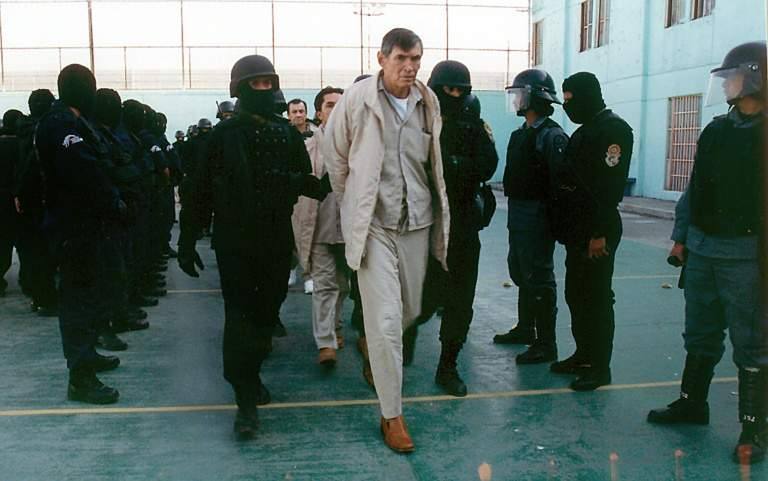
Miguel Angel Felix Gallardo, the founder of Mexico's Guadalajara cartel and one of the architects of the modern drug-trafficking trade, died in hospital on Sunday, November 15, at the age of 80, local security authorities said.
Source: Reuters
Felix Gallardo was transferred from prison to a private hospital in the western city of Guadalajara two days earlier and died at around 2 p.m. on Sunday after suffering multiple organ failure, Reuters reported. The security ministry of Jalisco state, where he was being held, said he had remained under observation with a guarded prognosis before he died at the medical facility, according to AFP.
Source: AFP
From police officer to 'boss of bosses'
Born on January 8, 1946, in Culiacan, in the northwestern state of Sinaloa, Felix Gallardo worked as a police officer and as a bodyguard to a Sinaloa governor before becoming a powerful criminal capo known as 'El Jefe de Jefes' — the boss of bosses — and 'El Padrino', the Godfather, AFP reported.
Together with fellow kingpin Rafael Caro Quintero and others, he set up the cartel in Guadalajara, the Jalisco state capital, becoming the first to move cocaine to the United States on a massive scale and forging an alliance with Colombian drug barons, including Pablo Escobar's Medellin cartel, Reuters said. His empire expanded in the 1970s and 1980s through bribes that won protection from corrupt officials and innovations such as using light aircraft to move drugs across the continent.
The cartel was formed around a 'hegemonic model' and laid 'the roots for nearly all of today's drug trafficking activities', according to InSight Crime, a website specialising in the drug trade, quoted by AFP.
The Camarena murder and decades in prison
Arrested in April 1989, Felix Gallardo was sentenced to 40 years in prison on drug-trafficking and weapons charges tied to the Guadalajara cartel. While already behind bars, he faced a separate prosecution over the February 1985 kidnapping and murder of US Drug Enforcement Administration agent Enrique 'Kiki' Camarena and Mexican pilot Alfredo Zavala Avelar — a killing that caused a diplomatic dispute with Washington, which pressed Mexico hard to arrest those involved, Reuters reported.
In 2017, a federal court found him guilty in the Camarena case and imposed a further 37-year sentence. He denied responsibility for the killings. Caro Quintero was arrested in 1985 and is now imprisoned in the United States on charges of drug trafficking and the agent's murder, AFP said.
Failing health and a blocked house arrest
Felix Gallardo, who was held at the Puente Grande prison in Jalisco, suffered poor health in his final years. AFP reported high blood pressure, diabetes and deafness among his conditions, and Reuters said he was blind in one eye, practically deaf and unable to walk on his own by the time the Spanish-language US network Telemundo interviewed him in prison in 2021. 'Thirty-two years have passed... That's an eternity for a man who did not commit any crime,' he said in that interview.
In 2022, then-president Andres Manuel Lopez Obrador said Felix Gallardo was 'in very poor health'. A judge granted him house arrest, but technical problems with electronic ankle monitoring prevented his transfer, AFP reported. His lawyers repeatedly sought house arrest on the grounds of his deteriorating health, Reuters said.
The empire that outlived him
The Guadalajara cartel imploded in the 1990s, and its local leaders formed regional cartels, including the Sinaloa cartel built up by Joaquin 'El Chapo' Guzman and Ismael 'El Mayo' Zambada, both now serving life sentences in the United States, AFP reported. Reuters described Felix Gallardo as an architect of Mexico's modern drug trade whose rise ignited turf wars that have led to hundreds of thousands of deaths and disappearances in the decades since.
His rise and fall reached a global audience when Mexican actor Diego Luna portrayed him in the 2018 Netflix series 'Narcos: Mexico'. With his death in a guarded Guadalajara hospital, the era of the man who first organised Mexico's cocaine trade at continental scale — and spent 37 years in prison for it — has formally closed.