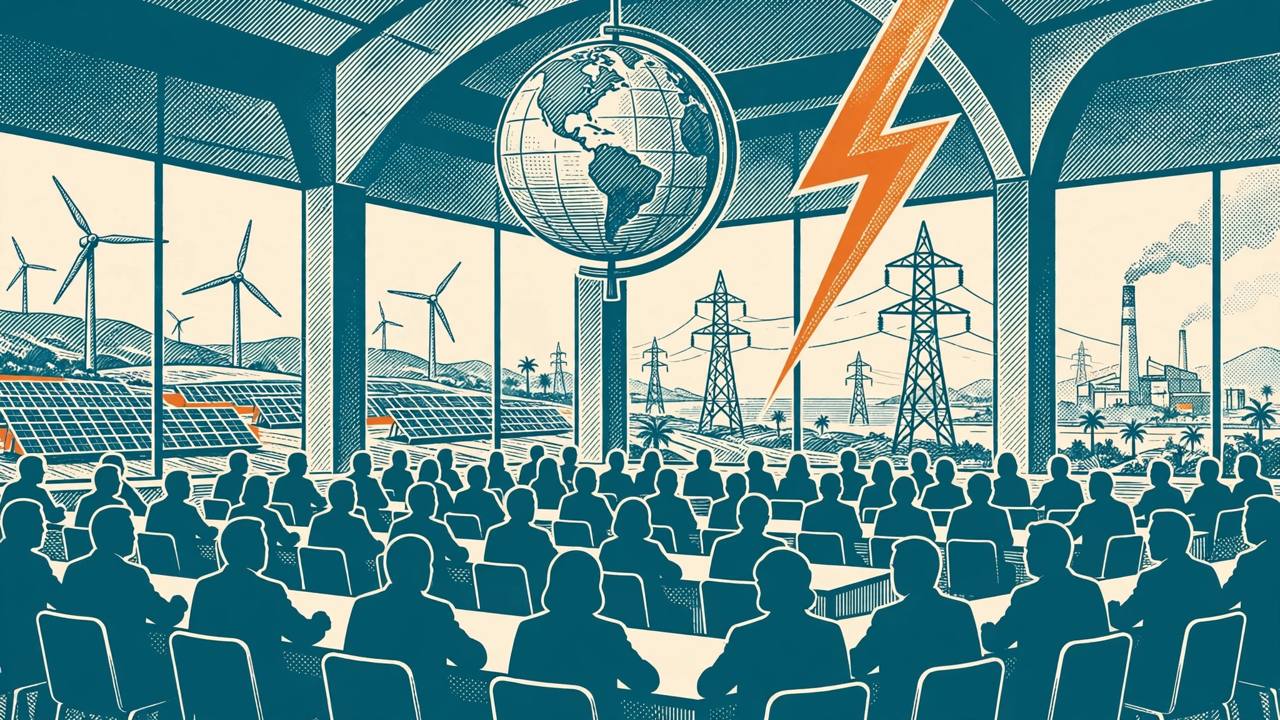
ANTALYA, Turkey — Global carbon dioxide emissions from fossil fuels are projected to fall 0.4% in 2026 to about 38.2 billion tonnes, according to the 2026 Global Carbon Budget, an assessment by more than 140 scientists from over 90 institutions that was presented on Tuesday at the COP31 climate talks in Antalya, Turkey. It would be a rare fall — driven less by climate policy than by the Iran war's oil-price shock and the rapid growth of solar and wind power.
Source: The Guardian, COP31 live coverage, Nov 10 2026
Emissions from burning oil alone are forecast to drop about 2% as drivers economise on fuel and switch to electric vehicles, the assessment said. Natural gas emissions are projected to fall 0.3%, while coal emissions rise 0.6% — a reminder that the shift is uneven across fuels and countries.
"This should be good news, but effectively in part it's caused by the high petrol prices and oil prices that are reducing the use of petrol… This is not sustainable," said Corinne Le Quéré, a Royal Society Research Professor at the University of East Anglia's School of Environmental Sciences, who led the new analysis, as reported by Reuters. Bill Hare of Climate Analytics, who was not involved in the research, cautioned that the projected fall is statistically indistinguishable from zero.
The scientists also warned that the small fossil-fuel fall was more than offset by increased emissions from deforestation and land-use change, following major fires in Southeast Asia and further conversion of wild land to agriculture. A single year of decline, they said, does not establish a lasting peak without deeper structural change in energy systems.
Turkey pushes a 35% electrification goal for the summit deal
On the same day, COP31 host Turkey urged countries to put a goal of increasing electricity's share of global energy use to 35% by 2035 — up from around a fifth today — at the centre of the conference's final agreement, Reuters reported. Turkey is seeking to incorporate the electrification goal into the formal outcome of the two-week talks, according to a person familiar with the matter.
Source: Reuters, Nov 10 2026
"The age of electricity is taking shape — and COP31 will be remembered as the moment we flicked the switch," Turkey's COP31 President Murat Kurum said in a press release on Tuesday morning, arguing the goal would cut emissions, boost energy security and drive economic growth. Australian Climate Change and Energy Minister Chris Bowen, who is leading negotiations at COP31, has previously said getting the commitment into the summit's overarching agreement was not a done deal.
Climate advocates have criticised the pledge because it does not require the additional electricity to come from low-carbon sources. Portugal's Environment Minister Maria da Graça Carvalho said on Monday her country would advocate linking the goal to clean power: "Our proposal is not simply electrification, but clean electrification. That means electricity from renewable sources rather than fossil fuels." The debate also spotlights the hosts themselves: coal generated about a third of Turkey's electricity last year and more than 40% of Australia's, according to government data cited by Reuters.
Even as he hosted the climate push, Turkish President Tayyip Erdoğan welcomed a new oil discovery, saying after a cabinet meeting on Monday that oil production from the Gabar fields in Turkey's southeast would exceed 100,000 barrels per day in the second half of 2027. Leaders from more than 90 countries are due to arrive in Antalya on Wednesday for the summit's high-level segment; the heads of the US and China are among the notable absentees.
What happens next: negotiators will spend the rest of the two-week conference deciding whether the 35% electrification target — and any clean-power condition attached to it — makes the final COP31 text, while a UN Environment Programme report published in October, cited by Reuters, says the world is already set to overshoot 1.5°C of warming above pre-industrial times.