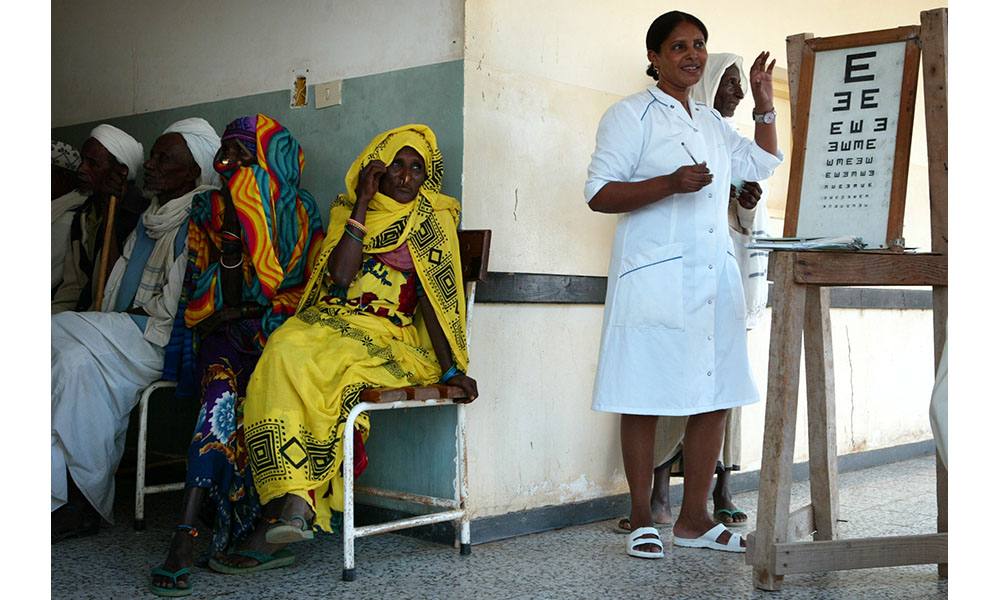
The World Health Organization (WHO) has validated Eritrea's elimination of trachoma as a public health problem, the agency announced on Monday, making Eritrea the 11th country in the WHO African Region and the 34th globally to reach the milestone against the world's leading infectious cause of blindness.
Source: World Health Organization via African Media Agency
'I congratulate the Government and people of Eritrea on this historic achievement,' said Dr Tedros Adhanom Ghebreyesus, the WHO Director-General. 'After two decades of determined effort, Eritrea has consigned trachoma as a public health problem to history. This is a victory for the communities most affected by this devastating disease, and a powerful example of what sustained national commitment can achieve.'
What trachoma is
Trachoma is caused by the bacterium Chlamydia trachomatis and spreads through contact with eye and nasal discharge from infected people. Repeated infections can scar the inner eyelid, causing the eyelashes to turn inward — a painful advanced stage called trichiasis — which can ultimately result in irreversible blindness. The disease is closely associated with poverty and limited access to water, sanitation, hygiene and health care, and disproportionately affects women and girls, the Fred Hollows Foundation said.
How Eritrea did it: the SAFE strategy
Following baseline surveys conducted in different parts of the country between 2006 and 2020, Eritrea progressively implemented the WHO's recommended SAFE strategy in communities where interventions were needed: surgery for trachomatous trichiasis, antibiotics to clear infection, facial cleanliness to reduce transmission, and environmental improvement, particularly improved access to water and sanitation.
The country surveyed all 58 sub-zobas, its second-level administrative areas, and health workers used digital tools for data collection and mapping to identify affected communities, including in hard-to-reach areas. The antibiotics distributed were predominantly oral azithromycin, donated by Pfizer Inc. through the International Trachoma Initiative. Eritrea's programme, led by its Ministry of Health and National Blindness Prevention Program since 2006, was supported by partners including the Fred Hollows Foundation, UNICEF, the END Fund and the WHO, and adopted a community-led sanitation approach that achieved gains with limited external funding.
'This success belongs first and foremost to the people of Eritrea,' said Dr Mary Stephen, the WHO Representative to Eritrea. 'The elimination of trachoma as a public health problem is the result of strong national leadership and ownership, and collaboration between communities, the Ministry of Health, the Fred Hollows Foundation, development partners and health workers across the country.' The Fred Hollows Foundation's chief executive, Ross Piper, said the achievement showed what national leadership, high-quality data, community ownership and committed partnerships can do behind a clear elimination goal.
What validation means — and the global picture
WHO validates elimination only after an independent, WHO-appointed dossier review group recommends it, confirming that the agreed epidemiological thresholds have been met and that systems are in place to detect and manage future cases. Eritrea has established systems to identify and manage new trichiasis cases and will continue surveillance after validation. Validation means the disease is no longer a public health problem — it does not mean the bacterium has disappeared entirely.
Globally, the population requiring interventions against trachoma fell from an estimated 1.5 billion in 2002 to below 100 million by November 2025, a reduction of about 94%. But as of March 2026, 92 million people still lived in trachoma-endemic areas and were at risk of blindness, and trachoma remained a public health problem in at least part of 29 countries. With this milestone, Eritrea also became the 66th country globally, and the 23rd in the WHO African Region, to have eliminated at least one neglected tropical disease.