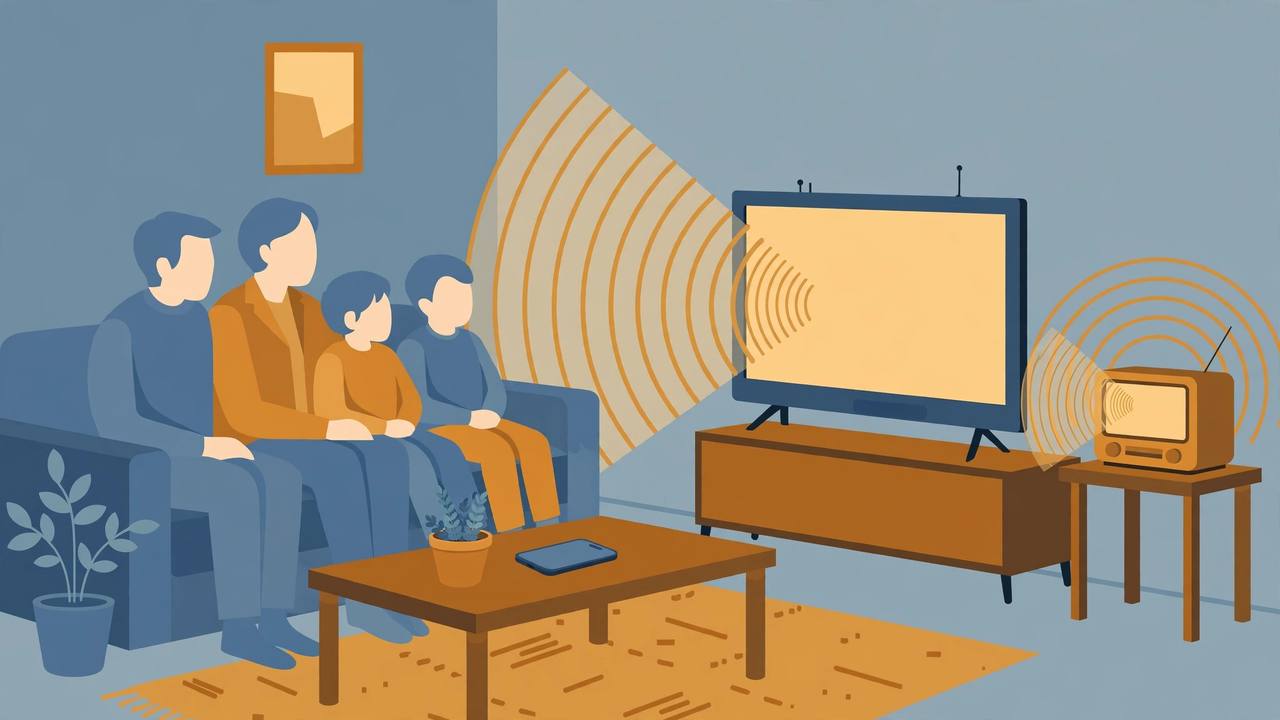
WASHINGTON — Televisions and radios across the United States will interrupt programming for about one minute on Tuesday, November 17, 2026, at approximately 2:20 p.m. Eastern Time, when the Federal Emergency Management Agency (FEMA), working with the Federal Communications Commission (FCC), conducts a nationwide test of the Emergency Alert System (EAS). FEMA says the test is only a test and that no action is required by the public. One point officials are stressing in advance: this year's test goes to broadcasters only — it will not be sent to cell phones, so a silent phone at 2:20 p.m. is expected, not a failure.
The message stations will carry, in English and Spanish through the Integrated Public Alert and Warning System (IPAWS), reads: 'This is a nationwide test of the Emergency Alert System, issued by the Federal Emergency Management Agency, covering the United States from 2:20 to 2:50 hours ET. This is only a test. No action is required by the public.' The FCC's notices give the test window as 2:20 to 2:50 p.m. ET, within which participating radio and television broadcasters, cable systems, satellite radio and television providers and wireline video providers relay the message and then resume normal programming.
What time is the test where you live?
FEMA gives a single national time — about 2:20 p.m. Eastern — and every U.S. time zone is on standard time on November 17. That means about 1:20 p.m. Central, 12:20 p.m. Mountain (including Arizona), 11:20 a.m. Pacific, 10:20 a.m. in Alaska and 9:20 a.m. in Hawaii. For the site's largest reader groups, that is 11:20 a.m. for California readers in Fresno, Sacramento, Stockton, Modesto, Bakersfield, Yuba City, San Jose and Los Angeles, and 2:20 p.m. for readers in New York and New Jersey. Punjabi truckers crossing time zones on I-5, I-80, I-40, I-10 and I-95 will hear the radio interruption at whichever local time applies where they are driving.
Why your phone will stay silent
The 2026 exercise tests the Emergency Alert System only. Wireless Emergency Alerts — the loud alerts that arrive on mobile phones — are not part of this year's test, according to FEMA's test FAQ. That is a change from the last nationwide test in October 2023, which did include phones. FEMA and the FCC announced this test on September 16, 2026 — FEMA by press release and the FCC in Public Notice DA 26-989 — and the FCC issued a follow-up notice on November 4 (DA 26-1190) repeating the same message wording and window, so the plan has been public and unchanged for two months.
Why FEMA runs this test
Under the IPAWS Modernization Act of 2015, FEMA is required by law to test the national public alert and warning system at least once every three years. The Emergency Alert System is the part of that system built on thousands of radio, television, cable, satellite and wireline providers. FEMA's October 14 bulletin explains the purpose of Tuesday's exercise: to assess whether participating providers receive the national message and pass it on correctly, after which programming resumes. The results help the agencies confirm the system would work in a genuine national emergency.
What is solid
- FEMA and the FCC will test the Emergency Alert System on Tuesday, Nov 17, 2026 at about 2:20 p.m. ET, on TV and radio only (FEMA test page; FCC Public Notice DA 26-989).
- Cell phones will not receive an alert in this test, and no action is required by the public (FEMA FAQ).
- If a real emergency or significant weather occurs on Nov 17, the backup date is Thursday, Dec 3, 2026 (FEMA/FCC).
What is only claimed
- A viral social-media claim of a nationwide '90-day blackout' starting Nov 17 is false: no federal agency, grid operator or utility has announced any power shutdown, and the only scheduled disruption is about one minute of interrupted TV and radio programming.
What you should do
Nothing — that is FEMA's official instruction. Do not call 911 or emergency lines about the test. Households may simply want to warn elderly relatives and anyone who did not grow up with the U.S. alert system that a loud tone and an official-sounding message on TV or radio on Tuesday afternoon is a scheduled exercise, in English and Spanish only, and not a real emergency. Because the test does not go to phones, anyone who relies only on a mobile phone will hear nothing at all.
For Punjabi diaspora families, the advance notice matters for a practical reason: the test message will not be broadcast in Punjabi or Hindi, so a grandparent watching television alone in Fresno or Queens could mistake the alert tones for a real warning. A one-minute explanation at home on Monday night prevents that confusion on Tuesday.
If Tuesday brings a real emergency
FEMA and the FCC say that if an actual emergency or significant weather event occurs on November 17, the test may be postponed. The published backup date is Thursday, December 3, 2026, at the same time. A real emergency alert, by contrast, would carry specific instructions for a specific place — the opposite of Tuesday's single nationwide test message.